
Welcome to the Korean Orders and Medals website. Here you will find detailed information on the Orders, Medals and Decorations of Korea from 1900 to the present. This website is for general interest. There is a lot of information that I have excluded, not because I want to, but because of the sheer volume. If you cannot find the answers that you are looking for, please don’t hesitate to contact me. You can reach me through the contact form at the bottom of every page.
Please excuse the mess. This website is currently under construction, and it will take some time before I can get it more readable/viewable. I think my current website organization is suitable; now I just need to start adding more specific information and pictures. Please bear with me.
There are two long-term additions that I want to make, but both are going to take considerable effort. One is to add pages detailing the medals used by the foreign countries that helped South Korea during the war. Another page that I am thinking about will cover ribbon bars. Please don’t expect these pages anytime soon.
There is also the possibility that I will eventually have webpages on North Korean Orders, Medals and Titles. The problem with North Korea is the large number of reproductions that are flooding the market. Since they have the original dies, you can’t tell the reproductions from the originals. As North Korea slips deeper into poverty, they will undoubtedly manufacture new designs to sell to the unwary collector. As far as I know, the only North Korean medals that have not been reproduced are the Russian manufactured pieces with the threaded posts, but that may also change.
If you are the copyright owner of anything on this website, please let me know.
I will adapt, modify, give source credits, or remove the content according to your wishes.
A little about me and my purpose for having this website
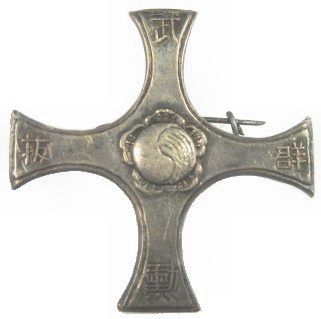
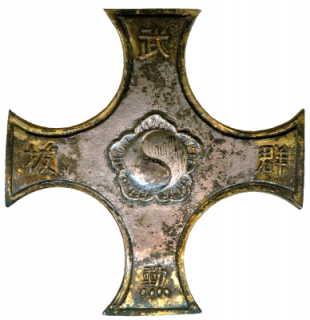
武勳拔群章 (무훈발군장)
Originally in the American Numismatic Society Collection, it was sold at Morton and Eden Auction #26, held on April 26, 2007, Lot #252. It sold for £320 plus a 15% buyer’s premium and shipping costs.
I spent two years in Korea as a member of the U.S. Air Force, and while I’ve left Korea, Korea has never left me. For many years, I collected Korean coins, currency, coin charms (amulets), and chatelaines. On Oct. 2, 1993, I attended the Long Beach Coin Show in Southern California, and while combing the bourse, I met Frank Draskovic, an international coin and medal dealer and numismatic researcher. He is a co-author of the “Standard Price Guide to World Crowns & Talers 1484-1968” in two editions. During that first chat, we discovered a mutual interest in not only Korean coins, but also Orders and medals. At the time, the only Korean medal he had was a Korean War vintage Order of Military Merit, Ulchi class, in a case named to an American officer. I was carrying photocopies of the Korean section in Robert Werlich’s book “Orders and Decorations of All Nations” (1967 edition), and when I pulled them out, Frank immediately recognized them and asked if I had the brown or blue edition of the book. Thus began a conversation about the lack of accurate information on Korean Orders, Decorations, and Medals (ODMs). That collaboration has endured for over 30 years and is now a close friendship. We began with targeted research, but keep in mind that all our initial efforts were pre-internet. We found that much of the information available was incomplete, incorrect, misconstrued, and, in a few cases, just plain wrong. It was obvious to us that a comprehensive study on the history of Korean Orders, Decorations and Medals was needed. We are currently writing that book, but there are several areas that remain a mystery. The central government legislation is now online, as required by law, but research problems persist because historical information from the various ministries is not completely online, and government employees lack the time (or willingness) to address historical inquiries. As an example, the two Distinguished Service Crosses shown on this page were authorized by the Korean Ministry of Defense. All attempts to contact the defense ministry have been futile. To date, all the information regarding this group of medals was obtained from some 1949 newspaper articles and the original notes accompanying one of the Distinguished Service Crosses.
When we started this project, we would have to identify the legislation by title and number, then send a money order and a request for copies of the legislation. It was excruciatingly slow; snail mail is just that, snail mail, and in a couple of instances, our request was denied. We would resubmit our request and hope that whoever opened our mail this time was not the same person who denied our initial request. In 1999, I received permission from the Korean Government to visit their Office of Protocol: Orders and Medals Department. I subsequently spent three weeks in Korea and was able to gather a significant amount of information. But in dealing with the department, I found that even their “official history” was not always “clear and concise.” For example, they were unaware that General Douglas MacArthur had received an Order of Military Merit, 1st Class with Gold Star, before Korea officially created its first Order of Military Merit. They did a quick check and were quite surprised to find that I was correct.1 Recently, a new question has come to light. The Korean Medal Rolls show that 13 Koreans were decorated with 3rd and 4th classes of the Order of Military Merit before Douglas MacArthur. Since there was no Order of Military Merit, what did they receive? In 2000, a database containing historical Korean legislation was created and launched online; however, it presented significant challenges for users who are not fluent in Korean. In 2009, the Korean Law Information Center launched its website, law.go.kr. It is also difficult to use by non-Koreans, but it is far better than the earlier database. Unfortunately, much of the early legislation is text only and with no drawings of the medals. In many areas, they have no information that would help a medal collector, and you need to search elsewhere for the drawings. The first 16 years of our research were painfully slow.
Perfer et obdura, dolor hic tibi proderit olim
“Be patient and tough; someday this pain will be useful to you”
I am currently planning another trip to Korea, probably in 2027 or 2028. I am currently constructing a list of questions that hopefully will finally answer some of the long-term problems that I have been facing. If you know of any way for me to get into some of the ministries, I would greatly appreciate the information. Most importantly, I need to get access to the Ministry of Defense.
Until we can resolve some mysteries, we cannot say when we will be able to publish. For a brief look at some of these issues, take a look at the Research Needed page. For those of you who are interested in doing some research of your own, please look at the Reference Material page. If you are trying to decipher Korean or Chinese text, please refer to the Korean Translations or Chinese Translations pages. On the Order of Military Merit webpage, you will find more information on the two 1949 Distinguished Service Crosses 武勳拔群章 (무훈발군장) that are pictured on this page.
Frank and I are both lifetime members of the Orders and Medals Society of America (OMSA) and the Southern California Orders and Medals Society (SOCALOMS). If you find yourself in the greater Los Angeles area at the end of the month, we would be honored to have you at one of our meetings.
As part of our research, we maintain reference collections of Korean Orders, medals, decorations, badges, pictures, postcards, documents, government publications, legal codes, photocopies, etc. We are extremely interested in obtaining more information for eventual publication. If you have anything that would benefit this effort, we would be deeply obligated to hear from you. We will be more than happy to give full source credits. We can be reached through the Contact Page.
An Abbreviated History of Korean Award Systems
A historical system of National Merit Rewards has been a basic part of national management, originating from the very earliest periods of Korean history. The book ‘History of the Three Kingdoms’ 삼국사기 (三國史記),2 is the oldest extant official history of the Samhan or Three Kingdoms period 삼국시대 (三國時代) of Korean history. The three kingdoms were Goguryeo 고구려 (高句麗 37 BC – 668 AD), Baekje 백제 (百濟 18 BC – 660 AD), and Silla 신라 (新羅 57 BC – 935 AD). In Goguryeo, there were two types of land grants. Sajon (사전, 賜田) were permanent and hereditary, while Sigup (식읍, 食邑) land grants were the assignment of the tax income from a tract of land that was given to the recipient until his death, at which time the income reverted to the state. These land grants could be either the usual perquisites of office, or they could be special awards for particularly meritorious service to the state.3 Eventually, the Silla Kingdom conquered the other two kingdoms. During the (United) Silla period, the Sahunkam 사훈감 (司勳監), later reorganized as Sangsaseo 상사서 (賞賜署), provided honorable treatment and benefits for those who rendered distinguished service to the state. During the Goryeo era 고려 (高麗 918-1392), the Sajuck 사적 (史績) originally administered awards to government officials, filial people, virtuous women, and those who had distinguished themselves in war. During the 14th year of King Sungjong 성종 (成宗 r. 982-998), the office was renamed Sangsukokong 상서고공 (尙書考功) but was later reorganized as Kokongsa 고공사 (考功司). The original Yi Dynasty (1392-1910) award’s department was called Kongshindogam 공신도감 (功臣都監) but also went by the name Chunghunsa 충훈사 (忠勳司). During the 7th year of King Sejo 세조 (世祖 r.1456-1469), the department was renamed Chunghunbu 충훈부 (忠勳部), and later, during the 31st year of King Kojong 고종 (高宗 r.1864-1907), it was renamed Kikongkuk 기공국 (記功局). You can find more information on early Yi Dynasty awards here. Typical ancient benefits included various amounts of farmland, slaves, tax revenues from land, preferences in employment, and educational benefits.4 These benefits were often, but not always, hereditary. The ancient benefit structures for those who rendered distinguished service to the state bear a striking similarity to the current structure. For a more detailed history of the Korean Empire Orders and Medals, see my webpage Orders of the Korean Empire. By the same token, for the history of South Korean Orders and Medals, see my web page A Brief Introduction to the Award System of the Republic of Korea.
Footnotes:
- This has since been remedied and is in the current edition of their medal history.
- Better known outside of Korea as the ‘Samguksagi’
- Han Woo-keun, The History of Korea, University Press of Hawaii, 1980, p. 54
- The importance of slavery in Korea has fluctuated over time. The historical nature of Korean slavery is a source of considerable debate, with some scholars viewing the Korean system of slavery as serfdom. This is due in part to the fact that some slaves had legal rights and were allowed to own other slaves as well as land. Korea had the longest unbroken chain of slavery of any society in history, spanning at least 1,500 to 2,000 years. This is due to a long history of peaceful transitions of power and stable societies. Slavery was often hereditary, but not always. The hereditary status of slaves was abolished in 1886 and 1887. Slavery was legally abolished in 1895, but vestiges of it remained until the end of the Japanese occupation of Korea in 1945. Slavery still exists in North Korea, encompassing about 10.4% of the population. Forced marriages, another form of slavery, are sanctioned by the North Korean state. In addition North Korean state-controlled “reward marriages” are occasionally arranged by authorities for model workers in political prison camps. China had a one-child policy which lasted for 36 years, from 1979 to 2015 (with nationwide enforcement beginning around 1980). The basic Chinese family values sons over daughters, and tens of thousands of girls were abandoned at birth. To fill the void, thousands of girls from North Korea have been forced into marriages or prostitution in China.