
Authorized Methods for Wearing Orders, Medals, and Decorations
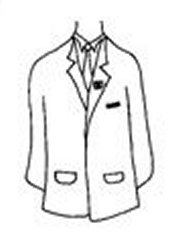
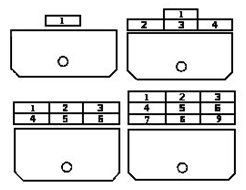
The “Methods of Wear” have been reasonably consistent throughout the history of South Korea. The Korean Government initially had a separate law governing the wearing of their Orders, Merit Medals, Kijang Medals, and Commendations, but in 1964 that section of the law was incorporated into the Decorations Law.
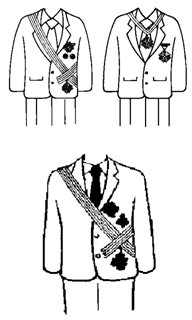
There are a couple of things that should be mentioned. When wearing multiple 1st Class orders on a sash, a person is required to wear the highest decoration and breast star, and only the breast stars from the other (lower prestige) sashed awards. If a recipient has a 1st Class with a sash and a 3rd Class that has no breast star, they cannot wear the 3rd Class at the same time. You cannot miniaturize any order that is on a sash or cravat. Moreover, miniature medals must be 1/2 the size of the full-size medal. And finally, miniature medals cannot be worn with full-size medals. Although not in the legal code, you cannot wear commendations below the prime ministerial level with any decoration given by the central government. However, because of the vagueness in the law, it happens relatively frequently. All that being said, there is a caveat. Miniature Breast Stars are known to exist because there are situations where Korean diplomats and high-ranking Korean military officers need to wear miniatures to conform with the other attendees of an event. Miniatures have been manufactured for these situations, even though it violates the legal codes. For more on miniature medals, see my webpage on the subject.
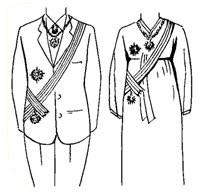
Notice that this is the only sashed award that is worn over the left shoulder.
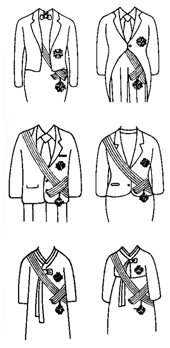
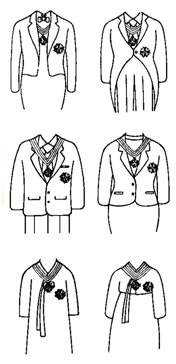
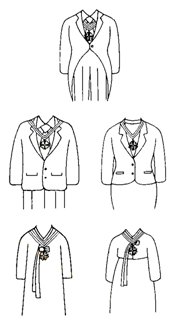
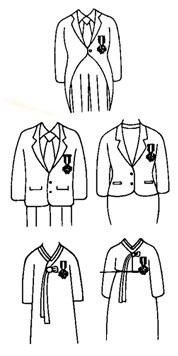
or Kijang Medals
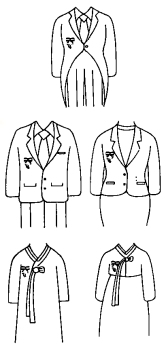
Ministerial Commendation
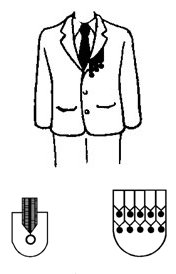
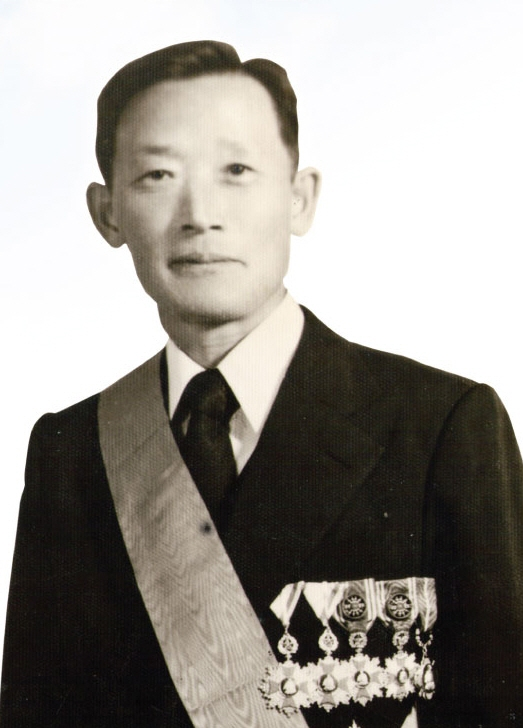
Kim Han-jun 김한준 (1929 – 2012)
Kim Han-jun volunteered to join the National Defense Guard in April 1947. In recognition of his abilities in the Battle of Gaecheon-Bihosan, he received a field commission to 2nd Lieutenant on Nov. 15, 1950. Later, after his victory at Hill 425, he was personally decorated with the Order of Military Merit, Taeguk Medal, by President Syngman Rhee. His awards include two Chungmu Medals, Order of Military Merit (12/30/1950 and 4/1/1951), two Hwarang Medals, Order of Military Merit (both on 5/20/1952), a Taeguk, Order of Military Merit (10/13/1953), and the Military Merit Medal (10/29/1956). He is shown here with his two Chungmu medals on shortened cravats that almost appear as trifold ribbons. Not exactly legal, but as a civilian, I assume they are acceptable.