
Please keep in mind that translating a document is an art form and not a technical science. If you can provide a better translation or an alternate translation, please contact me.
Korean Empire award documents are extremely difficult to find. Koreans tend to keep the documents when the name on a document has a direct connection to themselves. For myself, I have never been able to buy a Korean award document named to a Korean. I have been much luckier finding Korean documents for Japanese individuals.1 Aside from Korean award documents to Koreans, I particularly like finding award documents to Japanese individuals with the Japanese government’s “Permission to Wear” document. These allow the Korean awards to be worn by Japanese recipients.
You will notice that there is not a lot of visual difference between Korean and Japanese award documents. If you know of any other documents from this period, please let me know.
At the top center position on some documents
At the top center position on some documents, you will find the personal monogram 수결 (Sugeol 手決) of Emperor Kwangmu or Emperor Sunjong. These are also known in China and Japan as flower-press 花押 (화압) or hand-press 決押 (결압) (monograms). Sugeol 수결 (手決) means ‘execution by hand.’ Personal monograms are also called Seoap 서압 (書押), Surye 수례 (手例), Suap 수압 (手押), and Hwaap 화압 (花押), and the king’s is also referred to as Eoap 어압 (御押).

For Emperor Kwangmu’s personal monogram, he decided to use the words ‘il sim (一心),’ which translates as ‘one heart,’ ‘heart and soul,’ ‘wholeheartedly, ’ or ‘of one mind.’ He wrote the Chinese characters with ‘il’ (一) above ‘sim’ (心), then combined them into a single stylized character, and finally rotated the combined characters a full 180°. Notice that the stroke count is 5 for both “il sim” and for his monogram.
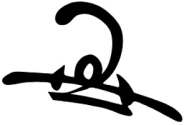
Emperor Sunjong also used the words ‘il sim (一心)’ for his personal monogram. The only difference is the circular flourish in the center.
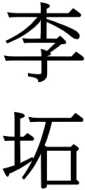
On some documents, in the center position, you will find Sunjong’s personal name, Yi Cheok 李坧 (이척)
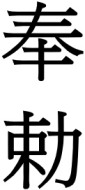
On some documents, in the center position, you will find the phrase “By Imperial Edict” 奉勅
Dating Korean Documents
These tables should make it a little easier to date Korean Award Documents.
The dates on Korean (and Japanese) documents are generally written (from top to bottom) as emperor’s name, year, month, and day (name…년…월…일). If you have a year, month, or day character and do not recognize the number in front of it, check out my table of Numbers and number-related words.
On documents with the date similar to “九年十年” (9 year 10 year) or “九十年”(9 10 year), it means that the award was for achievements over a period of time, in this case, during the 9th year and 10th year. It is not the date of the award. The same pattern can be used for months or days.
For Emperor Kwangmu’s 光武 documents (1897-1907), add the document’s year to 1896.
For Emperor Yunghui’s 隆熙 documents (1907-1910), add the document’s date to 1906.
For example:
Kwangmu 5th year (光武五年) would be 1896 + 5 = 1901.
Yunghui 2nd year (隆熙二年) would be 1906 + 2 = 1908.
Dating Japanese Documents
The same pattern is true for Japanese documents.
For Emperor Meiji’s 明治 documents (1868-1912), add the document’s year to 1867.
For Emperor Taishō’s 大正 documents (1912-1926), add the document’s year to 1911.
For Emperor Shōwa’s 昭和 documents (1926-1989), add the document’s year to 1925.
For example:
Meiji 40th year (明治四十年) would be 1867 + 40 = 1907.
Taisho 2nd year (大正二年) would be 1911 + 2 = 1913.
Showa 5th year (昭和五年) would be 1925 + 5 = 1930.
| 年 (년) Year | 月 (월) Month | ||||
|---|---|---|---|---|---|
| Emperor Kwangmu 光武 | 元年 = 1897 | 一月 = January | 一日 = 1st Day | 十六日 = 16th Day | |
| aka Kojong 高宗 | 二年 = 1898 | 二月 = February | 二日 = 2nd Day | 十七日 = 17th Day | |
| Personal Name: Yi Myeongbok 李命福, later Yi Hui 李㷩 | 三年 = 1899 | 三月 = March | 三日 = 3rd Day | 十八日 = 18th Day | |
| 四年 = 1900 | 四月 = April | 四日 = 4th Day | 十九日 = 19th Day | ||
| 五年 = 1901 | 五月 = May | 五日 = 5th Day | 二十日 = 20th Day | ||
| 六 年 = 1902 | 六 月 = June | 六 日 = 6th Day | 二十一日 = 21st Day | ||
| 七年 = 1903 | 七月 = July | 七日 = 7th Day | 二十二日 = 22nd Day | ||
| 八年 = 1904 | 八月 = August | 八日 = 8th Day | 二十三日 = 23rd Day | ||
| 九年 = 1905 | 九月 = September | 九日 = 9th Day | 二十四日 = 24th Day< | ||
| 十年 = 1906 | 十月 = October | 十日 = 10th Day | 二十五日 = 25th Day | ||
| 十一年 = 1907 | 十一月 = November | 十一日 = 11th Day | 二十六日 = 26th Day | ||
| 十二月 = December | 十二日 = 12th Day | 二十七日 = 27th Day | |||
| Emperor Yunghui 隆熙 | 元年 = 1907 | 十三日 = 13th Day | 二十八日 = 28th Day | ||
| aka Sunjong 純宗 | 二年 = 1908 | 十四日 = 14th Day | 二十九日 = 29th Day | ||
| Personal Name: Yi Cheok 李坧 | 三年 = 1909 | 十五日 = 15th Day | 三十日 = 30th Day | ||
| In Korean, Yunghui 융희 is often spelled as 륭희 | 四年 = 1910 | 三十一日 = 31st Day | |||
Award document design features
Most Korean Empire ‘Order of Merit’ documents have the Taeguk symbol in each of the four corners. The majority of the border is made up of plum flowers in alternating styles. The plum flower was the family crest of the Yi family, which controlled Korea. At the bottom center of many Korean Empire award documents, you will find a pair of rulers. These rulers, called Cheok 척, are a Korean unit of measure that is approximately one foot in length (30.3 cm equaling 11.92913 inches). Since the time of the Silla Kingdom 신라 新羅 (57 BCE–935 CE), the Golden Measure signified the king’s authority to rule the country. Yi Song-gye (1335-1408; reigned 1393-1398), the first king of the Yi Dynasty, knew he was destined to rule a country when he received the Golden Measure in a dream. The Golden Measure was a reaffirmation that the Yi Dynasty kings had the Mandate of Heaven and were entitled to rule the country.Notice on the Order of Golden Measure 大勳位金尺大綬正章 (대훈위 금척대수정장) breast star, below and to the right, has 4 rulers that are located at the 3, 6, 9, and 12 o’clock positions. The Order of the Golden Measure is often called the Order of Cheok, which is the correct Korean pronunciation of this particular measuring device. Korean Empire award documents are watermarked. Be suspicious of any document found without the watermark.
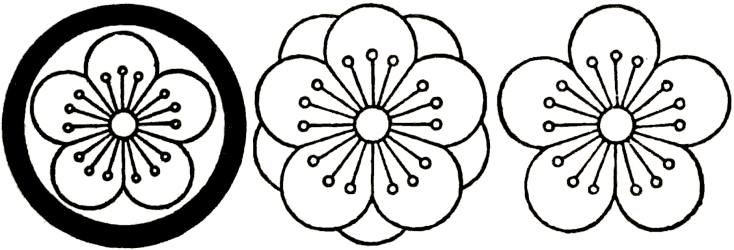
The name of the Korean Empires Royal Family 대한제국 황족 is Yi 李 which translates as plum. Their Crest is a Plum Blossom or Plum Flower and is written as 오얏꽃 (Oyat Flower) but in Chinese it is called the Purple Peach. The plum blossom is sometimes used as a watermark. Design variations do exist, for example, see my Yi Dynasty Commemorative Documents.
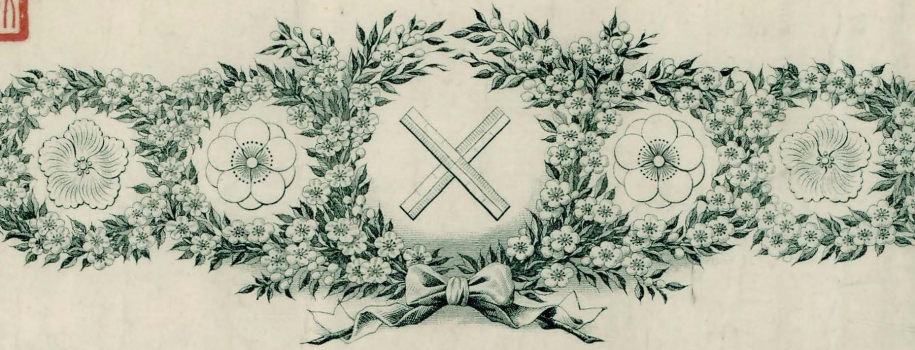
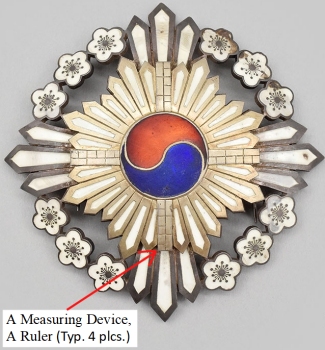
The Printing Bureau 인쇄국 was added to the Takjibu 탁지부 (度支部) government control by Royal Decree No. 30 칙령 제30호 on December 6, 1904, the 8th year of King Gwangmu’s reign. Documents printed after this date have the phrase ‘Manufactured by the Korean Government Printing Bureau (造製局刷印府政國韓)’. There may be exceptions, but I have not found any.
A word of caution
The example to the right appears to have a plum blossom centered on the bird’s breast. This is actually a Japanese commemoration medal for the China Incident.
Obverse: 支那事変記念 Commemoration of the China Incident.
Reverse: 寺内部隊梅田部隊 Terauchi Unit and Umeda Unit. (部隊 Butai is a military term that refers to a troop, force, or squad unit.)
The “China Incident” 支那事変 is the Japanese term for the initial, undeclared phase of the Second Sino-Japanese War (1937–1945), triggered by the Marco Polo Bridge Incident on July 7, 1937. This was well after the end of the Korean Empire in 1910.

Award Documents of the Korean Empire
Orders of Merit

Order of the Taeguk, Seventh Class
- By the Mandate of Heaven, the Emperor of the Great Korean Empire hereby decrees. 奉天承運大韓國皇帝以
- Ōmiya Genshichi (大宮源七), Private First Class, Infantry, Imperial Japanese Army, is specially awarded the Seventh Class Order of Merit and granted the Order of the Taeguk as a mark of Imperial favor. 大日本國陸軍步兵上等兵大宫源七 特敍勳七等贈與太極章表朕親愛之意
- Issued on Yunghui 2nd year, 12th month, 1st day, at Changdeok Palace in Hanseong, personally signed and sealed with the Imperial Seal. 隆熙二年十二月一日在漢城昌德宮親 盡押鈐璽
- Reported by President of the Bureau of Decorations, Senior First Rank, First Class Order of Merit, Yi Jaeguk (李載克). 表勳院總裁從一品勳一等李載克
- After examination, this certificate and the decoration were duly entered into the respective registers as Entry No. 587. 章各簿第五八七號編入事
- Recorded by Secretary of the Bureau of Decorations, Senior Third Rank, Fourth Class Order of Merit, Jeong Dongsik (鄭東植). 本記及勳章勘查後勳記勳 表勳院書記官正三品勳四等鄭東植
Size Approx. 44.8 x 60.2 cm (17.6 x 23.7”)
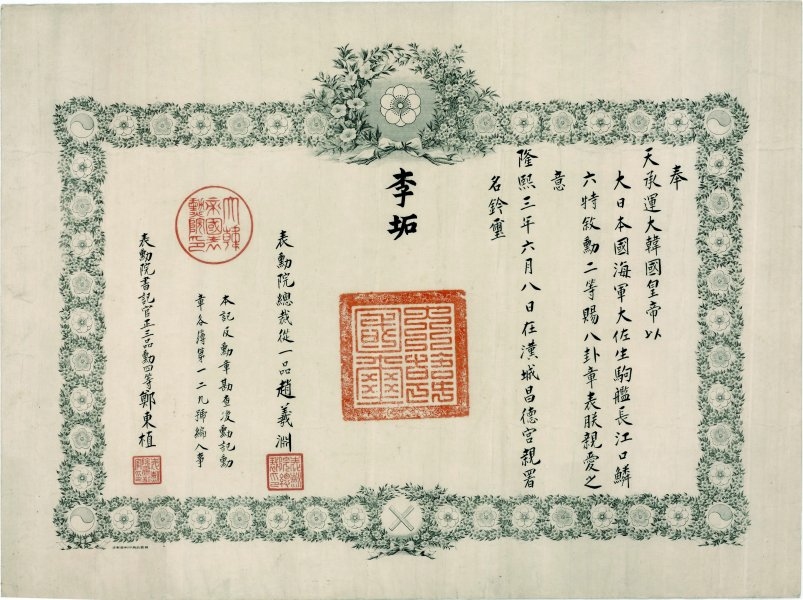
Order of the Eight Trigrams, Second Class
- To give with respect 奉
- By the Grace of God, the Emperor of the Korean Empire ordered as follows: 天承運大韓國皇帝以
- To express my appreciation, Isao Eguchi, Captain of the battle cruiser Ikoma and Rear Admiral of the Navy of Japan, is awarded the Second Class and granted the Medal of Eight Trigrams. 大日本國海軍大佐生駒艦長江口鱗六特敘勳二等賜八卦章表朕親愛之意
- Here is my stamp signed by myself at Changdeok Palace on June 8, 1909. 隆熙三年六月八日在漢城昌德宮親署名鈴璽
- Yi Cheok 李坧 (Yi Cheok is the personal name of Emperor Yunghui)
- Seal of the Korean Empire 大韓國璽 (large square, red seal in the center of the document)
- Deputy Principal of Award Record Office, Deputy First Rank, Jo Ui-yeon 表勳院總裁從一品趙義淵
- Seal of the President of the Award Records Office 表勳院總裁印 (small square, red seal at bottom)
- Seal of the Korean Empire Prime Minister Records Office 大韓帝國表勳院印 (small round, red seal at the top)
- The award grant is examined and recorded as No. 129 本記及勳章勘查浚勳記勳章各簿第一二九號編入事
- Registrar of Award Record Office, Third Rank, Class IV, Jeong Dong-sik 表勳院書記官正三品勳四等鄭東植
- Seal of Registrar of Award Record Office 表勳院書記官印 (small square, red seal at bottom-left corner)
- Made by the Korean Government Printing Office 韓國政府印刷局製造 (Fine print in the lower-left corner below the scrollwork)
Size Approx. 44.8 x 60.2 cm (17.6 x 23.7”)
For more on this award see My Eight Trigrams Mystery Page
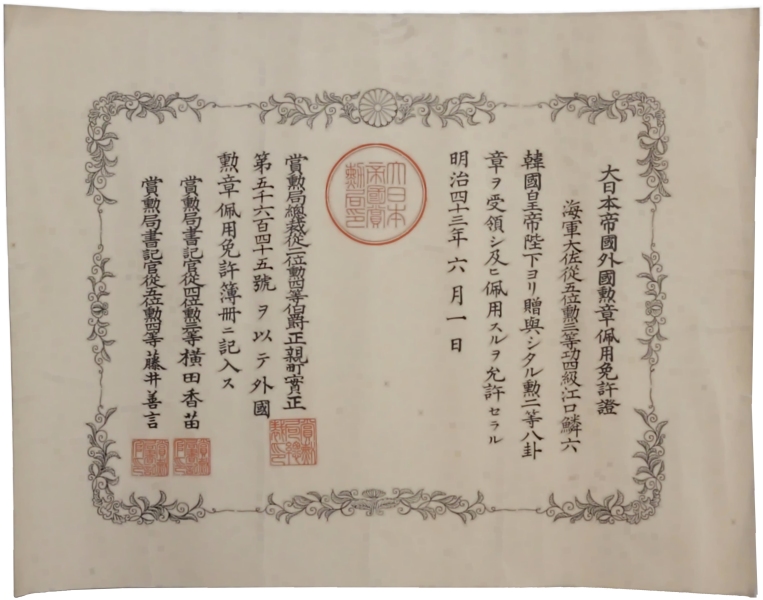
Japanese ‘Permission to Wear’ Document for the award directly above.
- Foreign Order of the Empire of Japan License 大日本帝國外國勲章佩用免許證
- Isao Eguchi, Navy Captain, Junior Fifth Rank, Third Class Merit Fourth Class 海軍大佐従五位勲三等功四級江口鱗六
- Received and presented the Order of the Eight Trigrams, presented by His Majesty the Emperor of Korea. 韓國皇帝陛下ヨリ贈與シタル勲二等八卦 章ヲ受領シ及ヒ佩用スルヲ允許セラル
- June 1, 1910 明治四十三年六月一日
- Earl Ogimachi Takaramasa, President of the Awards and Decorations Bureau, Second Rank, Fourth Class 賞勲局總裁從二位勲四等伯爵正親町寶正
- No. 5645, foreign countries 第五千六百四十五號 ヲ以 テ外國
- Entry in the book of licenses to wear the medal 勲章佩用免許簿冊ニ記入ス
- Kanae Yokota, Secretary of the Awards and Decorations Bureau, Junior Fourth Rank, Third Class 賞勲局書記官從四位勲三等 横田香苗
- Yoshitomo Fujii, Secretary of the Awards and Decorations Bureau, Junior Fifth Rank, Fourth Class 賞勲局書記官從五位勲四等 藤井善言
Size Approx. 34 x 43.9 cm (13.4 x 17.3”)
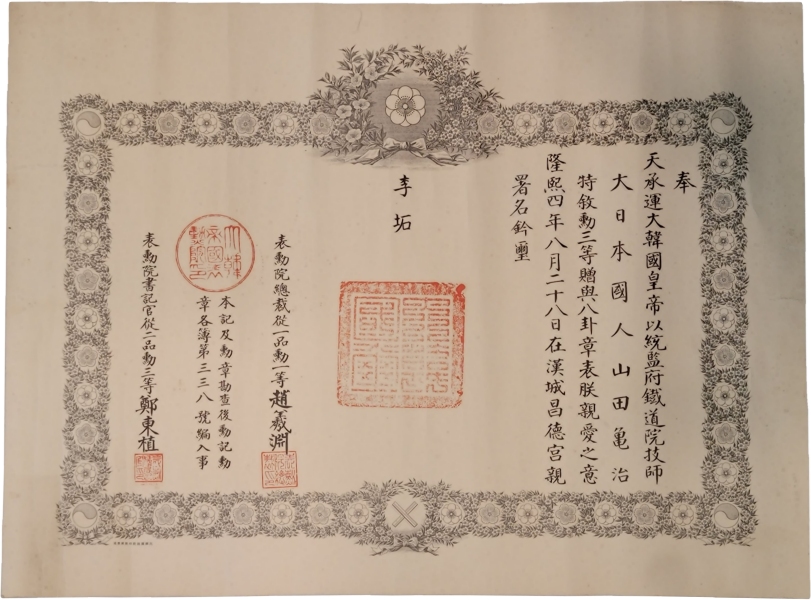
Order of the Eight Trigrams, Third Class
- By Imperial Command The Emperor of the Korean Empire, having received the Mandate of Heaven, hereby confers upon Yamada Kameji (山田亀治), a subject of the Empire of Japan and Engineer of the Railway Bureau of the Residency-General, the Third Class Order of Merit, together with the Order of the Eight Trigrams, as an expression of Our personal favor and affection. 奉天承運大韓國皇帝以統監府鐵道院技師大日本國人山田亀治特敘勳三等贈與八卦章表朕親愛之意
- Issued on the 28th day of the 8th month of the 4th year of Yunghui at Changdeok Palace in Hanseong.
- Personally signed and sealed. 隆熙四年八月二十八日在漢城昌德宮親署名鈐璽
- Yi Cheok (이척) 李坧 (Yi Cheok is the personal name of Emperor Yunghui)
- President of the Bureau of Decorations Senior First Rank, First Class Order of Merit, Jo Hui-yeon (조희연) 表勳院總裁從一品勳一等趙羲淵
- This certificate and the decoration, after inspection by the Bureau of Decorations, have been recorded in the official register of decorations as Number 338 in the respective register. 本記及勳章勳查後勳記勳
- 章各簿第三三八號編入事
- Secretary of the Bureau of Decorations, Junior Second Rank, Third Class Order of Merit, Jeong Dong-sik (정동식) 表勳院書記官從二品勳三等鄭東植
Size Approx. 44.8 x 60.2 cm (17.6 x 23.7”)

Order of the Eight Trigrams, Fourth Class
- To give with respect 奉
- By the Grace of God, the Emperor of the Korean Empire ordered as follows: 天承運大韓國皇帝以2
- In recognition of Shiro Kantaro, Senior Surgeon of the Imperial Japanese Navy, confers upon him the Fourth Class and granted the Medal of Eight Trigrams. 大日本國海軍大軍醫白井官太郎特敘勳四等賜八卦章表朕親愛之意
- Here is my stamp signed by myself at Changdeok Palace on Sept. 16, 1905. 光武九年九月十六日在漢城慶運宮親畫押鈐璽
- (At top center is the personal signature 수결 (Sugeol 手決) of Emperor Kwangmu.)
- Park Jeong-yang, Administrator-in-Chief of the Order of Merit Council, First Rank of the Senior Grade, First Class of the Order. 表勳院捴裁正一品勳一等朴定楊
- Upon the completion of the verification of this record and the medal, the said record and medal shall be filed under Entry No. 28 in the respective Registers of Order Certificates and Medals. 本記及勳章勘查後勳記勳章各簿第二十八號編入事
- Yi Byung-mok, Secretary of the Order of Merit Council, Third Rank of the Senior Grade, Sixth Class of the Order. 表勳院參書官正三品勳六等李秉穆
Size Approx. 44.8 x 60.2 cm (17.6 x 23.7”)
This document does not have the name of the printing agency, which is usually found under the border. See the document below.

Order of the Eight Trigrams, Fifth Class
- By Heaven’s mandate and under the authority of the Emperor of the Great Korean Empire. 奉天承運大韓國皇帝以
- Special Infantry Officer of the Imperial Japanese Army Matsuji Matsubara is hereby specially conferred the Fifth Class Order and presented with the Eight Trigrams Medal, expressing His Majesty’s personal favor. 大日本國陸軍步兵特務曺辰松原松司 特敘勳五等贈舆八卦章表朕親愛之意
- On December 1, 1908, at Changdeok Palace, Hanseong, the Emperor personally inscribed and affixed his seal. 隆熙二年十二月一日在漢城昌德宮親
- At dead center top is Emperor Sunjong’s personal signature, followed by the Imperial Seal 書押御璽.
- After reviewing this record and the medal, Li Jae-kuk, President of the Decorations Office and Senior First Rank, First Class, registered it in the medal roll under No. 212. 表勳院總裁從一品勳一等李載克 [Seals 印] 本記及勳章勘查後勳記勳 ● 章名簿第二一二號編入事
- Jung Dong-sik, Secretary of the Decorations Office, Senior Third Rank, Fourth Class, recorded this entry. 表勳院書記官正三品勳四等鄭東植 [Seal 印]
- Made by the Korean Government Printing Office 韓國政府印刷局製造 (Fine print in the lower-left corner below the scrollwork)
Size Approx. 44.8 x 60.2 cm (17.6 x 23.7”)

Japanese ‘Permission to Wear’ Document for the award directly above.
- Permit to Wear a Foreign Decoration of the Empire of Great Japan 大日本帝國外國勳章佩用免許證
- Army Infantry Special Sergeant Major Matsuji Matsubara, Holder of the Sixth Class Order of Merit and Seventh Class Order of the Golden Kite. 陸軍歩兵特務曹長勲六等功七級松原松司
- Permission is hereby granted to receive and wear the Order of the Eight Trigrams, 5th Class, bestowed by His Majesty the Emperor of Korea. 韓國皇帝陛下ヨリ贈與シタル勲五等八卦章ヲ受領シ及ヒ佩用スルヲ允許セラル
- August 28, Meiji 43 (1910). 明治四十三年八月二十八日
- [Seal 印]
- Count Ogimachi sanjyo Sanemasa, President of the Board of Decorations, Junior Second Rank, 4th Class Order of Merit. 賞勳局總裁從二位勳四等伯爵正親町實正 [Seal 印]
- Entered into the Foreign Decoration Wearing Permission Registry as No. 6262. 第六千二百六十二號ヲ以テ外國 勲章佩用免許簿冊ニ記入ス
- Kanae Yokota, Secretary of the Board of Decorations, Junior Fourth Rank, 3rd Class Order of Merit. 賞勳局書記官從四位勳三等橫田香苗
- [Seal 印]
- Yoshinobu Fujii, Secretary of the Board of Decorations, Junior Fifth Rank, 4th Class Order of Merit. 賞勳局書記官從五位勳四等藤井善言 [Seal 印]
Size Approx. 34 x 43.9 cm (13.4 x 17.3”)
Award Documents of the Korean Empire
Commemorative Medals
There are no known lists of recipients for Korean Commemorative Medals.
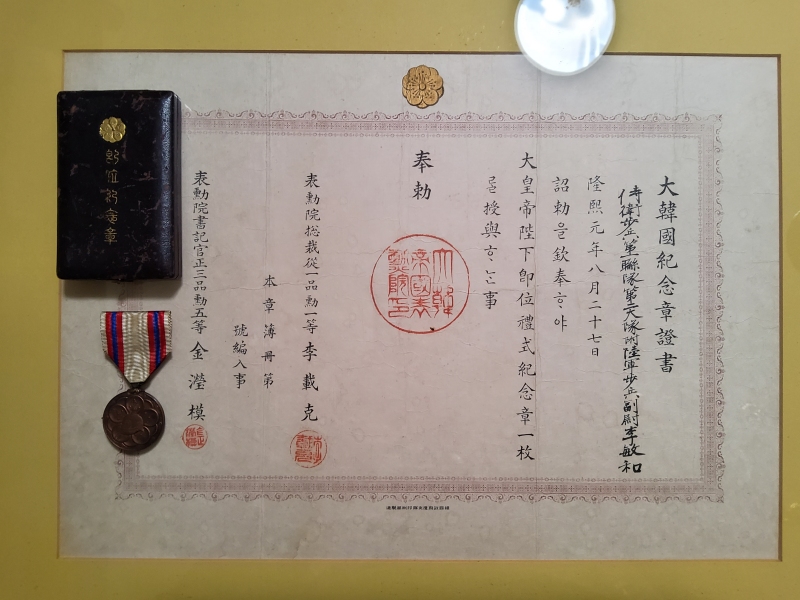
Award Document for the Enthronement Commemorative Medal
This award document accompanied the bronze 1907 Enthronement Medal. Note that the award document does not state that the medal is issued in silver or bronze. There are spaces for registering the award, but no registration numbers are entered. As far as I can determine, no Korean Commemorative Medal documents were issued with registration numbering. Since Chinese and Korean orders carried numbers, the lines of text for registration may be a superfluous space carried over from an order document. The entire text is printed except the line containing the recipient’s name, which is entered by writing brush. The crest is in gold, and the seals are vermilion. The certificate was printed by the Korean Government Finance Department Printing Bureau. It reads as follows:
- Translation:
- Great Korea Commemorative Medal Certificate
- Army Infantry Sub-Lieutenant Yi Min-ho
- Of the 2nd Battalion, 1st Regiment, Guards Infantry
- Yunghui 1st Year, 8th Month, 27th Day (Aug. 27, 1907)
- By Authority of Imperial Proclamation
- His Majesty the Emperor’s Enthronement Ceremony Commemorative Medal is hereby conferred
- Respectively Decreed (large-size seal)
- Decorations Office Judge Junior First Rank Degree Yi Sae-kee (medium-size seal)
- The Medals record book volume number (blank)
- Entry number (blank)
- Decorations Office Secretary Senior Third Rank Fifth Degree Kim Yin-ho (small size seal)
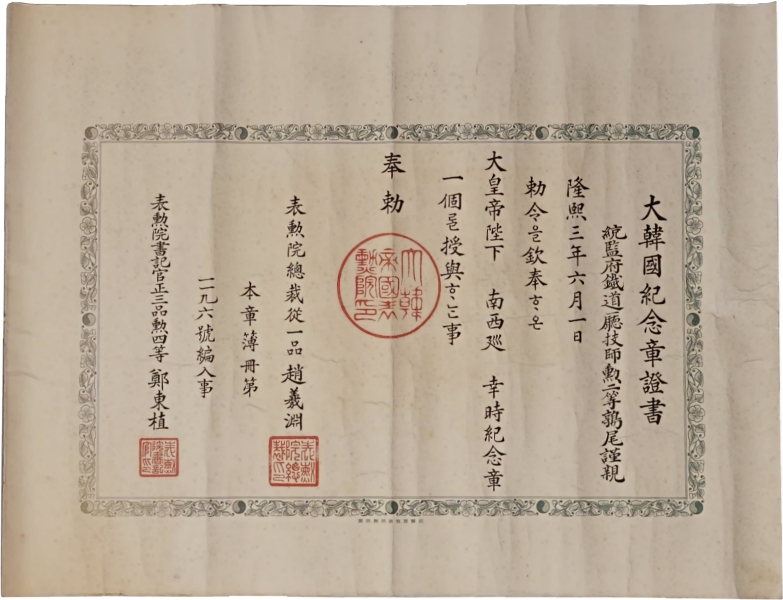
Award Document for the Imperial Tour Commemorative Medal
This document contains several Korean words that are no longer used, rendering the translation somewhat difficult.
- Awarded to Kinshin Uzurao (尾謹親), Railway Reception Officer of the Residency-General, Second Class Order of Merit. 大韓國紀念章證書統監府鐵道應接師勳二等骋尾謹親
- Issued on the 1st day of the 6th month, Year 3 of the Yunghui era. (June 1, 1909) 隆熙三年六月一日勅令을奉ᄒᆞ온
- By Imperial Decree, one commemorative medal was awarded on the occasion of the Great Emperor’s southern and western tour. 大皇帝陛下 南西巡 幸時紀念章一個ᄅᆞᆯ 授與ᄒᆞᄂᆞᆫ 事奉勅
- By Imperial Command, reported by the President of the Bureau of Decorations, Senior First Rank, Jo Hwiyeon (趙羲淵). 表勳院總裁從一品趙羲淵
- Entered into the register of medals as No. 296. 本章簿冊第 二九六號編入事
- Recorded by the Secretary of the Bureau of Decorations, Senior Third Rank, Fourth Class Order of Merit, Jeong Dongsik (鄭東植). 表勳院書記官正三品勳四等鄭東植
Size Approx. 32.7 x 42.8 cm (12.9 x 16.9”)

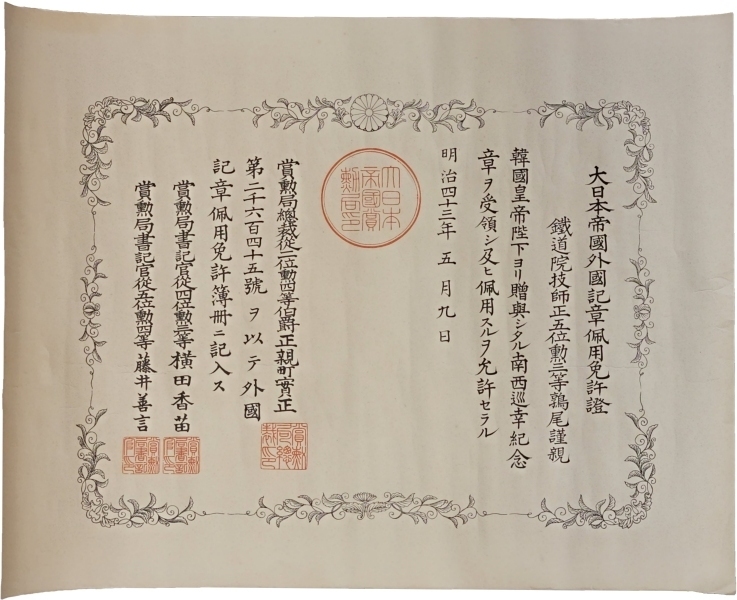
Japanese ‘Permission to Wear’ Document for the award directly above.
- Empire of Greater Japan: License to Wear a Foreign Decoration 大日本帝國外國記章佩用免許證
- Kinshin Uzurao, Engineer of the Railway Bureau, Senior Fifth Rank, Third Class Order of Merit鐵道院技師正五位勲三等鶉尾謹親
- Permission is hereby granted to receive and wear the Southwest Tour commemorative Medal, conferred by His Majesty the Emperor of Korea. 韓國皇帝陛下ヨリ贈興シタル南西巡幸紀念章ヲ受領シ及佩用スルヲ免許セラル
- Meiji 43rd year, 4th month, 9th day. May 9, 1910 明治四十三年五月九日
- [Seal] [印]
- Count Sanemasa Ogimachi, Director-General of the Board of Decoration, Junior Second Rank, First Class Order of Merit [Seal] 賞勲局賞勳局總裁從二位勳四等伯爵正親町實正 [印]
- Recorded in the Foreign Decoration Wearing License Ledger as No. 2645. 記章佩用免許簿冊ニ記入ス第二千六百四十五號ヲ以テ外國
- Kanae Yokota, Secretary of the Board of Decorations, Junior Fourth Rank, 3rd Class Order of Merit. [Seal] 賞勲局書記官從四位勲三等横田香苗 [印]
- Yoshinobu Fujii, Secretary of the Board of Decorations, Junior Fifth Rank, 4th Class Order of Merit. [Seal] 賞勲局書記官從五位勲四等藤井善言 [印]
Size Approx. 34 x 43.7 cm (13.4 x 17.2”)
Award Documents for the Suppression of Rioters and Bandits (Korean Patriots)
The Japan–Korea Treaty of 1905, also known as the Eulsa Treaty, the Eulsa Unwilling Treaty, or the Japan–Korea Protectorate Treaty, was made between the Empire of Japan and the Korean Empire on November 17, 1905. The treaty deprived Korea of its diplomatic sovereignty and made it a protectorate of Imperial Japan. It was a direct result of Japan’s victory in the Russo-Japanese War of 1904-05.
The Japan–Korea Treaty of 1907 provided that Korea should act under the guidance of a Japanese Resident General. The effect of the treaty’s provisions was that the administration of Korea’s internal affairs was turned over to the Japanese. The Korean army was disbanded on August 1, 1907, and large numbers of the former Korean soldiers turned to partisan tactics against the Japanese. See the Wikipedia article on Righteous Armies 의병(義兵). Armed resistance peaked in 1908 with around 70,000 Koreans participating in 1,450 clashes. After 1909, there was a dramatic decline in insurgent events due to concentrated eradication efforts by the Japanese.
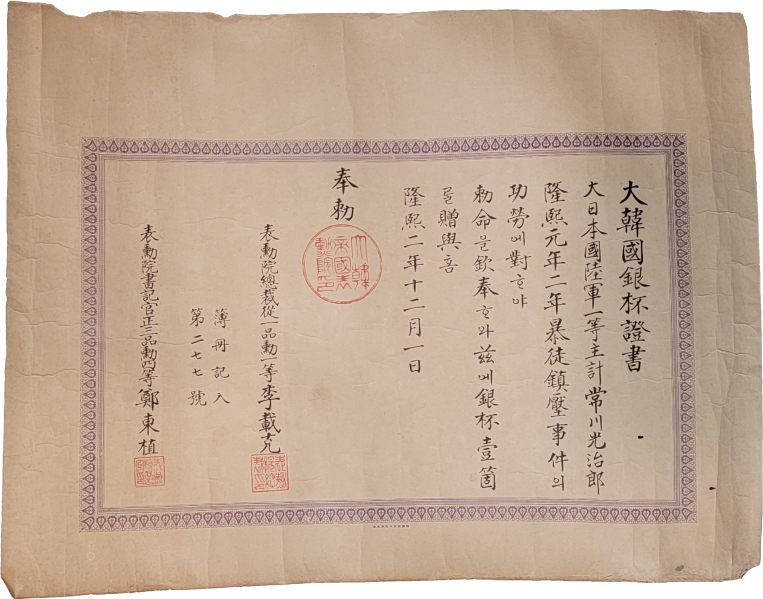
A 1908 Korean Silver Cup Award Document for the Suppression of Rioters (Koreans)
- Silver Cup Certificate of the Korean Empire 大韓國銀杯證書
- Awarded to Mitsujiro Tsunekawa First-Class Paymaster, Imperial Japanese Army 大日本國陸軍一等主計常川光治郎隆熙元年二年暴徒鎮壓事件의
- In recognition of his meritorious service in the suppression of the riot incidents in the first and second years of the Yunghui era, having respectfully received the Imperial Command, one silver cup is hereby bestowed upon him. 隆熙元年二年暴徒鎮壓事件의 功勞에對ᄒᆞ야勅命을欽奉ᄒᆞ와玆에銀杯壹箇 ᄅᆞᆯ贈與홈
- Yunghui 2nd year, 12th month, 1st day. December 1, 1908 隆熙二年十二月一日
- By Royal Order奉敎
- President of the Decorations Office Yi Jae-geuk 表勳院總裁從一品勳等 李載克
- Entered into Register No. 277簿冊記入 第二七七號
- Secretary of the Decorations Office Jeong Dong-sik 表勳院書記官正三品勳四等 鄭東植
- Korean Government Printing Office 韓國政府印刷局製造 (found in fine print at the center below the scrollwork).
Size Approx. 41.6 x 54.3 cm (16.4 x 31.4”)
Mitsujiro Tsunekawa (常川光治郞) graduated from Chuo University, Japan. He was commissioned as an officer in the Imperial Japanese Army (IJA) and served as a high-ranking official in the accounting department (paymaster) during the Japanese intervention in the Korean Empire.

A 1910 Japanese Silver Cup Award Document for Maintaining Public Order (Suppressing Koreans).
- Army Gendarmerie Sergeant Tokuji Kanno, Seventh Class Order of Merit 陸軍憲兵軍曹勲七等菅野徳治
- During the period encompassing July and August 1910 (Meiji 43), during the period of exceptionally heavy duties, you applied yourself with great diligence, and as your efforts in maintaining public order were significant, one silver cup is hereby presented in recognition of your service. 明治四十三年七八月ノ交職務格別多端ノ際黽勉事ニ従ヒ治安維持上其ノ勞不尠ニ付為慰勞銀盃壹個ヲ贈與ス
- August 29, 1911 (Meiji 44) 明治四十四年八月二十九日3
- Commander of the Chuncheon Gendarmerie 春川憲兵隊長, Director of the Gangwon-do Police Affairs 江原道警務部長, Army Gendarmerie Major, Junior Sixth Rank 陸軍憲兵少佐從六位, 4th Class Order of the Merit 勲四等, 4th Class Order of the Golden Kite 功四級, Miyayoshi Teradaira 寺平宮吉
Size Approx. 25.1 x 31.5 cm (9.94 x 12.4”)
Chuncheon 春川 (춘천: literally spring river,: formerly transliterated as Ch’unch’ŏn) is the capital of the Gangwon Province (Gangwon-do), South Korea. The city lies in the north of the country, located in a basin formed by the Soyang River and Han River. There is archeological evidence that the city was first settled several thousand years ago, as demonstrated by Stone Age artifacts in the collections of the Chuncheon National Museum and the Hallym University Museum. Historical records indicate that in 637 AD the city was called Usooju.

A 1911 Japanese Document for Maintaining Public Order (Suppressing Koreans)
- Certificate of Merit 賞詞
- Army Gendarmerie Sergeant Tokuji Kanno, 7th Class Order of the Merit. 陸軍憲兵軍曹勲七等 菅野徳治
- During the period around July 1910, amidst exceptionally busy and demanding duties, you applied yourself with great diligence, and your efforts in maintaining public order were significant. 明治四十三年七月ノ交職務格別多端ノ際黽勉事ニ從ヒ治安維持上其ノ勞
- On this first anniversary, your distinguished achievements are hereby specially commended. 不尠今一週年ニ際シ茲ニ特ニ功績ヲ表彰ス
- August 29, 1911 (Meiji 44) 明治四十四年八月二十九日4
- Commander of the Gendarmerie (Japanese military police, Kempeitai 憲兵隊) in Korea 朝鮮駐剳憲兵隊司令官, Chief of Police Affairs of the Government-General of Korea 朝鮮總督府警務總長, and the fifth rank of Army Major General 陸軍少将正五位, 2nd Class Order of the Merit 勲二等, 3rd Class Order of the Golden Kite 功三級, Motojiro Akashi 明石元二郎
Size Approx. 25 x 31.5 cm (9.8 x 12.4”)
NOTES:
No other records have been found for Tokuji Kanno 菅野徳治
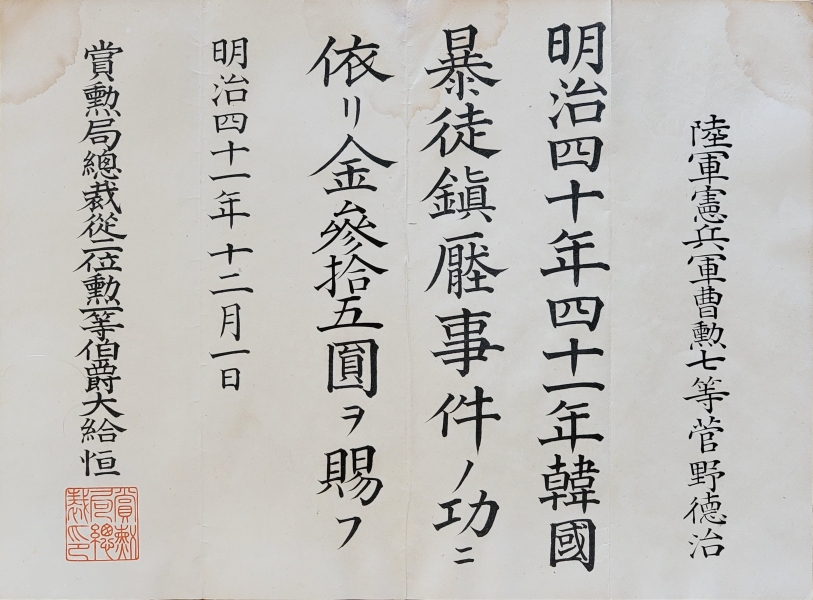
A 1908 Japanese Document Awarding 140 Yen in Gold for the Suppression of Bandits (Koreans)
- Army Infantry Sergeant, 7th Class Order, Arajiro Ogata 陸軍歩兵軍曹 勲七等 緒方荒次郎 (He was previously awarded either a 7th Class, Order of the Sacred Treasure, or a 7th Class, Order of the Rising Sun)
- Meiji 1907-1908 Hanguk (Korea) 明治四十年四十一年 韓國
- Awarded 140 yen of gold in recognition of the achievements in the campaign/affair to suppress bandits. 暴徒鎭壓事件ノ功ニ依リ金百四拾圓ヲ賜フ
- Meiji Dec. 1, 1908 明治四十一年十二月一日
- The president of the Honors Bureau, Junior Second Class Court Rank, 1st Class Order, Earl Okyu Hisashi 賞勲局總裁 従二位 勲一等 伯爵大給恒 (He was previously awarded with either a 1st Class Order of the Sacred Treasure or 1st Class Order of the Rising Sun.)
Size Approx. 22.7 x 30.8 cm (8.9 x 12.1”)
NOTES:
No other records have been found for Arajiro Ogata 緒方荒次郎
Japanese Passport 1902
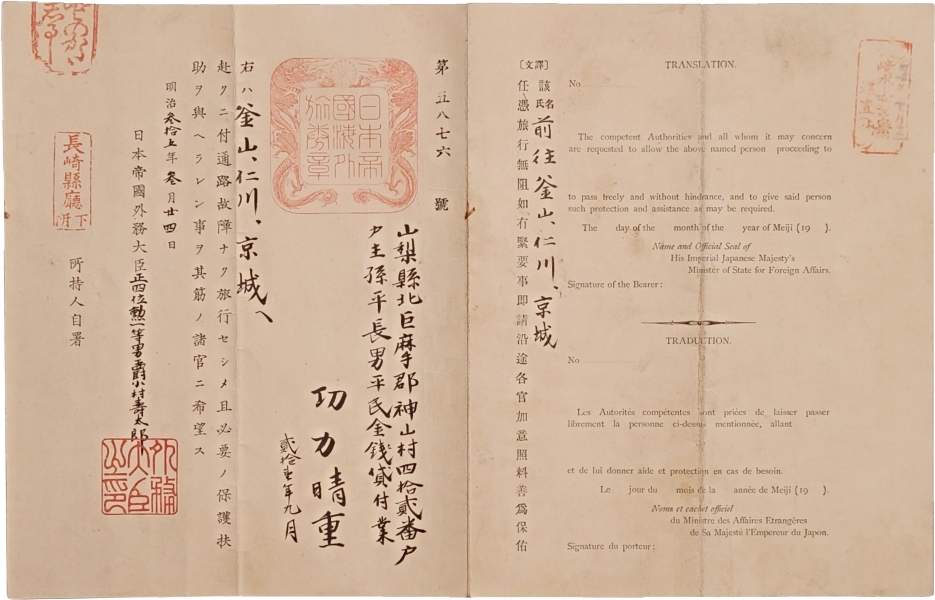
(Right Side)
- The said person is proceeding to Fusan (Pusan), Jinsen (Inchon), and Keijo (Seoul) 該氏名前往 釜山、仁川、京城
- As long as there is no urgent matter, it is respectfully requested that the authorities along the route allow free travel without obstruction and kindly provide care, protection, and assistance. 任憑旅行無阻如冇緊要事即請沿途各官加意照料善爲保佑
(Left Side)
- No. 5876 第5876號
- 42 Kamiyama Village, Kitakoma District, Yamanashi Prefecture 山梨縣北巨麻手郡神山村四拾貳番戶
- Head of Household: Son Hei, Eldest Son, Commoner, Money Lending Business 戶主孫平長男平民金銭貸付業
- Horiki Harushige 功力晴重
- September 1888 (明治)貳拾壹年九月
- Regarding the above-mentioned person proceeding to Busan, Inchon, and Keijo (Seoul), 右ハ釜山、仁川、京城
- It is hereby requested that all relevant authorities ensure that the journey is conducted without any hindrance along the route and that necessary protection and assistance be provided. 赴クニ付通路故障ナク旅行セシメ且必要ノ保護扶 助ヲ與へラレン事ヲ其筋ノ諸官二希望ス
- March 24, 1902 明治参拾五年参月廿四日
- Minister for Foreign Affairs of the Empire of Japan, Senior Fourth Rank, Order of Merit, Baron Komura Jutaro 日本帝國外務大臣正四位勲等男爵小村壽太郎
- Nagano Prefectural Office 長崎縣廳
- Signature of bearer 所持人自署
Size Approx. 23.4 x 36.8 cm (9.2 x 14.5”)
Miscellaneous Korean Documents
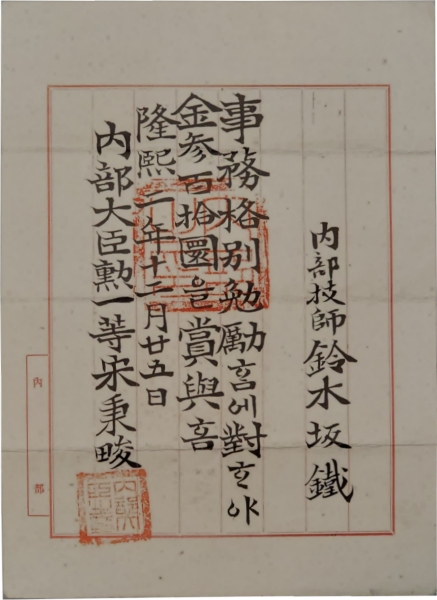
A 1908 Cash Award of 310 Won for Exceptional Diligence.
- To Suzuki Sakatetsu (鈴水坂鐵), Engineer of the Ministry of the Interior 内部技師鈴水坂鐵
- In recognition of his exceptional diligence in official duties, a reward of three hundred ten won in gold is hereby granted. 事務格别勉勵ᄒᆞᆷ에對ᄒᆞ야金参百枪圜을賞與ᄒᆞᆷ
- Yunghui 2nd year, 12th month, 25th day (Dec. 25, 1908) 隆熙二年十月廿五日
- Minister of the Interior, First Class Order of Merit Song Byeongpan (송병판). 内部大臣勳一等宋秉畈
Size Approx. 27 x 19.7 cm (10.6 x 7.8”)
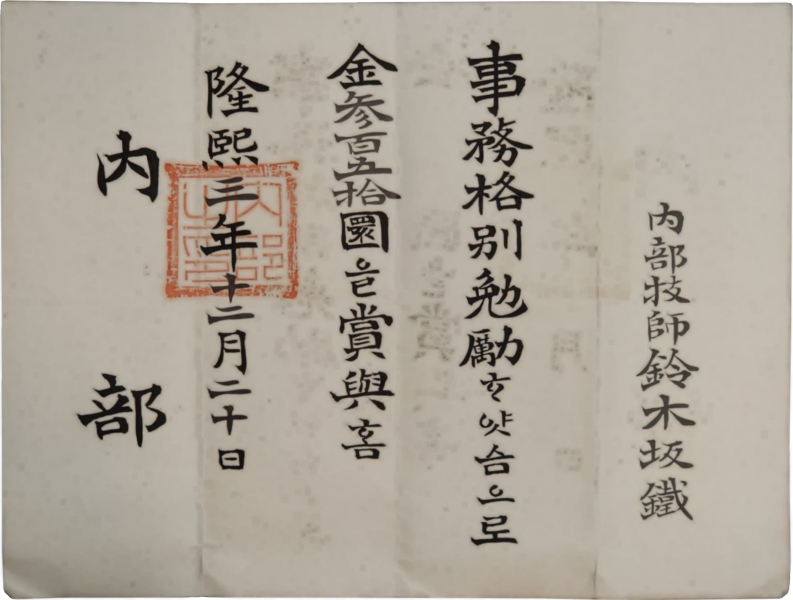
A 1909 Cash Award of 350 Won for Exceptional Diligence.
- To Suzuki Kotetsu (鈴木故鐵), Engineer of the Ministry of the Interior 内部技師鈴木故鐵
- In recognition of his exceptional diligence in official duties, a reward of three hundred fifty won in gold is hereby granted. 事務格别勉勵ᄒᆞ얏슴으로金参百五枪圜을賞與ᄒᆞᆷ
- Yunghui 3rd year, 12th month, 20th day (Dec. 20, 1909) 隆熙三年十二月二十日
- Ministry of the Interior 内部
Size Approx. 27.3 x 36.4 cm (10.7 x 14.3”)

A 1898 Appointment Document
Appointment of Hwang Seok-mun 黃石敏任 (황석민임)
- Appointment of Mingling Ministry of Justice (泰奉) as Judge 明陵泰奉叙判任 (명릉태봉서판임)
- Ranked as an Official of the Eighth Grade 官八等者 (관팔등자)
- Kwangmu 2nd year, 2nd month, (blank) day. February 1898 光武二年二月 日 (광무이년이월 日)
- [Seal of the Imperial Household Ministry] 【印章:宫内府印】(印章:宫内府印)
- Minister of the Imperial Household Ministry, serving concurrently as Minister of the Uijeongbu, Seong Gi-un 成歧運 (성기운) 议政府督政宫内府大臣临时署理成歧運 (의정부독정궁내부대신임시서리성기운)
- [Seal of the Minister of the Imperial Household] 【印章:宫内大臣】 (인장:궁내대신)
Size Approx. 32.5 x 49.3 cm (12.8 x 19.4”)
The following three documents were issued to No Jik-hyeon 盧直鉉 (노직현). He is not listed among the recipients of a Korean Order of Merit

A 1903 Appointment Document
- By imperial decree, 勅 命
- No Jik-hyeon (노직현), a ninth-grade junior official, was appointed as a Councilor of the Jungchuwon and confirmed in his sixth-class rank. 九品從仕郎盧直鉉任中樞院議官叙奏任官六等者
- Kwangmu 7th year, 3rd month, 13th day (March 13, 1903) 光武七年三月十三日
- This appointment was formally announced by the Acting Chief and Deputy Chief of the Jungchuwon, Kim Ga-jin 金嘉鎭 (김가진). 中樞院議長代辨副議長金嘉鎭宣
Size Approx. 39.5 x 58 cm (15.6 x 22.8”)

A 1902 Promotion Document
- No Jik-hyeon (노직현) was appointed to the Department of Internal Affairs, serving as a junior official and promoted to a rank officer of the sixth class. 盧直鉉任內部主事叙判任官六等者
- Kwangmu 6th Year, 6th month, 7th day (June 7, 1902 光武六年六月七日
- He was duly entrusted by the Prime Minister and Internal Affairs Minister to the position of Chief of the Hyeminwon, with Li Gwan-ha 李乾夏 (이건하) serving as the presiding head. 議政府贊政内部大臣篤任恵民院總裁李乾夏
Size Approx. 37.5 x 49 cm (14.8 x 19.3”)

A 1907 Promotion Document
- By imperial decree, 勅命
- No Jik-hyeon (노직현), a Sixth Grade Junior Instruction Official, was promoted to Third Grade Senior Councilor. 六品承訓郎盧直鉉陞正三品通政大夫者
- Kwangmu 11th year, 3rd month, 4th day (March 4, 1907) 光武十一年三月四日
- During the renovation of the Dingji Pavilion at the Yeonggyeong Tomb, he served as supervisor overseeing the inscription and revision of the stele, 永慶墓丁字閣碑閣修改時監董加資事奉勅
Size Approx. 38.7 x 60.7 cm (15.2 x23.9”)
Japanese Pre-WWII Award Documents.
Note the similarity of Japanese award documents to those of the Korean Empire. Even the placement of the seals is similar.

The 1912 Japanese ‘Korean Annexation Medal’ award document
- Certificate of the Korea Annexation Commemorative Medal 韓國併合記念章之證
- Army First-Class Senior Nursing Officer, Order of the Rising Sun Seventh Grade, Kimura Hozo In accordance with Imperial Edict No. 56 of 1912, the Korea Annexation Commemorative Medal is hereby awarded. 陸軍一等看護長勲七等木村保蔵明治四十五年勅令第五十六號ノ上日ニ依リ韓國併合記念章ヲ授與セラル
- Taisho 1st year, 8th month, 1st day. (August 1, 1912) 大正元年八月一日
- [SEAL]
- Director General of the Bureau of Decorations, Junior Second Rank, Third Grade, Count Ogimachi Saneto 賞勲局總裁從二位三等伯爵正親町實正 [Signature Stamp]
- Having examined this certificate and recorded it in the Korea Annexation Commemorative Medal register under entry No. 24,096. 此證ヲ勘査シ第二万四千九十六號ヲ以テ韓國併合記念章簿冊ニ記入ス
- Secretary of the Bureau of Decorations, Senior Fifth Rank, Order of the Rising Sun Fourth Grade, Fujii Yoshikoto 賞勲局書記官正五位勲四等 藤井善言 [Signature Stamp]
Size Approx. 40.7 x 51 cm (16.0 x 20.1”)
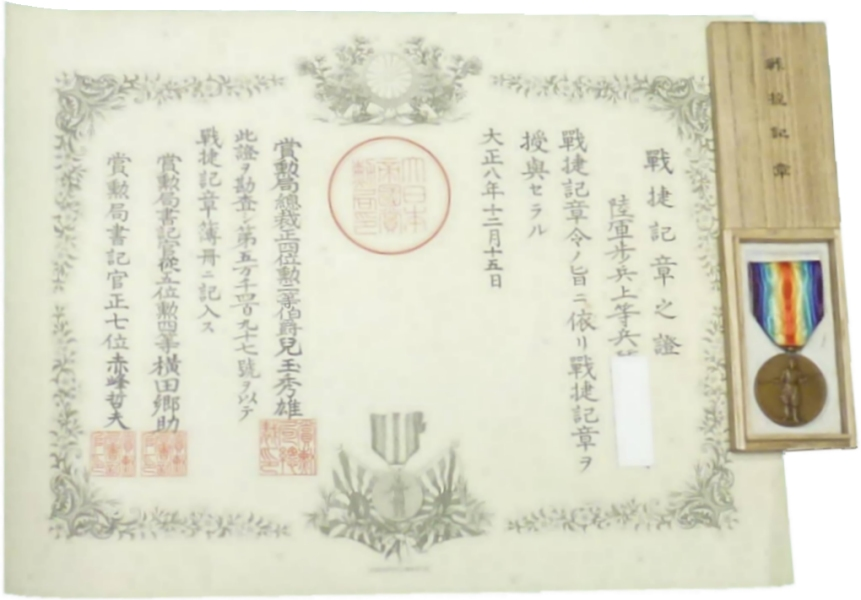
Japanese World War I Victory Medal
Currently working on the translation
Footnotes:
- Orders of merit distribution is 54% Korean, 42% Japanese, and for the remaining eleven countries, 4%.
- This ties into the Mandate of Heaven 天命 (lit. ‘Heaven’s command’) whcih is a doctrine that was used to legitimize the rule of the king or emperor. According to this doctrine, Heaven 天 bestows its mandate on a virtuous ruler. The Mandate of Heaven also extends to the ruler’s family having divine rights.
- This is exactly 1 year after the effective date of the Japan–Korea Annexation Treaty (한일병합조약).
- This is exactly 1 year after the effective date of the Japan–Korea Annexation Treaty (한일병합조약)