
(Japan’s) Chosŏn Army Maneuvers Badge
Since the Japanese invasion of Manchuria in 1931, there had been many small incidents along the railroad line connecting Peking 北京 with the port city of Tientsin 天津. After Japan occupied Northeast China, it created a puppet regime and established Manchukuo in Changchun on March 9, 1932. In 1935, Japan actively planned an “autonomy” movement, which was an attempt to separate China from control of its five northern provinces, which included Hopeh 河北, Chahar 察哈, Suiyuan 綏遠, Shandong 山東, and Shensi 陕西. The Japanese were trying to create a second “Manchukuo.” Japan held divisional maneuvers in Korea in 1935, which were aimed at making emergency reinforcement of front-line units. In the first half of 1936, Japan increased the number of its troops in Northern China to strengthen their garrison, which was headquartered in Tientsin. On July 7, 1937, the Japanese army attacked the Lugou Bridge, and the war broke out. In the West, this is referred to as the Marco Polo Bridge Incident, also known as the Lugou Bridge Incident (盧溝橋事變). This incident is generally regarded as the start of the Second Sino-Japanese War. In China and Korea, it is more often known as the “July 7th Incident.”
The obverse inscription is 皇軍 (황군), Imperial Army. The reverse inscription is in 7 lines, with the first four lines being 朝鮮軍 (조선군) ‘Chosŏn Army,’ 師團對抗 (사단대항) ‘Divisional two-side maneuvers’ (i.e., two divisions pitted against each other), 特別演習 (특별연습) ‘Special Maneuvers,’ and 参加章 (참가장) ‘Participation Badge.’ The fifth line is stamped lettering inside a banner, which denotes the unit that participated. As an example, 歩兵75 (보병75), the ’75th Infantry Regiment.’1 The last two lines are 皇紀 二五九五 ‘1935’ and 非常時 (비상시) ‘in an emergency’ (in a time of emergency).
The website “Medals of Asia” has a number of these medals both for the Japanese army and for the Japanese Chosŏn army at Army Maneuvers Badges with “Chrysanthemum/Mum” Design. The overall appearance of these badges is very similar to early Japanese “Army War College Graduation Badges” 陸軍大學校卒業徽章. You can find several examples of the graduation badges at Medals of Asia.
The known Chosŏn army units engaged in the 1935 divisional exercises were the 工兵 19 (19th Engineering Battalion), the 工兵 20 (20th Engineering Battalion), the 野砲 25 (25th Field Artillery Regiment), the 野砲 26 (26th Field Artillery Regiment), and the 28th 騎兵 (28th Calvary Regiment). There were also a number of 歩兵 Infantry Regiments, namely the 73rd, 74th, 75th, 77th, 78th, and 80th. So of these badges were manufactured by 東寶徽章製作所 (동보휘장제작소), Toho Badge Manufacturing Co., Ltd.
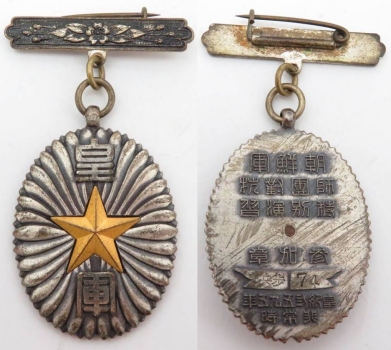
74th Infantry Regiment
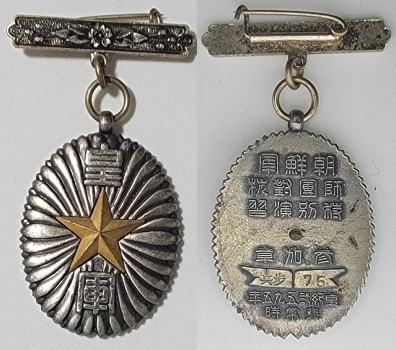
75th Infantry Regiment
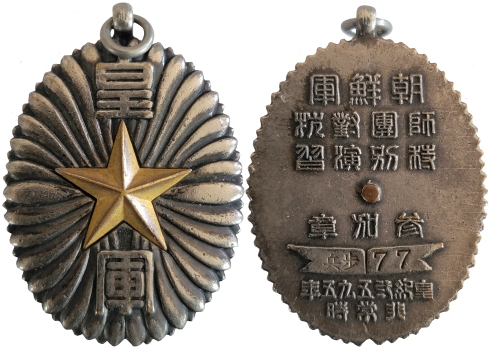
77th Infantry Regiment
There is a variant form found on the Medals of Asia Website
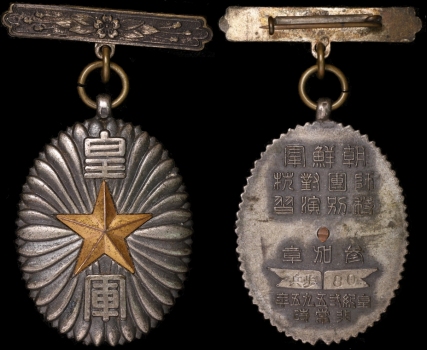
80th Infantry Regiment
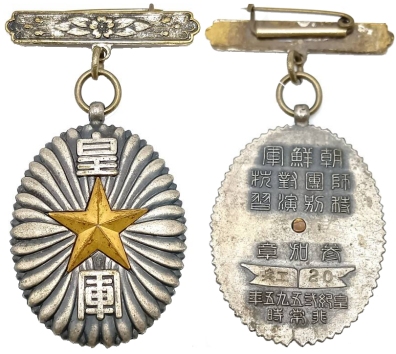
20th Engineering Battalion
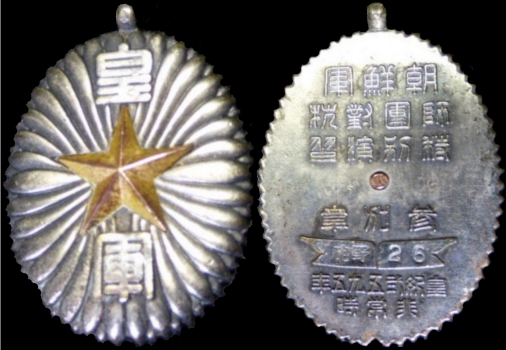
26th Field Artillery Regiment
A slightly different (Japan’s) Chosŏn Army Maneuvers Badge
This badge is very similar to the Maneuver Badges above; however, the suspension is quite different. I don’t think it’s from the same time period. This badge was awarded to the 80th Infantry Regiment. In the group above, there is also a badge given to the 80th Infantry Regiment.
The obverse inscription is 皇軍 (황군), Imperial Army.
The reverse inscription is in 5 lines: 朝鮮軍 (조선군) ‘Chosŏn Army,’ 師團対抗 (사단대항) ‘Divisional two-side maneuvers,’ 特別演習 (특별연습) ‘Special Maneuvers,’ and 参加章 (참가장) ‘Participation Badge.’ At the bottom under the hook, the inscription reads ’80th Infantry Regiment’ 歩兵80th. Unlike the badges above, this piece is undated.
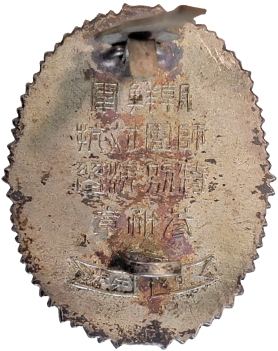
Off-Camp Housing

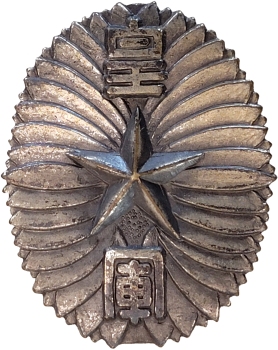
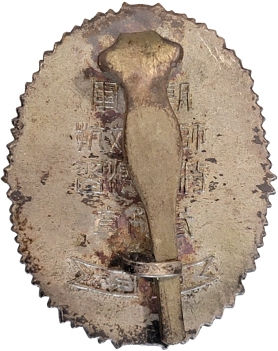
The badge to your right was used to show that the recipient had authorized off-camp housing. The obverse inscription reads as 歩兵第七十八聯隊, “78th Infantry Regiment,” while the reverse has 營外 居 任證, “Certificate of residence outside the camp,” and 第35號, “Number 35.” It was probably issued to a married officer. The name of the recipient and the date on which it was issued are unknown. It resembles the Imperial Japanese Army dog tags, but it is my understanding that IPA dog tags were 33 × 45 mm, while this item is a little larger at 41 × 51 mm. However, it would make sense that this was worn with the dog tag.
The 78th Infantry Regiment, of the Imperial Japanese Army, was attached to the 39th Infantry Brigade of the 20th Division (第20師団). The division call sign was Morning Division (朝兵団), which was a reference to the fact that it was stationed in Chosŏn (朝鮮 Korea).2 The 20th Division was established on Dec. 24, 1915, as a garrison force for Korea. After Japan’s victory in the Russo-Japanese War, the occupation of the peninsula, and the eventual annexation of Korea, the need was felt for a dedicated garrison force raised from Japanese with local knowledge of Korea. The 20th Division was stationed in what is now Yongsan-gu, Seoul, and was responsible for the security of the southern areas of Korea. Although officially raised in 1915, due to budgetary issues, the 20th Division existed only on paper until 1918. After the Mukden Incident,3 The strength of the 20th Division was increased with the addition of the 29th Infantry Regiment. In 1931, the 20th Division was re-stationed on the Liaodong Peninsula 遼東半島 at Jinzhou (錦州). It was present at the Marco Polo Bridge Incident 盧溝橋事變 (July 7, 1937). However, later that same month, without experiencing any combat, it was withdrawn back to Keijo (Seoul), Korea.
In September 1942, the 77th Infantry Regiment, which had been part of the 20th Division, was elevated into the 30th Division. From 1943, the remainder of the 20th Division (which included the 78th Infantry Regiment) was transferred to the Japanese 18th Army 第18軍, located in the Southern Area Command, New Guinea. Of the approximately 25,000 men dispatched, only 1,711 survived the war. In September 1945, most of the 18th Army had been annihilated. Of Major General Hatazō Adachi’s (安達 二十三) original 140,000 men, barely 13,000 were still alive when the war ended. The remnants of the Japanese 18th Army surrendered to the Australian 6th Division at Cape Wom, near Wewak, New Guinea. A Cape Wom Memorial Park with a Surrender Memorial is located at the spot. The Japanese prisoners were held on Mushu Island before being returned to Japan. More men died in New Guinea from malaria and malnutrition than from combat. On July 12, 1947, General Adachi was sentenced to life in prison for war crimes. In a final farewell letter to the 18th Army, the general wrote, “During the past three years of operations, more than 100,000 youthful and promising officers and men were lost, and most of them died of malnutrition… At that time, I made up my mind not to set foot on my country’s soil again but to remain as a clod of earth in the Southern Seas with the 100,000 officers and men…”. He subsequently committed seppuku on September 10, 1947. It is my understanding that he used a paring knife and did not have a traditional Kaishakunin which is the traditional process of beheading a person who has committed seppuku.
Jiandao Expeditionary Army Dispatch Commemorative Medal—1933 年間島派遺軍出征訳念章
Jiandao or Chientao, known in Korean as Gando or Kando, is a historical border region along the north bank of the Tumen River in Jilin Province of Northeast China that has a high population of ethnic Koreans
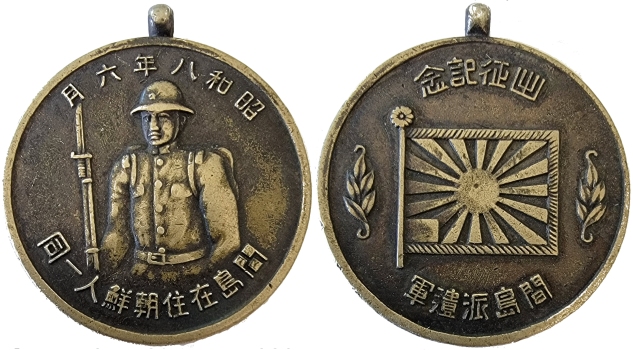
Top line: 昭和八年六月 – Showa 8th year 6th month (June 1933)
Bottom line: 間島在住朝鮮人一同 All the Koreans living in Jiandao
Reverse:
Top Line: 出征訳念 (출정역념) Dispatch Commemorative
Bottom line: 間島派遺軍 (간도파유군) Jiandao Expeditionary Army.
After the Russo-Japanese War (1904-05), Japan began the process that led to the formal annexation of Korea, with Korea becoming an integral part of the Japanese Empire in 1910. During the early years of the 20th century, Korean immigration to Manchuria steadily increased, with either refugees fleeing from Japanese rule or encouragement by the Japanese government for people to develop the land.
The Japanese first infiltrated Jiandao in April 1907 to collect information and data. On August 7, 1907, Japanese troops invaded Jiandao and claimed that the “Jiandao Issue” was “unsettled.” 4
Japan began to expand into northeast China, with one of the primary targeted regions being Jiandao. The Japanese claimed ethnic Koreans living in this region should be placed under the direct jurisdiction of Imperial Japan. In the Jiandao Convention of 1909, Japan affirmed the territorial rights of the Qing over Jiandao, but only after the Chinese foreign ministry issued a thirteen-point refutation statement regarding its rightful ownership. As part of the convention, Japan agreed to withdraw its troops within two months. The treaty also contained provisions for the protection and rights of ethnic Koreans under Chinese rule. Nevertheless, there were large Korean settlements, and the area remained under significant Japanese control and influence.
Koreans in Jiandao were a source of friction between the Chinese and Japanese governments. Japan maintained that all ethnic Koreans were Japanese nationals, subject to Japanese jurisdiction and law. They further demanded the right to patrol and police the area. The Qing and local Chinese governments insisted on their territorial sovereignty over the region.
After the Mukden Incident of 1931, the Japanese Kwantung Army invaded Manchuria. Between 1931 and 1945, Manchuria was under the control of Manchukuo, a Japanese puppet state. From 1934, the area formed the new Jiandao Province of Manchukuo. There was a new wave of immigration, and Koreans were actively encouraged (or forced) to colonize and develop the region. The Japanese also moved to suppress all resistance in the region. From September 1931 to March 1935, the Japanese regular forces and police murdered approx. 4520 people. Because of Japanese oppression in the area, many ethnic Koreans joined or funded the activities of the Communist military forces.
In December 1938, a counterinsurgency unit called the Gando Special Force was organized by the Japanese Kwantung Army to combat communist guerrillas in the region. The Gando Special Force earned a reputation for brutality.
After World War II, many Korean expatriates in the region moved back to Korea, but a significant number remained in China. The descendants of these people form much of the Korean ethnic minority in China today. The area was first nominally part of the Republic of China’s new Songjiang Province, but with the communist seizure of power in 1949, Sonjiang’s borders were changed and Jiandao became part of Jilin Province. The area is now the Yanbian Korean Autonomous Prefecture in Jilin.
1935 Imperial Dog Association Watch Fob
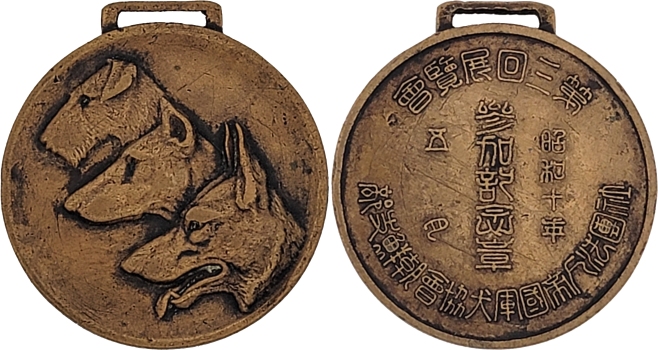
The reverse has “3rd Exhibition” 第三回展覧會, “Participation Commemorative Badge” 参加記念章, “Showa 10th year, 5th month” (May 1935) 昭和十年五月, Imperial Dog Incorporated Association 杜團法人帝國軍犬協會, Korea Branch 朝鮮支部.
Nick at Medals of Asia has this medal and a 1934 exhibition fob with case. This original case has a manufacturer’s paper label for the Okubo Masatoshi Shop 大久保眞敏商店. I don’t know if Okubo Masatoshi had a shop(s) in Japan, but they definitely had a shop in Seoul.
These fobs are sometimes listed as “Imperial Army Dog Association medals,” but this is not supported by the wording on the medal or on the case. That being said, there is a strong link between the Imperial Dog Association and the Imperial Army Dog Association. For more on this, see https://asiamedals.info/threads/history-of-imperial-japan-military-dog-association-teikoku-gun-yoken-kyokai-no.27376/#post-361537
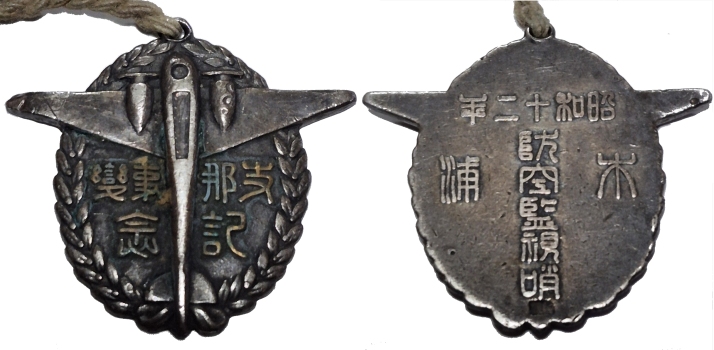
Mokpo Air Defense Badge
The obverse inscription (reading from right to left) “Memory of the Chinese Incident” or “Commemoration of the Chinese Incident” 支那事變記念 (지나사변기념). At the top of the reverse, the inscription reads “Showa 12th Year” 昭和十二年 (소화십이년) 1937. The two larger characters to the left and right of center are Mokpo 木浦 (목포). The inscription down the center is Air Defense Observation Center 防空監視哨 (방공감시소). Mokpo is one of Korea’s three port cities and the first to be opened independently on the orders of King Kojong on Oct. 1, 1897. It was a key base for the Japanese during colonial rule. I have found very little information on the air defense system in Mokpo, but I did find a reference that states that some of the air defense facilities installed during World War II are being preserved. During the Korean War, the American Fifth Air Force referred to the Mokpo Military Facilities as K15.
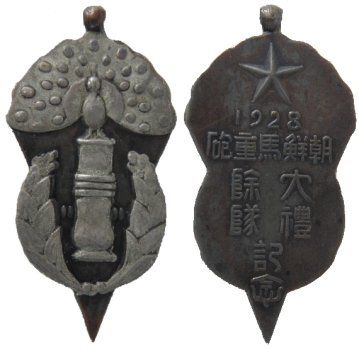
Chosŏn Horse Heavy Artillery
Aside from the translation, there is nothing that I have been able to find on the Chosŏn Horse Heavy Artillery.
On the obverse is the Hōō/Fenghuang/Phoenix with all of its plumage. This is an imperial symbol. The bird is perched atop an antique cannon.
On the reverse at the top is “1928,” which is followed by 朝鮮馬重砲 “Chosŏn Horse Heavy Artillery.” This is followed by a vertical line reading 大禮 “Grand Ceremony.” This may be a reference to the Emperor Showa’s Enthronement Ceremony, which took place in 1928. The second vertical line translates as 除隊 “Discharge,” and at the bottom is 記念 “Commemorative.”
Footnotes:
- The literal translation of 歩兵 is “walking soldier.”
- The literal meaning of 朝鮮 is ‘Pristine Morning’ or Morning Calm. It is actually a reference to the fact that the morning rises in Korea before it rises in China.
- The Mukden Incident was a false flag event staged by the Japanese military as a pretext for the 1931 Japanese invasion of Manchuria. In Japan, the Mukden Incident is known as the Manchurian Incident (滿洲事變) and usually refers to the entire sequence of events (including the invasion), rather than just the initial attack. In China, the attack is known as the Liutiao Lake Incident (柳條湖事變) or as the “9.18 (September 18) Incident” (九・一八事变) and also refers to the entire sequence of events.
- For reference, one should research the “Jiandao Massacre.”