
The Korean Railroad
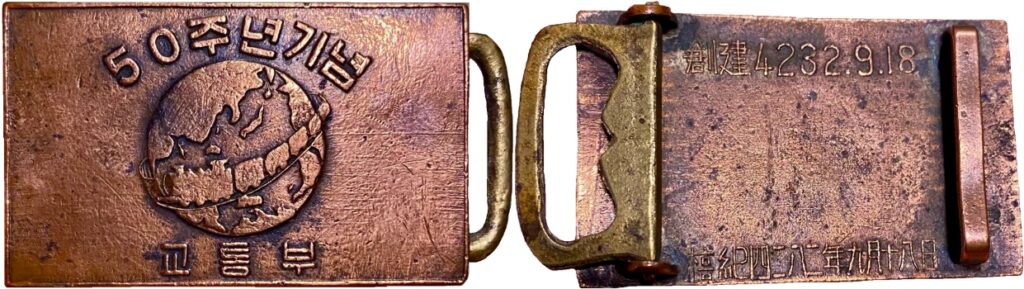
The obverse inscription at top is 50 주년기념 “50th anniversary commemoration”, while the bottom inscription is 교통부 Ministry of Transportation. The reverse inscription at the top is 創建 4232.9.18 “Creation Sept. 18, 1899, and at the bottom is 檀紀 四二八二年九月十八日 “Dangi 4282 year, 9th month, 18 day” which further translates as Sept. 18, 1949.1
For centuries, the Han River has served as an important transportation corridor connecting Seoul and the port of Inchon (Japanese: Chemulpo, Jemulpo). At the end of the 19th century, Korea’s burgeoning industrial development required a new system of mass transportation from the city to the port. The Korean Empire realized the necessity of building a railway but did not have the financial resources nor the technical ability to undertake such a project. In February 1891, King Kojong negotiated a “Railway Construction Treaty” with the American entrepreneur James R. Morse. He had been trying to obtain the construction rights to the Seoul–Inchon railway project under the auspices of Horace Newton Allen, who at the time was secretary of the American legation to Korea. On March 29, 1896, the rights to build the railroad were formally sold to Morse. This was the first patent granted by the Korean government for the construction of a railway and the first time that American interests received a transfer of rights from Korea. This first railroad was to be called the Gyeongin Railroad 京仁鉄道会社 since it connected Gyeongseong (Seoul) and Inchon.2 James R. Morris created the US Plenipotentiary Corporation and, under it, began construction. The plan was to use it as a privately held enterprise, but labor and payment disputes stalled construction. Japanese interests had spread false rumors (fake news) about the political stability of Korea, and Morse’s American investors withdrew their financial support for the project. Consequently, the company was sold on April 2, 1897, for 1.8 million yen to the Japanese-owned Gyeongin Railroad Joint Stock Company, led by Eiichi Shibusawa 渋沢 栄一. Once under Japanese control, the railbed was moved due to the backlash of Japanese landlords who owned sections of the originally proposed railbed. The 32.9 km (20.4 mi) line between Noryangjin and Inchon was officially opened on Sept. 18, 1899. However, it wasn’t fully completed until July 8, 1900, when the line was extended another 5.8 km (3.6 mi) from Noryangjin and crossed the Han River to Gyeongseong Station (Seoul Station). On Nov. 1, 1903, the railroad was absorbed by the Gyeongbu Railway but continued operating as the Gyeongin Line. When the line was opened, the Ministry of Agriculture and Rural Affairs (농림축산식품부) issued the “Gyeongin Railway Regulations 경인간 철도규칙,” which was the first Korean law regarding railway operations. Because the original rail line was built in a rush, the alignment was not good, so in 1907 and 1908, less than 10 years after its opening, a large-scale improvement project was carried out. For many years the Japanese debated double-tracking the line, but this did not happen until 1963, well after Korea’s liberation from Japanese control. Today, it is a quadruple track with two high speed, express lines and two local feeder lines. 3
Until 2017, “Railroad Day,” which originally started in 1937, was held annually on September 18th, commemorating the opening of the Gyeongin Line. Over the years, there has been considerable criticism that the date was inappropriate because the opening of the Gyeongin Line was carried out by the Japanese. On May 8, 2018, the Korean government held a Cabinet meeting and changed the date of Railroad Day to June 28th. On that date in 1894, the Korean Railroad Bureau (鐵道局) was established.
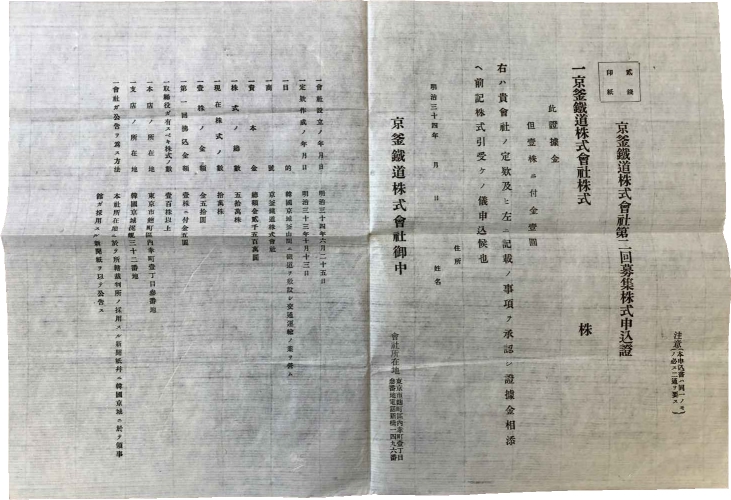
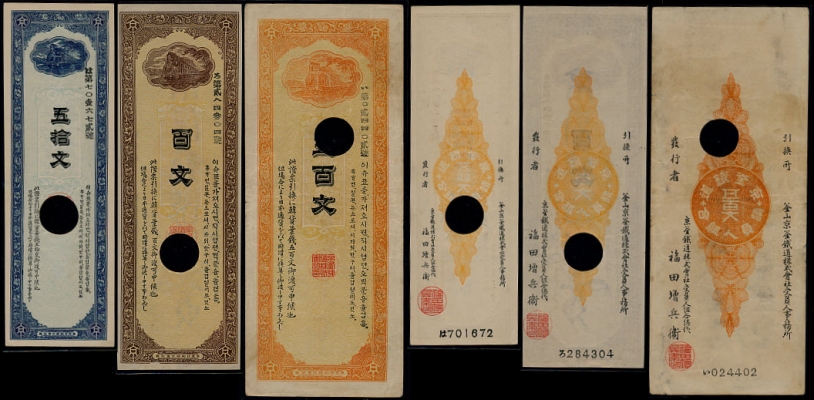
The second rail line in Korea was the Gyeongbu Railway 京釜鉄道会社.4 It is sometimes called the Keijo-Pusan Railway. “Keijo” (京城) was the Japanese word and pronunciation for the city of Seoul, while “Gyeongseong” (京城) is the Korean pronunciation.5 James R. Morris had also acquired the right to lay the line between Seoul and Pusan, but due to financial difficulties, Japan acquired the right to lay the line, establishing the Gyeongbu Railroad Co., Ltd. (June 25, 1901) and began construction shortly thereafter. When the Russo-Japanese War (1904-05) broke out, construction was rushed to facilitate the transportation of Japanese military supplies, but the line was not completed until 1908. The Gyeongseong-Pusan Railway is primarily known today for issuing banknotes (scrip) in 50, 100, and 500 Mun denominations. According to Japanese information sources, these notes were the company’s daily payment certificates. There are sources indicating that a 300-mun was also issued, but there are no known specimens. The Gyeongbu Line became an important stepping stone for Japanese influence on the Korean peninsula. The rail line eventually became the center of South Korea’s modern transportation and logistics network and is known today as the Gyeongbu Main Line.
Due to the importance of railways, many of them were nationalized. They first came under the jurisdiction of the Railroad Management Bureau, General Administration 統監府鉄道管理局 (1905); then the Resident-General’s Railway Administration 統監府鉄道庁 (Imperial Ordinance No. 176, June 1906); then the Japanese Government’s Hanguk Railway Management Bureau 韓国鉄道管理局 (Imperial Ordinance No. 160, June 18, 1909); and finally, after the Japan-Korea Annexation, the Government-General of Korea’s Railway Bureau 朝鮮総督府鉄道局 (1910-1917). The Gyeongbu Line and the Gyeongui Line 京義線 were a vital link that served as the backbone of Japan’s continental policy.6 They underwent a complete overhaul in the 1910s and were one of the first to be double-tracked. In 1911, construction of a bridge over the Yalu River was completed. The Korean railway system was now connected with the South Manchuria Railway (Mantetsu) 南満洲鉄道 (満鉄), and international trains began operations on the peninsula.7 From July 31, 1917, until April 1, 1925, railway operations throughout Korea were entrusted to the South Manchuria Railway (Mantetsu Gyeongseong Bureau 満鐵 京城 管理局).
After WWII (1945), US military rule (USAMGIK 1945-48), Korean independence (1948), and the Korean War (1950-53), South Korea’s railways, like its territory, were limited to the South. In 1946, all domestic railways, including private railways operated under the Japanese occupation, were nationalized, and the Korea Railroad Administration 韓國鐵道公社 (한국철도공사) was established. The Korea Railroad Corporation (韓國鐵道公社 한국철도공사) is the national railway operator in South Korea. It is branded as KORAIL (코레일) and changed its official Korean name (한국철도; 韓國鐵道) in November 2019. Currently, KORAIL is a government-owned corporation managed by the Ministry of Land, Infrastructure, and Transportation. Over the years, the tracks between North and South Korea have been reconnected and disconnected several times. I cannot say with any certainty where the connection stands today. There have been discussions of connecting the rail system to Russia and to Japan via a tunnel under the Sea of Japan.
Interesting little side note. During the occupation of Korea by the Japanese, cars and trains were driven on the left side of the road. After WWII, the United States Army Military Government in Korea (USAMGIK 1945-48) changed the road traffic to driving on the right. However, doing the same for the railroads was not economically feasible. Most Koreans can’t answer why one is right and the other left. The subways, which were constructed long after the Japanese occupation, are driven on the right.
Korean Railroad Logos 1906-1945
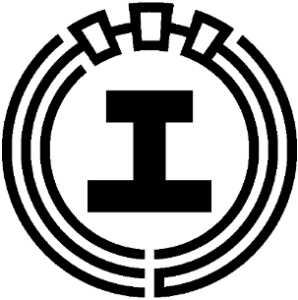
Used from Sept. 1, 1906, until Dec. 12, 1909
統監府 鐵道管理局
통감부 철도관리국
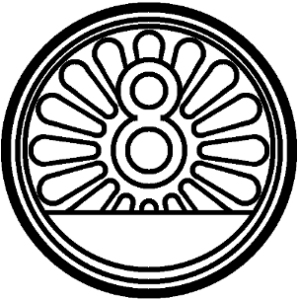
Used from Dec. 16, 1909, until Sept. 30, 1910
鐵道員 韓國鐵道管理局
도원 한국철도관리국
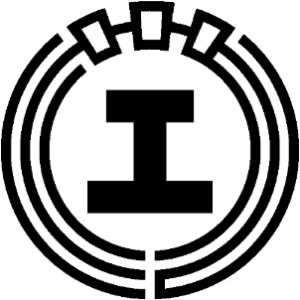
Used from Oct. 1, 1910, until July 7, 1917
朝鮮總督府 鐵道局
조선총독부 철도국
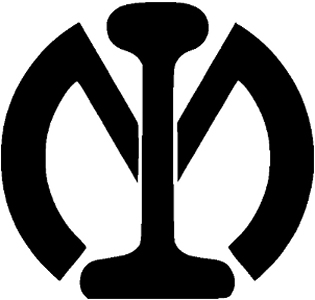
Used from July 31, 1917, until March 3, 1931
満鐵 京城 管理局
만철 경성 관리국
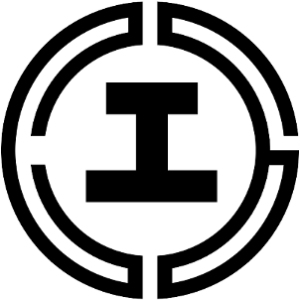
Used from April 1, 1925, until May 31, 1935
朝鮮總督府 鐵道局
조선총독부 철도국
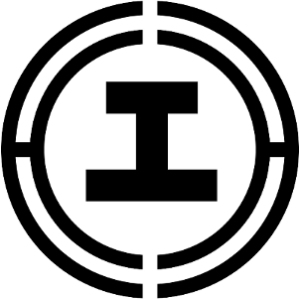
Used from June 1, 1935, until Aug. 15, 1945
朝鮮總督府 鐵道局
조선총독부 철도국
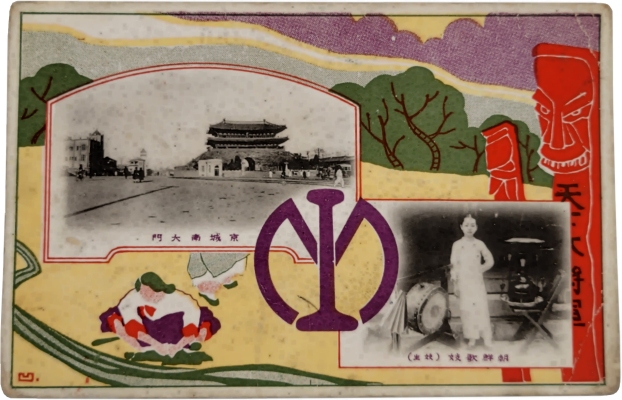
Stamp used from July 31, 1917, until March 3, 1931
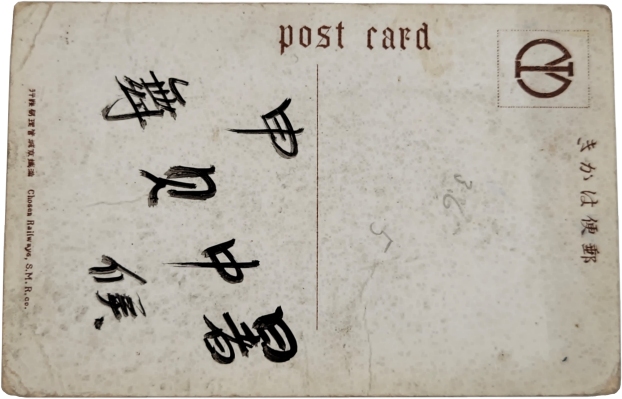
Left edge has “Chosen Railways, S.M. R. co.”
(S.M. R. co. – South Manchuria Railway Company)
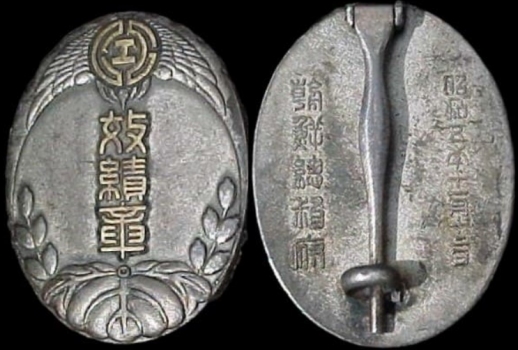
Railroad Achievement Medal – 1930
Obverse:
At the top is the Chosŏn Government Railway Logo 朝鮮總督府 鐵道局, used from April 1, 1925, until May 31, 1935.
The three Chinese characters down the center are 效績章, Achievement Medal.
Reverse:
On the right-hand side is the date 昭和五年十一月十二日, Shōwa 5th year, 11th month, 12th day – Nov. 12, 1930.
On the left-hand side is 朝鮮総督府, the Office of the Governor-General of Korea.
Picture Source: Medals of Asia
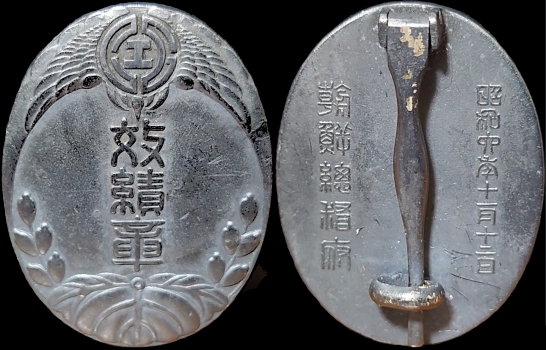
Railroad Achievement Medal – 1931
Obverse:
At the top is the Chosŏn Government Railway Logo 朝鮮總督府 鐵道局, used from April 1, 1925, until May 31, 1935.
The three Chinese characters down the center are 效績章, Achievement Medal.
Reverse:
On the right-hand side is the date 昭和六年十一月十二日 Shōwa 6th year, 11th month, 12th day – Nov. 12, 1931.
On the left-hand side is 朝鮮総督府, the Office of the Governor-General of Korea.
Hallmarked 純銀 sterling silver on the underside of the pin, 2.4 x 3.1 cm at 16.3 g.
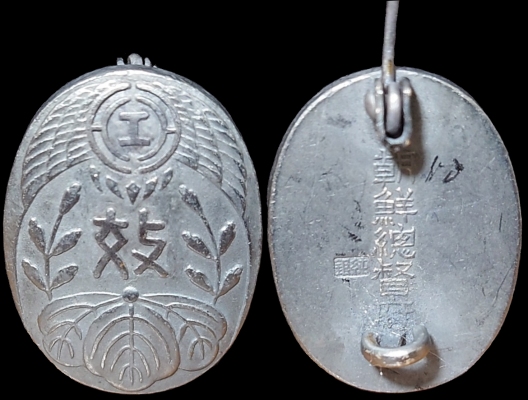
Railroad Achievement Medal – Undated
Obverse:
At the top is the Chosŏn Government Railway Logo 朝鮮總督府 鐵道局, used from June 1, 1935, until Aug. 15, 1945.
The character in the center is 效, meaning “to devote, result, effect, or effectiveness,” and is shorthand for 效績章, “Achievement Medal”
Reverse:
The script down the center is 朝鮮総督府, the Office of the Governor-General of Korea.
It is undated, hallmarked 純銀 sterling silver, 1.7 x 2.25 cm at 7.5 g., and the pin is intact.
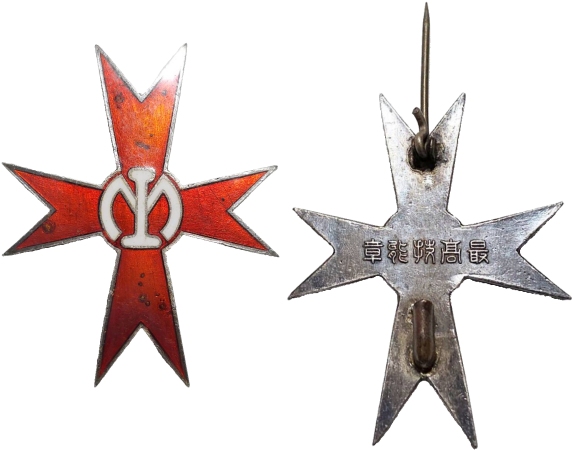
Mantetsu Highest Skill Level Badge.
On the obverse, in the center, is the Mantetsu logo, which was also used as the Mantetsu Gyeongseong Bureau logo from July 31, 1917, until March 3, 1931. Since this badge is undated, there is no way to tell whether this medal was used in Korea or not.
On the reverse is the inscription ‘Highest Skill Medal’ 最高技能章.
According to Nick at the Medals of Asia, these badges were manufactured by the Mori Yoko workshop in Mukden 奉天森洋行 謹製. Nick has pictures of an original case with the miniature badge. For more information, see Medals of Asia.
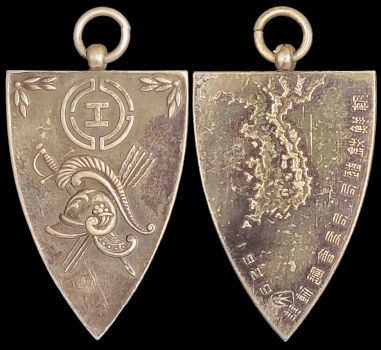
Railroad Association Badge
Obverse:
At the top is the Chosŏn Government Railway Logo 朝鮮總督府 鐵道局, used from April 1, 1925, until May 31, 1935.
Reverse:
Chosŏn Railway Bureau 朝鮮鉄道局.
Bureau Friendship Association Athletics Club 局友會運動部.
It is dated 1929 on the left-hand side.
On the bottom is a “Martlet” stamp, which was the Hattori Workshop mark. Although not marked, it appears to be silver.
36.2 x 22.3 mm, 8.6 g.
Medals of Asia has an example of this medal without the “Martlet” stamp, but with a mark for silver
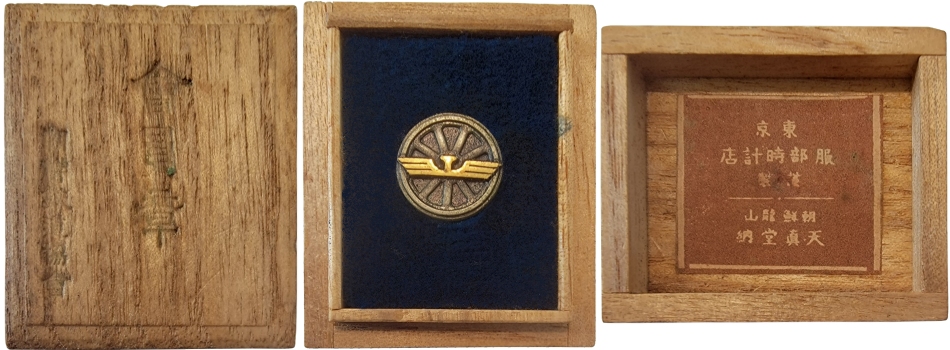
Korean Railway Association Member’s Badge 朝鮮鉄道協会 会員章
Actually a lapel pin. There is nothing written on the lapel pin. I am working on translating the label on the inside of the box cover.
Size 12.2 mm, 3.6 g.
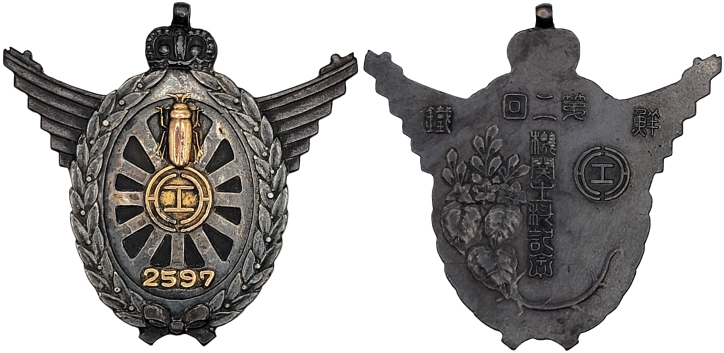
Engineer Department Commemorative Badge
Obverse:
At the top is a crown, with a beetle below. In the center is the Chosŏn Government Railway Logo, which was used from June 1, 1935, until Aug. 15, 1945 선총독부 철도국 朝鮮總督府 鐵道局. At the bottom is the Japanese Kōki year 2597, which is 1937.
Reverse:
The outside term 鮮鐵 (선철) is an abbreviation for the Korean Governor-General’s Railway 朝鮮總督府鐵道 (조선총독부철도). In the center is 第二回 (제이회), meaning “second round” or, more simply, “the second.” And then vertically down the center is 機関士科記念 (기관사과기념), Engineer Department Commemorative.
There is a partial label on the inside of the case. It’s difficult to tell, but this badge may have been manufactured by the Okubo Masastoshi Shop 大久保眞 敏商店 located in Keijo (Seoul).
51.5 x 48.7 mm, 27 g.
I am probably wrong, but Japanese badges feature beetles due to their deep cultural ties symbolizing strength, warrior spirit (like samurai helmets), perseverance, and rebirth, alongside a general Japanese appreciation for the aesthetic and spiritual significance of insects in nature, often linked to Shinto beliefs and ‘mono no aware’ (transience). Beetles are popular pets and cultural icons, representing power and fierce battles, making them common motifs in art, toys, and badges.
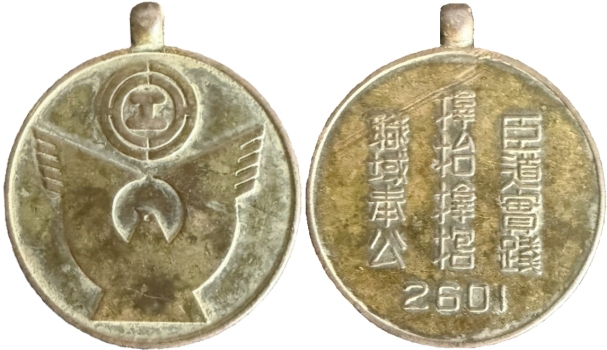
Chosŏn Railway Company Samuhara Good Luck Charm
On the obverse: At the top is the logo of the Chosŏn Government Railway, which was used from June 1, 1935, until Aug. 15, 1945 朝鮮總督府 鐵道局 (조선총독부 철도국). Below this is the symbol of the Imperial Rule Assistance Association 大政翼贊會 (대정익찬회). The Imperial Rule Assistance Association was founded on October 12, 1940, and was the Empire of Japan’s ruling political organization during much of the Second Sino-Japanese War and World War II. Its purpose was to organize Japan’s wartime mobilization for “Total War” and was modelled on the mass party models of Germany’s Nazi Party and Italy’s National Fascist Party. When the organization was officially launched, its founder, Prime Minister Fumimaro Konoe 近衞 文麿 was hailed as the “political savior” of the nation in chaos.8 However, internal divisions soon appeared, and ultimately, it was not as successful in mobilizing the public as Germany and Italy were. After the 1942 Japanese general election, all members of the Diet were required to join the Imperial Rule Assistance Association. Because of its failures, it was formally dissolved on June 13, 1945, roughly three months before the end of World War II in the Pacific.
On the reverse (reading from right to left) is the phrase 臣道實践, “Practice Way of Serving” [to the Emperor and Country]. It was the official “Spirit Slogan” of the Imperial Rule Assistance Association. This is followed by 𪮷抬𪮷𪮇 “Samuhara” (サムハラ), which is the generic name of three gods (天之御中主神、高皇産霊神、神皇産霊神) and was considered an amuletic phrase to ward off all sorts of misfortune, including protection against bullets. Japanese soldiers sent off to war invoked its protection by writing the characters for “Samuhara” on their personal belongings. The last line is 職域奉公, meaning “to serve one’s country through one’s occupation.” This was a popular slogan of the Greater Japan Imperial Rule Assistance Association. The number “2601” at the bottom refers to the Imperial Year (Koki / 皇紀) 2601, which corresponds to the year 1941.
Size: 28 x 24 mm (1.1 x 0.94 inches)
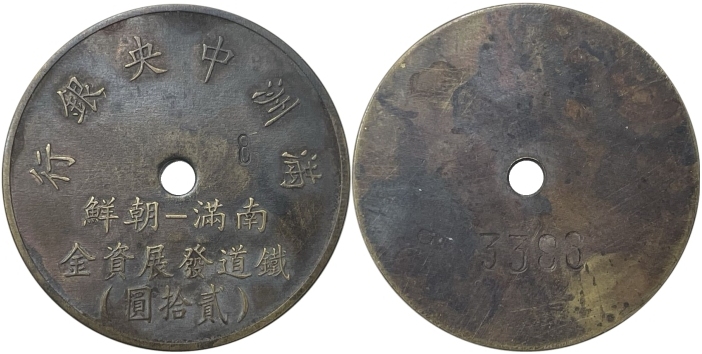
Manchuria Central Bank Token
Obverse:
Manchuria Central Bank 満洲中央銀行
South Manchuria–Chosŏn (Korea) Railway Development Fund 南満-朝鮮 鐵道發展資金
(20 Yen) (貳拾圓)
With a hand-punched “8” in the center field
Reverse:
Hand-punched “3383”
40 x 0.9 mm 9.2 g
According to Nick at Medals of Asia, these are fake tokens; however, he does not state why he considers them to be fakes.
See “Fake Central Bank of Manchuria Tokens“
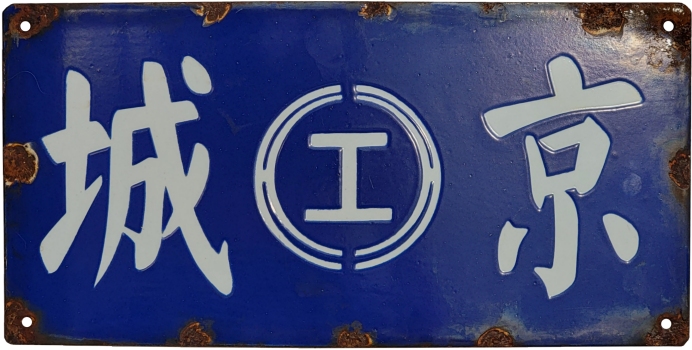
Porcelain Railroad Sign
Reading from right to left is 京城 (Keijo), which was the Japanese name for the city of Seoul. (Pronounced Gyeongseong 경성 in Korean, it translates as “Capital City.”)
The symbol in the center is the logo of the Chosŏn Government Railway 조선총독부 철도국 (朝鮮總督府 鐵道局) used from June 1, 1935, until Aug. 15, 1945.
August 15, 1945, is the date that Emperor Hirohito broadcast the Japanese surrender to his people. It is celebrated as V-J Day in Allied countries and as Liberation Day in Korea. The official signing of the surrender documents occurred later on September 2, 1945, aboard the USS Missouri in Tokyo Bay.
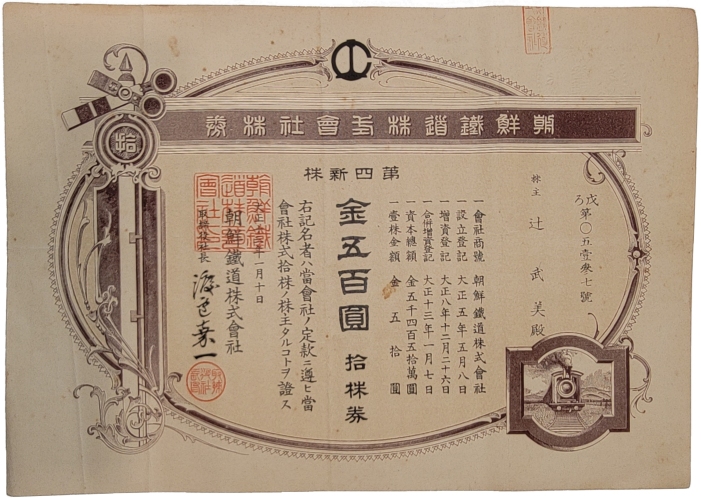
Korean Railway Company, Shares Certificate
Korea Railway Co., Ltd. 朝鮮鐵道株式會社株券
Five hundred yen of gold 金五百圓
Taisho 13th year, 1st month, 10th day 大正13年一月十日 (Jan. 10, 1924)
It’s interesting to note that the logo at top center does not match any of the railroad logos listed above.
Footnotes:
- Dangi is a calendar system formerly used in Korea. To arrive at the Western date, subtract 2333 from the Dangi year. To learn more about the Dangi system, see my Korean Calendar Systems webpage.
- This is often mistakenly called the Gyeongseong Inchon Railway 京城釜山鉄道会社 (경성인천철도회사). In the company’s official title, the cities of Gyeongseong (Seoul) 京城 and Inchon 仁川 are abbreviated as 京 and 仁, respectively, making it the GyeongIn railway. In Japanese this is pronounced as the Keijin Railway.
- If you are interested in more information on the Gyeongin Railroad, see “Seoul Chemulpo Railroad – The First Railroad of Korea” by Patrick R. O’Donnell, Prentiss Publication, Honolulu, Hawaii, 2021.
- This is often mistaken for the Gyeongseong-Pusan Railway 京城釜山鉄道会社 (경성부산철도회사). In the company’s official title, Gyeongseong (Seoul) 京城 and Pusan 釜山 are abbreviated as 京 and 釜, respectively, making it the GyeongBu railway.
- Seoul has been known in the past by several names, including Wiryeseong 위례성 (慰禮城), Hanseongbu 한성부 (漢城府), Bukhansangun 북한산군 (北漢山郡), Namgyeong 남경 (南京), Hanyangbu 한양부 (漢陽府), Hanseong 한성 (漢城), and Hanyang 한양 (漢陽). During the Chosŏn Dynasty era, the city started to be called “Seoul” by the public. The traditional names of Hanyang and Hanseong used during the Chosŏn Dynasty were almost replaced by Seoul and were only used as formal names for the city. In 1948, the city officially took its more familiar name, Seoul 서울. “Seoul” is a purely indigenous Korean word and can only be written in Hangul. There are no corresponding Chinese characters, so when translated into Chinese, it is automatically translated as 漢城 Hànchéng, the Chinese characters and pronunciation for Hanseong 한성.
- Construction of the Gyeongui Line 京義線 began in 1902 and connected Seoul and Sinuiju 新義州 in present-day North Korea.
- After Russia’s defeat in the Russo-Japanese War (1904-05) and the signing of the Portsmouth Treaty (Sept. 5. 1905), the Russian-controlled areas in Manchuria were taken over by Japan. The South Manchuria Railway Company, Ltd. (南満州鉄道株式会社) Mantetsu (満鉄) was established in 1906.
- After the war, Konoe was suspected of war crimes, and on December 16, 1945, he committed suicide by ingesting cyanide before he could be arrested by the authorities.