
On Oct. 2, 1993, I attended the Long Beach Coin Show in Southern California, and while combing the bourse, I met Frank Draskovic, an international coin and medal dealer and numismatic researcher. He is a co-author of the “Standard Price Guide to World Crowns & Talers 1484-1968” in two editions. During that first chat, we discovered a mutual interest in not only Korean coins but also in Korean Orders and Medals.
Although his Korean collection is small, it is very significant.
“Buzz” Aldrin’s Korean Order of Civil Merit, Mugunghwa Class

Notice there is no ribbon bar or lapel pin.
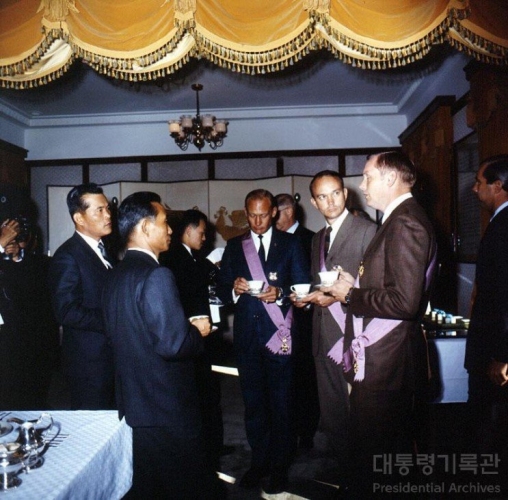
Photo courtesy of the Korean Presidential Archives 대통령기록관 Public Information Office, Management #CET0028578


Fun fact: Buzz Aldrin’s name is actually Edwin Eugene Aldrin Jr. His younger sister mispronounced “brother” as “buzzer” and the nickname stuck. In 1988 he changed his legal name to Buzz.
The Substitute Series of the Order of Military
The history of Korea’s “Order of Military Merit” begins with General Douglas MacArthur. On Sept. 29, 1950, there was a formal ceremony during which the general officially returned the city of Seoul to the Republic of Korea. President Syngman Rhee wanted to award a medal to the general, but the Korean government had not officially established an Order of Military Merit. The President authorized the addition of a gold star to the Order of National Foundation, which he wanted to present to Douglas MacArthur as the Order of Military Merit along with a document. I believe that a 1st class of the Order of National Foundation was to be used as a substitute for General MacArthur’s Order of Military Merit; however, there are no pictures of the medal, and any documentation of the award being given to MacArthur is missing from the Korean records. All the examples of a substitute Order of Military Merit with Silver Star use the 2nd Class of the Order of National Foundation.
Even though an Order of Military Merit was later instituted on Oct. 18, 1950, the Korean government continued to issue the substitute Order of Military Merit with a document stating that it was the “Order of Military Merit with Gold Star 금성 (金星 for a 1st Class) or a Silver Star 은성 (銀星 for a 2nd Class).” All of these substituted medals went to high-ranking American officers. It is assumed that the Korean Government wanted to keep some form of continuity between American officers when wearing their Korean Orders. Without the star, there is no way to differentiate between an Order of Military Merit and an Order of National Foundation unless one has a document stating otherwise.
Even though there was a 3rd class of the Order of National Foundation, it was never utilized to create 3rd or 4th classes for the Order of Military Merit. According to the Korean Medal Roll, no 2nd Classes of the Order of National Foundation were issued.
The Korean War Museum in Seoul has no examples of the substituted medals. For more on this subject see my Order of Military Merit / Substitute Series.
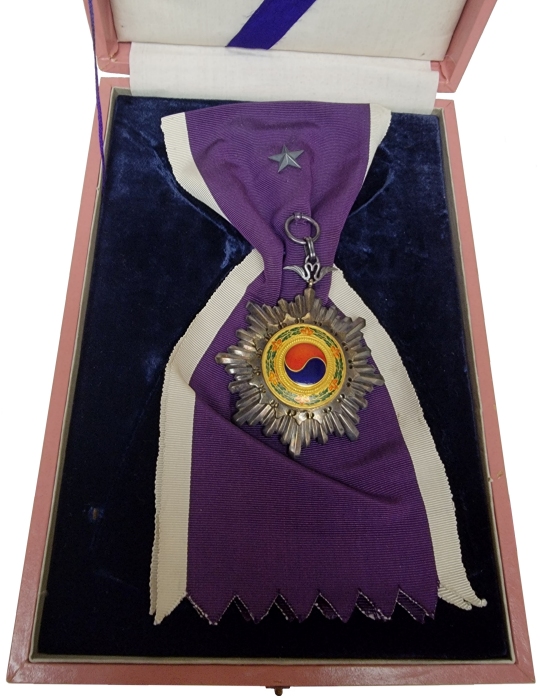
Awarded to Rear Admiral Allen E. Smith on Feb. 3, 1951.


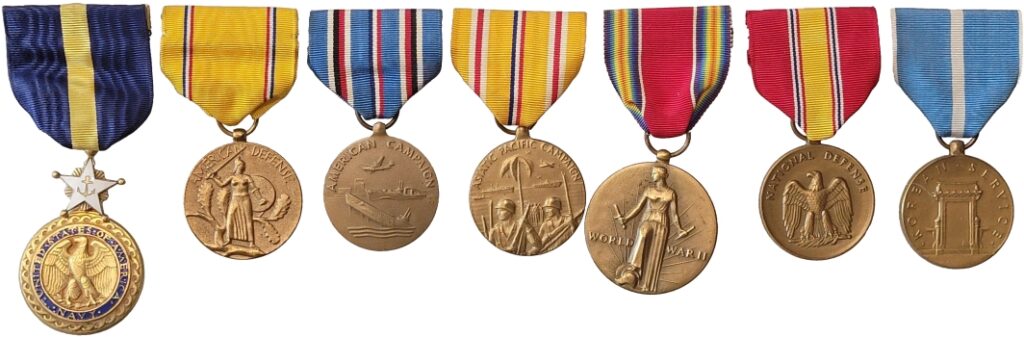
Admiral Allen Edward Smith (1892-1987)
United States Navy Admiral Smith graduated from the United States Naval Academy in 1915. During World War II, Smith was the commander of the USS South Dakota. Later he was the commander of Service Squadron Ten. In the Battle of Okinawa, he was the commander of Cruiser Division 5 and commanded the bombardment of the island, supporting the invasion task force. By 1944 Smith was a rear admiral and acting commander of the 17th Naval District, Kodiak, Alaska, and was the commander of Cruiser Division 5 at the start of the Korean War. He later was the commander of the 13th Naval District in Bremerton, Washington. In 1950 he was commander of the United Nations Blockading and Escort Force Korea, as well as commander of Task Force 95. Smith was awarded three Legion of Merit medals and also awarded the Navy Distinguished Service Medal. After he retired from the Navy, he authored the novel “Mighty Mo. The USS Missouri: A Biography of the Last Battleship.”
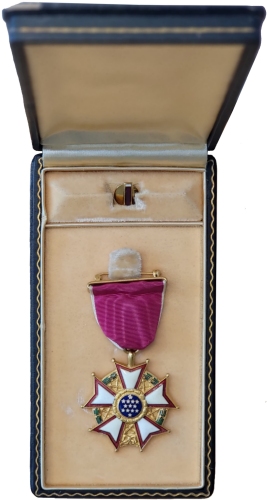
He was awarded three of them during World War II.
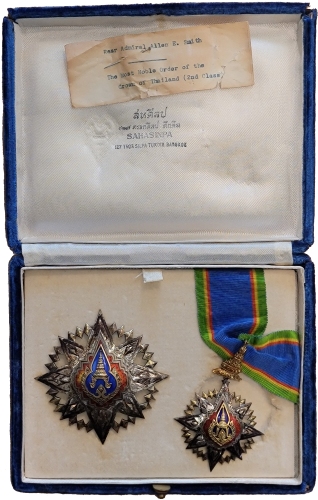
2nd Class
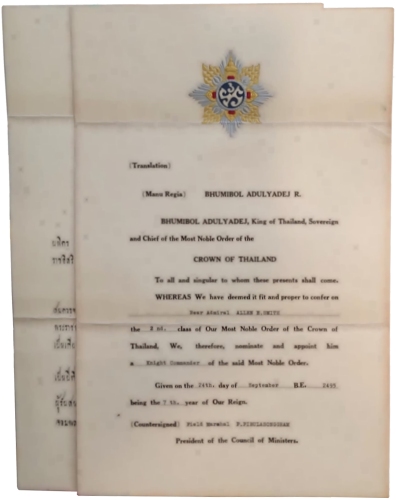
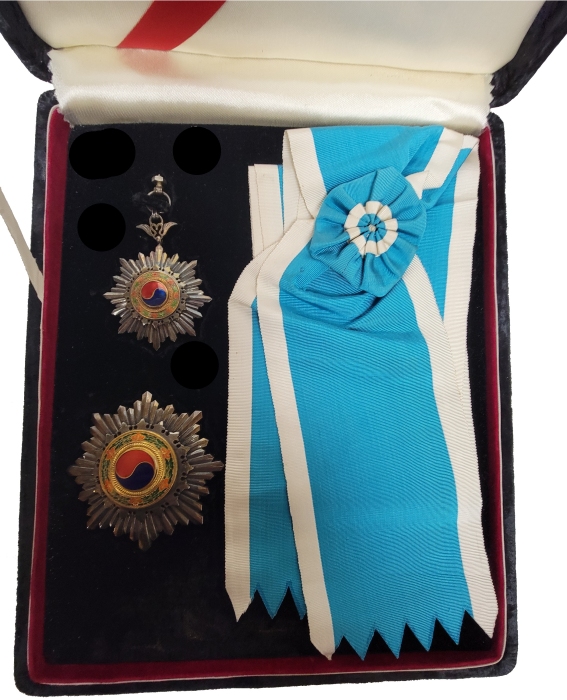
There were 19 total issued.
Of the three astronauts on the Apollo-Saturn 11 crew, two were Boy Scouts. Neil Armstrong was an Eagle Scout (1947), while Edwin “Buzz” Aldrin was a Tenderfoot. Of the 12 American astronauts who have walked on the Moon, 11 have been Boy Scouts.
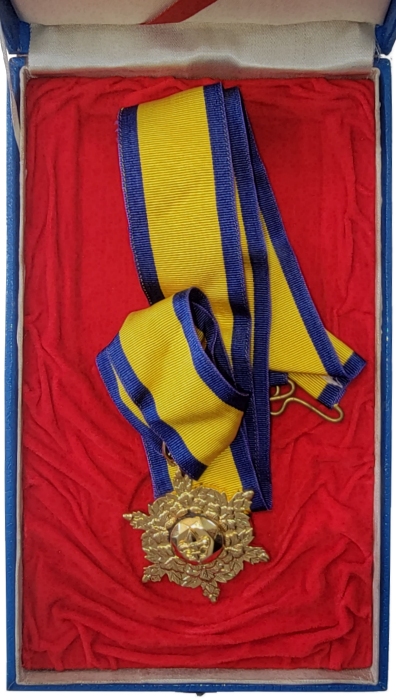
The reverse has the inscription “BSK” and “No.70”
There is no indication of medal’s name.