
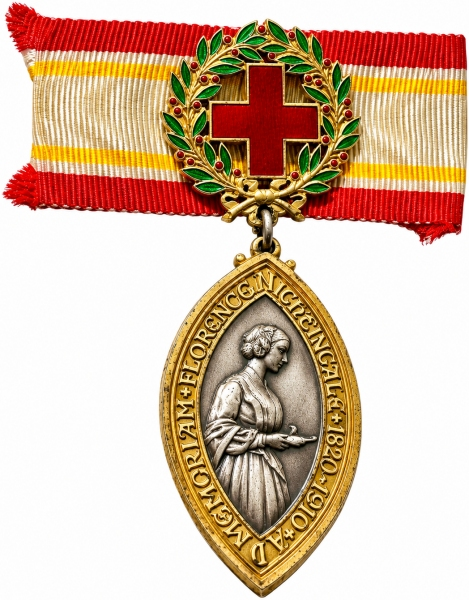
In recognition of her dedication to social services, this Florence Nightingale Medal 플로렌스 나이팅게일 기장을 was awarded by the International Committee of the Red Cross in 1969 to Miss New Soon-han (usually romanized as Nu Soon-han or Yoo Soon-han 유순한 柳順韓). In its official Circular No. 475, issued in Geneva on May 12, 1969, the International Committee of the Red Cross identified her as Recipient No. 20: Miss New, Soon-Han, Republic of Korea.
Miss New was a prominent South Korean nursing administrator and educator. Her award is independently recorded in the original 1969 International Committee of the Red Cross archives. The medal was presented live on both radio and television in a ceremony conducted by South Korean Prime Minister Chung Il-kwon 정일권 (1917–1994) before an audience of more than 1,000 people. At the time of her nomination, she served as the Director of Nursing Service (1962–1970) and advisor to the nursing school at the National Medical Center in Seoul.
Born in Pyongyang in 1912, Mrs. New Soon-han is the younger sister of Dr. Yoo Il-han 유일한 (柳一韓 1895–1971), a renowned independence activist and founder of Yuhan Corporation, a leading pharmaceutical company in Korea. Mrs. New graduated from the Department of Nursing at Pyongyang United Christian Hospital 평양연합기독병원. At the age of 37, she traveled to the United States to pursue an advanced nursing education at Glendale Sanitarium and Hospital’s nursing school in California. She graduated in 1947 and wanted to modernize nursing care in Korea. Particularly interesting is her association with the rebuilding of South Korea’s medical infrastructure following the Korean War. After her return, she served as head of nursing at Seoul National University Hospital, Chonnam National University Hospital, and the National Medical Center (1962–1970). She concluded her civil service career as the head of Education and Training at the National Institute of Health. Starting in 1972, she was elected to five consecutive terms as president of the Public Health Nurses Association under the Korean Nurses Association, shaping national standards for community and public health nursing. After retiring from public service in 1975, she moved to Busan to join Dr. Chang Kee-ryo (장기려), a pioneer in Korea’s health insurance movement, serving as Vice President of the Blue Cross Social Welfare Association 청십자사회복지회 which provided medical care for the impoverished. Throughout the late 1970s and 1980s, she held leadership positions with the Busan Association for the Rehabilitation of Disabled Persons and served as Chairperson of the Busan Lifeline (부산 생명의 전화), a suicide prevention hotline.
On Dec. 17, 1964, the Ministry of Health and Social Affairs 보건사회부 awarded her a Prime Minister’s Commendation 국무총리표창. Ten years later, on Feb. 13, 1973, the National Institute of Health, Ministry of Health and Social Affairs 보건사회부국립보건연구원 awarded her the Order of Service Merit 근정훈장 Green Stripes Medal녹조근장 (a 4th Class).
THE NATIONAL MEDICAL CENTER: A PRODUCT OF POSTWAR KOREAN RECONSTRUCTION
The Korean War had ended in an armistice in July 1953, leaving the country with extensive damage to hospitals, medical facilities, and public health infrastructure. The institution with which New, Soon-Han was associated has an unusually important history.
The National Medical Center in Seoul was established through cooperation between the Republic of Korea, the United Nations Korean Reconstruction Agency, and the governments of Norway, Sweden, and Denmark. During the Korean War, the three Scandinavian nations had made substantial contributions to medical relief. Norway operated the Norwegian Mobile Army Surgical Hospital, commonly known as NORMASH. Denmark dispatched the hospital ship Jutlandia, while Sweden maintained a Red Cross field hospital in Busan. Following the war, the three countries sought to continue their medical assistance through a permanent institution that would help reconstruct South Korea’s healthcare system. The resulting National Medical Center opened on October 1, 1958. Its mission went beyond providing hospital treatment. It was established to improve medical standards, train healthcare professionals, and introduce modern hospital administration and clinical practices. The institution incorporated training facilities for medical personnel, including nurses. For the following decade, Scandinavian medical professionals worked alongside Korean personnel, contributing to the development of professional medical education and healthcare services. According to historical material published by the Royal Norwegian Embassy in Seoul, a total of 367 Scandinavian medical professionals and other personnel worked at the institution during its first ten years. The National Medical Center was transferred to Korean administration in 1968, although Scandinavian assistance continued beyond that date. This timing makes New, Soon-Han’s 1969 award particularly interesting. She was serving in a senior nursing leadership position at the institution during the period immediately following its transfer to Korean administration. Her responsibilities belonged to a broader historical movement in which South Korea was developing the domestic leadership, training systems, and professional infrastructure required to sustain its modern healthcare institutions. Although the ICRC records do not specify every aspect of her individual career, they directly establish her leadership role within this important institution.
Information source: Royal Norwegian Embassy in Seoul, “National Medical Center” historical account published May 19, 2017. This institutional history documents the founding of the National Medical Center, Scandinavian involvement in its development, and the transfer to Korean administration in 1968.
THE FLORENCE NIGHTINGALE MEDAL: ORIGINS OF AN INTERNATIONAL HONOR
The Florence Nightingale Medal traces its origins to the earliest decades of the international Red Cross movement. At the Eighth International Conference of the Red Cross, held in London in 1907, the Hungarian Red Cross proposed an international decoration recognizing nurses who had demonstrated exceptional devotion to the sick and wounded. The proposed award was intended to commemorate Florence Nightingale (1820–1910), whose work during the Crimean War helped transform nursing into an organized, professionally trained occupation. Nightingale became internationally famous for her work at the military hospitals in Scutari, where wounded and sick soldiers suffered under difficult medical and sanitary conditions. Her subsequent influence extended into hospital administration, sanitation, public health, medical statistics, and the education of professional nurses. The Hungarian proposal recognized the desirability of an international honor that would acknowledge comparable service in later generations. The International Committee of the Red Cross investigated the proposal, consulted national Red Cross societies, and developed plans for a permanent award. At the Ninth International Conference of the Red Cross, held in Washington, D.C., in 1912, the Florence Nightingale Medal was formally established.
The original plan provided for a limited number of medals to be awarded annually, together with a parchment diploma. The outbreak of the First World War delayed its inaugural distribution. The first awards were eventually announced on May 12, 1920, the centenary of Florence Nightingale’s birth. The medal subsequently developed into one of the foremost international distinctions associated with professional nursing.
AN AWARD SELECTED THROUGH INTERNATIONAL REVIEW
Unlike medals issued automatically for participation in a campaign, period of service, or membership in an organization, the Florence Nightingale Medal required individual nomination and selection. Under the regulations in force in 1969, national Red Cross societies submitted the names and qualifications of candidates they considered worthy of recognition. The International Committee of the Red Cross reviewed those nominations and determined which individuals merited the distinction. The qualifications included exceptional nursing service in difficult circumstances, distinguished care of the sick and wounded, and important contributions by nursing administrators and organizers. A maximum of 36 medals could be issued during each biennial distribution, although the ICRC is not obliged to award the entire allocation. The selection process therefore imposed an international numerical limit rather than assigning a predetermined number of decorations to every participating country. This distinction is central to understanding the medal’s scarcity. In its retrospective statistical account published in 1970, the ICRC recorded only 11 Florence Nightingale Medal recipients from the Republic of Korea through the 1969 distribution. This places New, Soon-Han among a relatively small early group of South Korean recipients of the decoration.
HUGUENIN OF LE LOCLE, SWITZERLAND: MANUFACTURE AND QUALITY
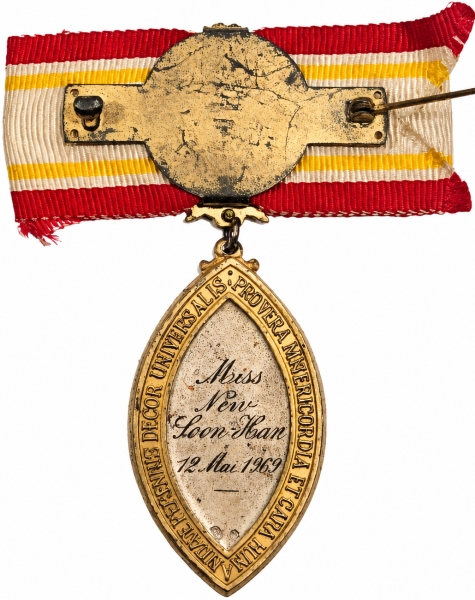
The medal is attributed to Huguenin of Le Locle, Switzerland, an established Swiss manufacturer of medals, decorations, badges, and commemorative pieces. Huguenin’s work is familiar to collectors of European and international decorations, particularly those featuring intricate metalwork and enamel. Florence Nightingale Medals of this period were produced in silver-gilt, with the traditional design specified by the ICRC. The official regulations called for the medal to bear a portrait of Florence Nightingale on its obverse, together with the commemorative inscription referring to her life. On the reverse, the decoration carries a Latin inscription surrounding the central field in which the recipient’s name and award date are engraved. The Latin motto reads: PRO VERA MISERICORDIA ET CARA HUMANITATE PERENNIS DECOR UNIVERSALIS. The medal is suspended from an ornamental laurel wreath surrounding a red cross, with a red-and-white ribbon. This combination of classical decoration, humanitarian symbolism, and individual recipient engraving has remained closely associated with the award. The present example is identified as a Huguenin-manufactured .925 sterling-silver decoration, with gilded and enameled elements characteristic of the official issue. The silver content and manufacturer attribution are significant physical details, but the principal historical value rests in the medal’s official purpose and recipient identification.
THE IMPORTANCE OF INDIVIDUAL RECIPIENT ENGRAVING
The Florence Nightingale Medal is particularly desirable as a named historical decoration. The original rules required the name of the holder and date of award to appear on the reverse. This feature allows individual medals to be connected with surviving official records and, in favorable cases, to specific biographical and historical documentation. For a collector, the difference between an unnamed medal and a named original award can be substantial. An unnamed example may still represent an important historical design. A named original award, however, can preserve the identity of the person whose achievements were recognized. In this case, the attributed recipient is independently documented in an original ICRC circular, a later account of the presentation ceremony, and the ICRC’s historical register. The surviving records identify her position at the National Medical Center and establish the circumstances under which the medal was awarded. That degree of traceability is one of the most appealing aspects of collecting individually awarded international decorations.
COLLECTOR MARKET AND DOCUMENTED COMPARABLE SALES
Original Florence Nightingale Medals occupy a specialized segment of the international orders-and-decorations market. They appeal to collectors of Red Cross history, historical nursing awards, named decorations, and medals connected to distinguished individuals. Values vary considerably according to the recipient, age, condition, completeness, and surviving documentation. Several publicly recorded transactions provide useful market context.
Drouot Estimations, February 20, 2022: €1,400. An original Florence Nightingale Medal awarded to Mademoiselle Jeanne Euverte on May 12, 1969, sold for €1,400, excluding buyer’s fees. This example was manufactured by Huguenin in silver-gilt and enamel and was accompanied by its original case, miniature medal, award diploma, correspondence concerning the presentation, and period Red Cross publication material. This is a particularly relevant comparison because it belongs to the same 1969 international distribution as New, Soon-Han’s medal. Its unusually complete original documentation is an important distinction.
Schulman Auction 348, July 3, 2015: €900. A Florence Nightingale Medal awarded to Mademoiselle Cécile Mechelynck on May 12, 1931, described as uncirculated and housed in its original case of issue, realized €900.
Noonans, March 7, 2007: £700. A named Florence Nightingale Medal was awarded to Miss Lorna Ellice Mackenzie on May 12, 1937, realizing £700. The medal was described as silver, silver-gilt, and enamel, with ribbon, in extremely fine condition.
eMedals: $675. A Huguenin-manufactured Florence Nightingale Medal awarded to Mrs. Dagmar E. Stenbeck on May 12, 1961, was recorded as sold for $675. The decoration was named, hallmarked, and retained its original ribbon.
Dorotheum, November 15, 2024: €500. A Florence Nightingale Medal was awarded to Madame Zsofia Nitsch on May 12, 1979, realizing €500. The medal was identified as a Huguenin-manufactured silver-gilt and enamel example with a .925 silver marking and original ribbon.
These transactions illustrate the established specialist market for named Florence Nightingale Medals. They also demonstrate the considerable variation in results between individual awards, particularly where original cases, diplomas, and supporting documentation survive. The present medal’s interest lies especially in its South Korean attribution and the detailed contemporary record of the 1969 presentation ceremony.