
Miniature Medals 약장
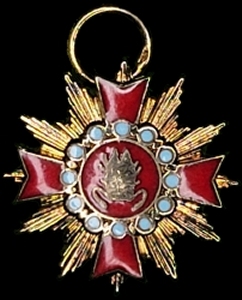
Some Korean Orders and medals are available as miniature medals, Yak Jang 약장. Korean law requires miniature Medals to be ½ of their normal size, and expressly prohibits miniaturizing Orders that are normally worn on a sash or cravat. During the 1950s, most Korea Orders and Medals were breast medals. Miniatures from this time can be found, but starting in the early 60s, Sashes and Cravats were added to the higher classes. Korean legislation also prohibits the wearing of full-sized orders on a sash or cravat while wearing miniature medals of the lower classes. In general, only the 4th and 5th classes of an Order, Merit Medals and Ki Jang can be miniaturized. Because of these prohibitions, miniature medals are rarely found after the 1950s. High ranking military officers and civil servants want to wear their most prestigious orders at formal events, so miniatures are usually not needed by the recipients.
All that being said, there is an exception. Miniature Breast Stars are known to exist because there are situations where Korean diplomats and high-ranking Korean military officers need to wear miniatures to conform with the other attendees of an event, and in these situations, miniatures have been manufactured, even though they violate the legal codes. Interesting enough, even though illegal, miniature breast stars are available from the Korean government. Also, keep in mind that Korean legal restrictions do not apply to foreigners.
A couple of interesting footnotes:
Korean legislation gives Korean Awards precedence over foreign decorations. However, it is not unusual to find Korean groups or ribbon bars where the assemblage is done by the relative importance of the individual medals, regardless of the award’s origin. In the example below and to the left, the U.S. Bronze Star has been mounted by its relative importance between the Orders of Military Merit and the Defense Merit Medal. In the center group below, the United Nations medal is placed last after all the Korean medals, as required by Korean Law. If it had been mounted by its relative importance, it would be after the Korean War Medal. The same is true for the third group below. The U.S. Legion of Merit is placed last, however in this case, there are no medals of lower importance, only higher.
The Korean phrase “Yak Jang” 약장 is used for “Miniature Medal” and for “Ribbon Bar,” but translation programs usually render it as “Medicine Chest” or “Medicine Cabinet.” On a few rare occasions, it is rendered as “deshabille” or “dishabille,” a French term referring to the state of being dressed in a casual or careless style.
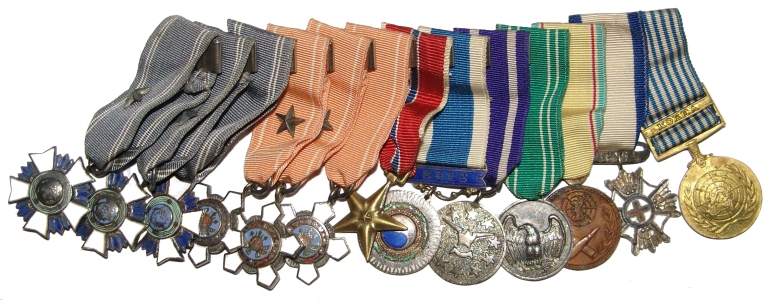
Order of Military Merit, Chungmu w/Silver Star
Order of Military Merit, Chungmu w/Silver Star
Order of Military Merit, Chungmu
Order of Military Merit, Hwarang w/Silver Star
Order of Military Merit, Hwarang w/Silver Star
Order of Military Merit, Hwarang
United States Bronze Star
Defense Merit Medal
10th Anniversary of the Military Founding
Guerilla Warfare Service Medal
Korean War Service Medal
Red Cross Membership Medal, Silver Class
United Nations Medal for Korea
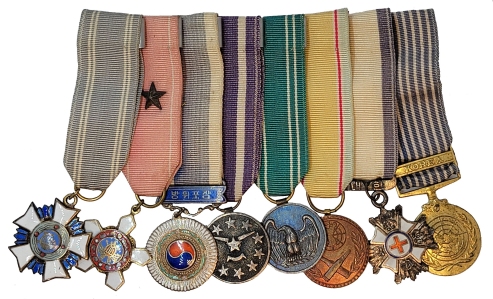
Order of Military Merit, Chungmu
Order of Military Merit, Hwarang with Gold Star
Defense Merit Medal
10-year Anniversary of the Military Founding
Guerilla Warfare Service Medal
Korean War Service Medal
Red Cross Membership Medal, Silver Class
United Nations Medal for Korea
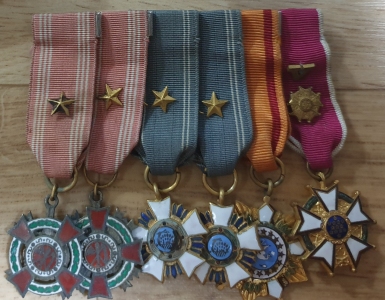
Order of Military Merit, Ulchi w/Gold Star
Order of Military Merit, Ulchi w/Gold Star
Order of Military Merit, Chungmu w/Gold Star
Order of Military Merit, Chungmu w/ Gold Star
Order of Service Merit, 5th Class but with a 1973 ribbon
U.S. Legion of Merit, Officer Degree (3rd Class)
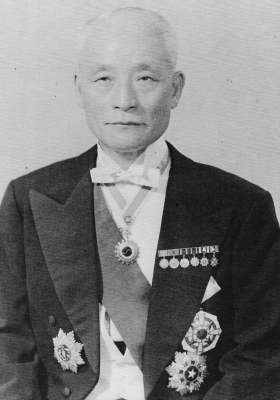
Kim Hong-Il 김흥일 (金弘壹 1898-1980)1
Kim Hong-Il was born in Korea and was briefly a teacher. He was arrested and imprisoned by a Japanese gendarmerie. After his release, and not wanting to live under Japanese rule, he defected to the Republic of China. He graduated from the Chinese Republican Guizhou Military Academy in January 1921, and was commissioned as a second lieutenant. He joined the Korean Independence Army immediately after graduation and served as a cadet captain, instructor, company commander, and battalion commander at the Military Academy. He served as a captain of the Independence Army Volunteer Corps in 1921, and deputy commander of the Korean Volunteer Army in 1923. After which, he joined the Chinese National Revolutionary Army in 1926 and directly participated in Chiang Kai-shek’s Northern Expedition. In 1939, he was promoted to brigadier general of the Chinese Central Army, which made him the first Korean to become a general in the Chinese Republican Army. In June 1945, he became the Chief of Staff of the Korean Liberation Army while still serving in the Chinese Army. After World War II, he was promoted to major general in the Chinese Army (Nov. 1945). He later returned to Korea, and in December 1948, enlisted in the Korean military and was appointed as a brigadier general. This made him the first general appointed after the founding of the Korean army on Aug 15, 1948. He retired as a Lieutenant General on Mar. 20, 1951. However, some sources indicate that he was discharged in October 1951. He then served as the Korean ambassador to the Republic of China from 1951 to 1961, became the Korean Minister of Foreign Affairs in May 1961, and later served as the 9th President of the Korean Veterans Association 대한민국재향군인회 (大韓民國在鄕軍人會)(Dec. 1961). He actively opposed the Korea-Japan Agreement, broke away from the Park Chung-hee administration, and entered politics in 1967.
His Awards from Korea include: the Order of Military Merit, Chungmu (Dec. 30, 1950); the Order of Military Merit, Taeguk (July 26, 1951); the Order of Civil Merit, Blue Stripes (Jan. 1, 1960); the Order of Merit for National Foundation, 3rd Class (Mar. 1, 1962); and the Order of Civil Merit, Mugunghwa Class (Aug. 11, 1980).
From the Republic of China, he received: the Meritorious Service Medal for the Jinan Operation 제남작전유공 (濟南作戰有功) (1928), the Mangaryeong Rotary Meritorious Service Medal 만가령 회전 유공훈장 (萬⊙領會戰有功受大功勳章) (1938), the Hwaju Honorary Medal for the Exclusive Supervision of the Sango Association 상고회전 전용감수 화주영예훈장 (上高會戰⊙戰勇敢受華胄榮譽勳章) (1941), the Chinese Anti-Japanese War Commemorative Medal 중국항일전쟁기념훈장 (中國抗戰有功受勝利勳章) 및 항전기념장 (抗戰記念章) (1945), the First Class Commander of the Northwest Territories, Air Force, Army and Navy 서북시가전유공육해군일등장장 (四平街戰功作戰有功受陸海軍一等奬章) (1946), the Loyalty and Diligence Medal 충근훈장 (忠勤勳章), The Order of the Clouds and Banner 대수운마훈장 (大綬雲摩勳章) and The Order of the Brilliant Star 대수경성훈장 (大綬景星勳章).
General Kim Hong-il was named one of the four greatest heroes of the Korean War by the Ministry of National Defense in 19832 and was selected as the Independence Activist of the Month in August 1999 and the War Hero of the Month in January 2015. The Kim Hong-il General Memorial Society was established in 2024 to honor the achievements of General Kim Hong-il.
This is the only set of miniatures, that I have seen, where even the ribbons are enameled. With the enameling, the ribbons mimic an enameled ribbon bar set. Very strange
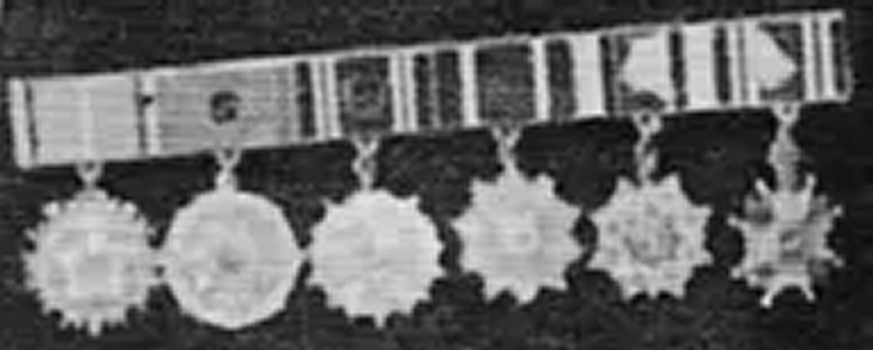
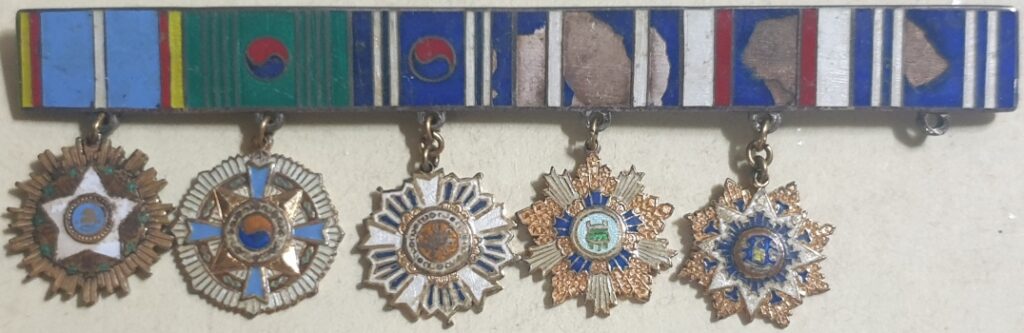
From the collection of Kim Yong-rak.
General Kim Hong-il and the Korean Independence Movement.
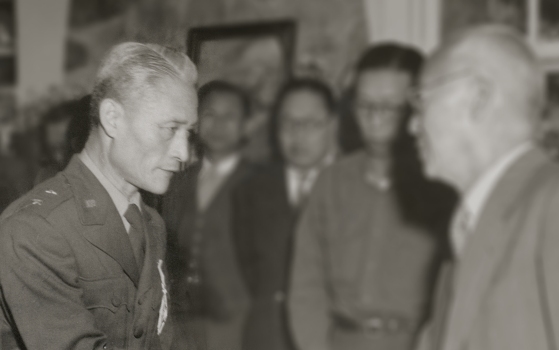
Lee Bong-chang 이봉창 (李奉昌 1900–1932)
Lee Bong-chang, a member of the Korean Patriotic Corps, requested a bomb that could be thrown from a long distance. He was planning to assassinate the Japanese Emperor Hirohito. Kim Gu 김구 (金九) as the leader of the Korean Provisional Government in China, subsequently discussed the matter with General Kim Hong-il. The general obtained a grenade which had low explosive power but was light in weight and could be thrown over a greater distance. It was also easy to conceal. On Jan. 8, 1932, Lee Bong-chang threw the grenade at Emperor Hirohito as he was passing in front of the Metropolitan Police Department after finishing a military inspection ceremony at the Yoyogi Parade Ground in Tokyo. The assassination attempt failed but garnered considerable interest and economic support for the Korean Independence Movement.
Dr. Yun Bong-gil 윤봉길 (尹奉吉 1908 – 1932)
Kim Gu 김구 (金九) leader of the Korean Provisional Government, heard that the Japanese army was holding a ceremony to commemorate the victory in the Shanghai Incident and to celebrate “Tenchō Setsu” (the birthday of Japanese Emperor Shōwa). He decided to have Dr. Yun Bong-gil throw a bomb during the ceremony. He requested and received lunchbox and water bottle-shaped bombs from General Kim Hong-il.3 On April 29, 1932, Dr. Yun Bong-gil threw the bombs at the stage where the Japanese military leaders were attending the ceremony at Hongkou Park 虹口公園 in Shanghai. It resulted in annihilating the Japanese military leaders who had led the invasion, including the Japanese Army Commander-in-Chief, General Shirakawa. At that time, Chinese President Chiang Kai-shek of the Kuomintang government praised Yun Bong-gil highly, saying, “What the million-strong Chinese army and 400 million people could not do, one young man from Korea has achieved.” Later, the Chinese Nationalist Kuomintang government greatly supported the activities of the Provisional Government of the Republic of Korea in both military and administrative aspects until the defeat of Japan. Mamoru Shigemitsu (重光 葵, 1887–1957) was one of the Japanese dignitaries who was severely injured in the attack. He lost his right leg and walked with an artificial leg and cane for the rest of his life. As Japan’s Foreign Minister, he was the man in the top hat and cane who, on September 2, 1945, limped up to the table and signed the Instrument of Surrender aboard the USS Missouri (BB-63), formally ending WWII.
After Korea achieved independence, Kim Gu interred the remains of Lee Bong-chang, Yun Bong-gil and Baek Jeong-gi in Hyochang Park 효창공원, located in the Yongsan District of Seoul. Their grave site is known as the Graves of the Three Martyrs (삼의사묘; 三義士墓).4 A statue of Lee wielding a hand grenade is also located in the park. On March 1, 1962, both Yun Bong-gil and Lee Bon-chang were posthumously awarded the Order of Merit for National Foundation. Yun received the Jung Jang 중장 (重章 1st Class), and Lee received the Bok Jang 복장 (複章 Second Class). Koreans refer to the actions of all three men as “Righteous Deeds” 의로운 행위. One man’s patriot is another man’s terrorist, two sides of the same coin.
Footnotes:
- His pen name was Ilseo (逸曙), his nickname was Choi Se-pyeong (崔世平), and he had several Chinese names such as Wang Ung (王雄), Wang Ilseo (王逸曙), and Wang Bugo (王復高).
- In 1983, the Ministry of Defense and Army Headquarters designated the four major heroes of the Korean War as Kim Hong-il, Kim Jong-oh 김종오 (1921–1966), Douglas MacArthur, and Walton Walker.
- Kim Hong-il’s nephew, Kim Young-jae, was also an independence activist and served in the National Revolutionary Army and in the Republic of Korea Air Force. He participated in manufacturing the bombs used by Yun Bong-gil.
- Baek Jeong-gi 백정기 (白貞基1896-1934) was a Korean anarchist and independence activist who fought against Japanese colonial rule. He plotted the assassination of a Japanese consul but was arrested before he could carry out the plan. He died in a Japanese prison. On March 1, 1963, he was posthumously awarded the Order of National Foundation, Tan Jang 단장 (單章 Third Class).