
The subject of “Koreans During WWII’ is an expansive topic, with many nuances. The subject of Koreans who served the Japanese Empire during World War II is a hotly debated subject and a political hot potato. Were Korean volunteers truly volunteers, or were they coerced? Were any conscripted Koreans truly loyal to Japan? The questions are endless, and the accusations are numerous. My intention is to present this topic neutrally, exploring it as a subject of discussion or inquiry without framing it in terms of absolute right or wrong. This approach allows for a more open and balanced examination of different perspectives and complexities.
Table of Contents
- Korean Volunteers for the Japanese Officer Corps
- Korean Volunteers for the Japanese Enlisted Ranks
- Japan’s Declaration of War on the United States and Great Britain
- Military Conscription
- Labor Conscription or Labor Requisition
- Koreans in the United States
- The Aftermath of World War II
Korean Volunteers for the Japanese Officer Corps
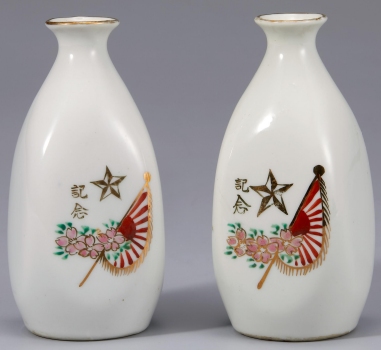
On the front is the inscription 記念 meaning Commemorative. On the backside is a three line inscription: 朝鮮龍山步兵 Chosŏn Yongsan Infantry, 第七十八聯隊 Seventy-eighth Regiment, and 堀田長雄 – Nagao Hotta who was the man who ordered the Tokkuri and a set of sake cups (as a gift for friends and relatives).
Picture source: Yongsan History Museum
Before the Annexation of Korea in 1910, officer volunteers from Korea had been joining the Imperial Japanese Army Academy 륙군사관학교 (陸軍士官学校) located in Ichigaya, Tokyo. The vast majority of these volunteers were royal family members or aristocratic family members (Yangban 양반 兩班). Only one of these Koreans ever made it into the upper ranks of the Japanese military through merit, and that was Hong Sa-ik. After the annexation, Koreans entered the academy based in part on their abilities, but mostly on their connections to the Governor General of Korea. Some of these graduates were
- Lieutenant General Yi Un 이은 (李垠) (Crown Prince of Korea, son of Emperor Kojong)
- Lieutenant General Jo Seong-geun 조성근 (趙性根)
- Lieutenant General (Viscount) Yi Beyong-mu 이병무 (李秉武)
- Lieutenant General Hong Sa-ik 홍사익 (洪思翊) (executed after WWII for war crimes)
- Lieutenant General Kim Suk-won 김석원 (金錫源) (became a major general in the South Korean Army after World War II)
- Major General Kim Eung-seon 김응선 (金應善) (military aide and personal guard to Prince Yi Un)
- Major General Wang Yu-shik 왕유식 (王瑜植)
- Major General Yi Hee-du 이희두 (李熙斗) (died in 1925 and did not serve in World War II)
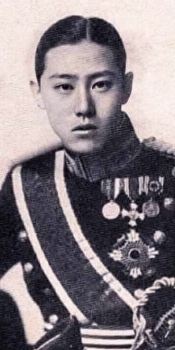
- Colonel Yi U 이우 (李鍝) (Prince, Grandson of Emperor Kojong): He was killed at Hiroshima by the atomic bomb. Two days later, after the funeral for the prince, his adjutant, Lieutenant Colonel Yoshinari Hiroshi (吉成 弘), committed seppuku (ritual suicide) for failing to adequately protect Prince Yi.1 (The picture of Prince Yi U, at the left, indicates that he was awarded the “Grand Cordon of the Order of the Paulownia Flowers.”)
After the annexation of Korea, it was legal for a young Korean to become an officer in the Imperial Japanese Army, but no legal channels existed for doing so. It wasn’t until 1925 that Koreans could actually apply for admission to the preparatory school of the Japanese Army. From then until 1928, there were Korean applicants every year, but not a single Korean was accepted.
In 1932, the Japanese established the puppet regime of Manchukuo in Northern China. To provide the Manchukuo Imperial Army with more reliable troops, military academies 만주국신경륙군군관학교 (滿洲國新京陸軍軍官學校) were established in Mukden 奉天 and in the capital of Hsinking 新京. Attending the Imperial Japanese Army Academy in Japan was impossible without the right connections, so a number of ethnic Koreans saw the Manchukuo military academies as their only opportunity for a military career. Among the Manchukuo Army Academy graduates were South Korean Generals Paik Sun-yup 백선엽 (白善燁, 1920–2020) and Chung Il-kwon 정일권 (丁一權, 1917–1994). The future president of South Korea, Park Chung-hee 박정희 (朴正熙, 1919–1979), was also a graduate of the Manchukuo Imperial Army Academy.
Korean Volunteers for the Japanese Enlisted Ranks
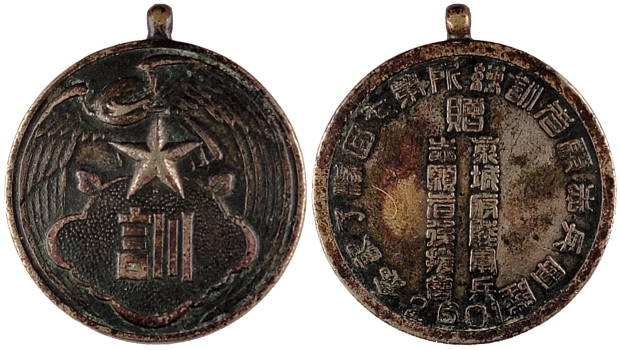
On the obverse is 訓, which is short hand for 訓練所 Training Center.
On the reverse, along the outside rim it has 陸軍兵志願者訓練所第七回修了記念 Army Soldiers Training Center 7th Graduation Commemorative. In the center columns it has 贈 gift, 京城府陸軍 Gyeongseong Prefecture Army and 兵志願者後援會 Soldier Volunteer Support Association.
In 1938, the Japanese Empire launched the National Spiritual Mobilization Movement 國民精神総動員運動, and on September 22 of that year, the Korean Federation 朝鮮聯盟 for National Spiritual Mobilization was formed to support the expropriation of human and material resources. The National Spiritual Mobilization Federation established a wartime system through cooperation on the national policy of the Japanese during wartime, as well as the nationalization of the Korean people and the unification of internal affairs. In 1940, the Chosŏn Federation for National Mobilization was expanded to become the All-In-One Chosŏn Federation.
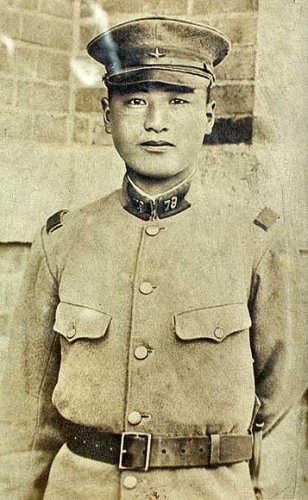
In the early stages of the Second Sino-Japanese War (1937-1945), the Governor General in Korea (GGK) limited Koreans to labor roles supporting the war. The recruitment of enlisted soldiers did not begin until Feb. 22, 1938, when the GGK announced that Korean men could apply for service in the Japanese Imperial Army through the Korean Special Volunteer Soldier System 육군특별지원병제도.2 This was followed 4 years later when the GGK announced the Korean Student Special Volunteer Soldier System, 학도 특별지원병 제도. In May 1943, the GGK announced the creation of the Naval Special Volunteer Soldier System, 해군 특별지원병 제도. Many POW camp guards were not conscripted but volunteered. On May 22, 1942, a system allowing Koreans to apply to be prison guards for American and British prisoners of war was announced. Applicants needed to be between the ages of 20 and 35, have robust bodies and no diseases, have completed at least 4th grade in elementary school, and be able to carry on everyday conversation in Japanese. Many who applied for camp guards felt it was safer than the fighting on the front lines.
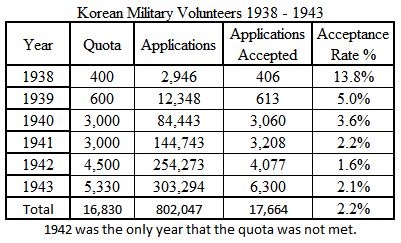
The acceptance rate of volunteers into the Japanese Army was 14% in 1938 but dropped to a 2% acceptance rate in 1943, while the annual number of applicants increased over the same time span (see the chart below). On average, only 2.2% of applicants were accepted into the Army. While these systems were allegedly “volunteer,” it is estimated that only 35% of all applicants were actual volunteers. The Japanese, to save face, coerced the majority of applicants or simply doctored the books. The primary reason that enticed young Koreans to apply to the Japanese army was the extreme poverty faced by the peasants. There are estimates that more than 90% of those who actually did “volunteer” came from peasant families. Other special enticements were also given, which included promises that volunteers were to receive priority for police officer and civil servant jobs as well as other leadership positions after being honorably discharged from the military. In 1938, volunteers had to submit five types of documents: “Applicant Training Camp Admission Application,” “Resume,” “Asset and Income Statements with Certifications,” and a “Physical Fitness Test Sheet.” In 1940, the Governor-General of Korea (GGK), 조선총독 (朝鮮総督), lowered the height and educational requirements. They also reduced the number of documents required to volunteer. The “Asset and Income Statements with Certifications” were deleted. One has to ask if there was such an excess of volunteers, why did the GGK lower the standards?
It was an era where heroes were produced and praised daily. Newspapers of the time were filled with stories of patriotic Koreans. Yi Won-ha 이원하 was a healthy 74-year-old man living in Cheongju, Chungcheong Province 청주, 충청도. He purportedly died on Jan. 26, 1939, under a Japanese flagpole, but what was important was his position. He was purportedly found kneeling and bowing towards the east, where the Emperor of Japan resides. His patriotic story was made into a movie and shown throughout the Korean peninsula. The title was “I Will Die under the Flag” (국기 밑에서 나는 죽으리). Yi Chang-man 이창만 (李昌萬) was a 29-year-old man living in Hoengseong, Gangwon-do 횡성, 강원도. In 1940, he committed suicide when he failed to overcome the high competition rate and was not selected as a volunteer soldier. Corporal Yi In-seok 이인석 was the first Korean volunteer to die while fighting in the Sino-Japanese War. In February 1940, he became the first Korean to be awarded the Order of the Golden Kite 금치훈장 (金鵄勲章). The class is unknown, but purportedly it was a 1st class. In Korea, this order is often called the Gold Decoration 금치장 (金鵄章). Yi In-seok’s birthplace in Okcheon, North Chungcheong Province (옥천, 충북도), became a patriotic pilgrimage site.
Volunteers for the Japanese Imperial Navy were subjected to much higher loyalty standards than the Army because it only takes 1 man to scuttle a ship. The Navy Special Volunteer System, 해군특별지원병제, came into effect in August 1943. There were only two classes, the first lasting 6 months, while the second only lasted 4 months due to the manpower shortages caused by the war.
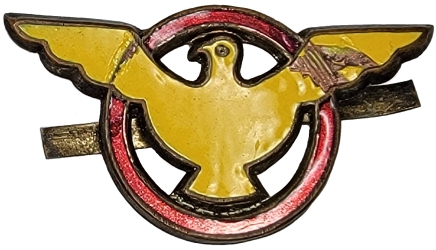
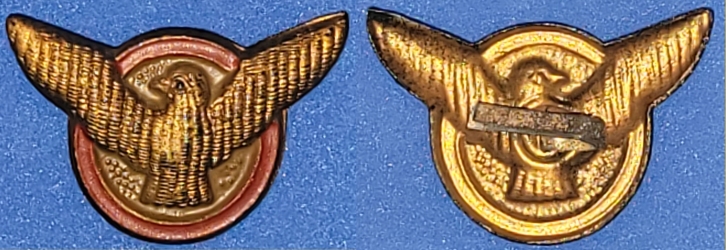
It would appear that the yellow bird with a red circle that goes behind the wings and below the tail feathers was used exclusively in Korea for volunteer badges. Yellow eagles with red circles were used on other Japanese badges. The red circles that go behind or in front of the tail feathers were Japanese Imperial Army paratrooper wings. A solid red sun disc behind the bird is not uncommon.
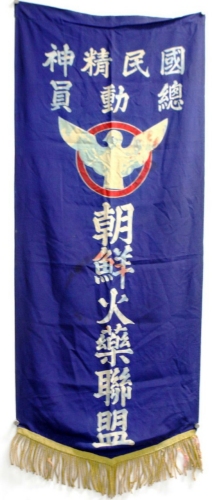
國民精神 總動員 朝鮮火藥聯盟
(국민정신 총동원 조선화약연맹)
“General Mobilization of National Spirit – Chosŏn Explosives Federation”
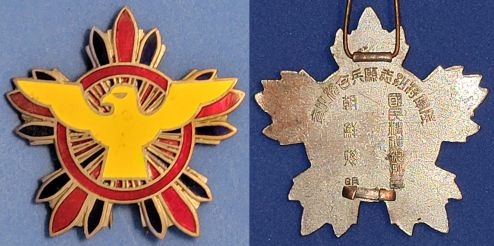
Army Special Volunteer Pass Badge
[Pass as in passed the exam and entered the volunteer training program]
Right Vertical line 國民精柮總動員 Mobilization of National Spirit
Left Vertical Line 朝鮮聯盟 Chosŏn Federation
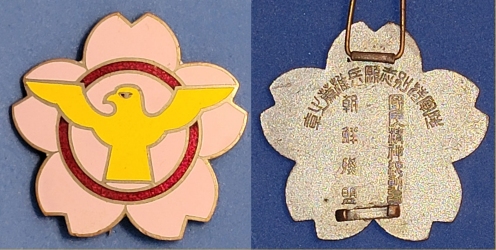
Army Special Support Soldier Reservation Branch
Right Vertical line 國民精神總動員 Mobilization of national spirit
Left Vertical Line 朝鮮聯盟 Chosŏn Federation
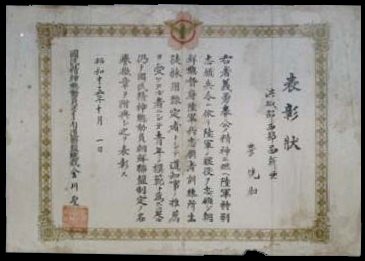
for the Army special Support Soldier Reservation Branch
Photo source: 표창장 -[개화는 침략도구].
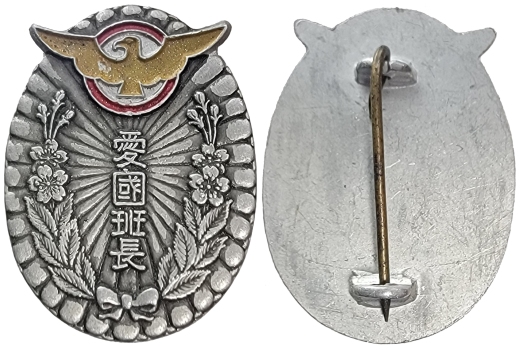
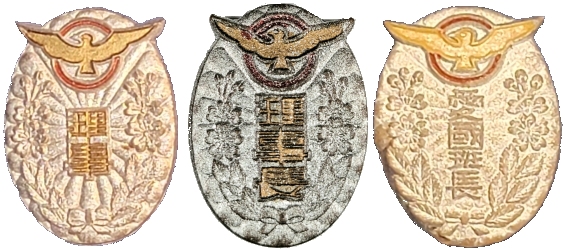
Two Character: 理事 (리사) Councilor.
Three Character Inscription 理事長 (리사장) Chairperson/Chairman.
Four Character: 愛國班長 (애국반장) Patriotic Group Leader.
The two character inscription is the most common.
The Chinese appear to be the first to use papier-mâché beginning about 200 AD, not long after they invented paper.
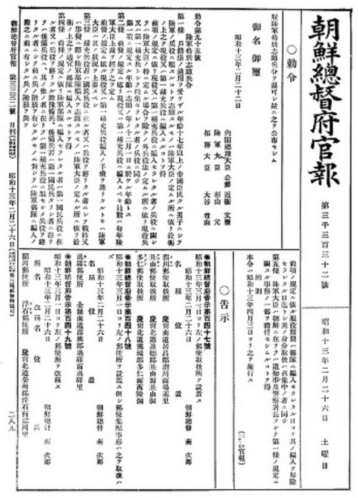
Government-General of Korea Official Gazette, Edict #95, February 26, 1938
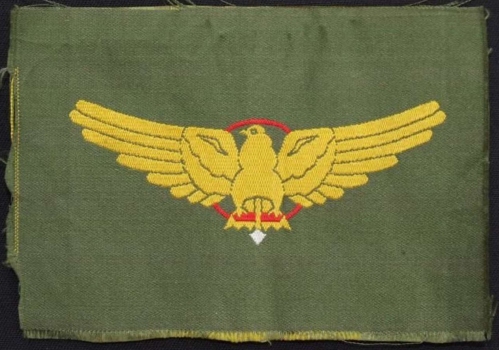
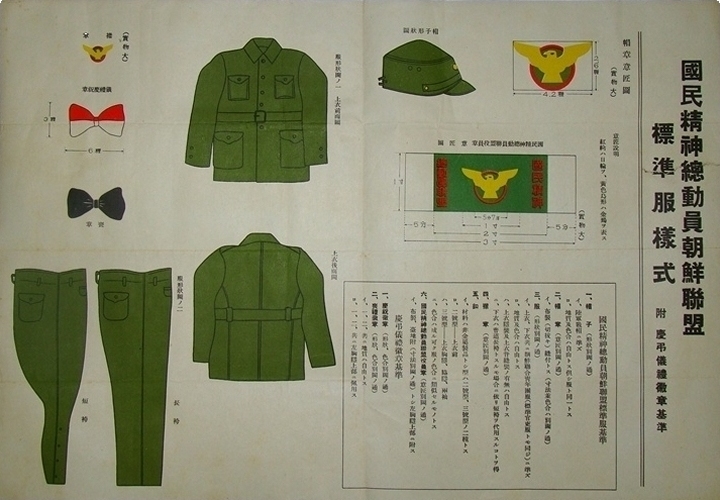
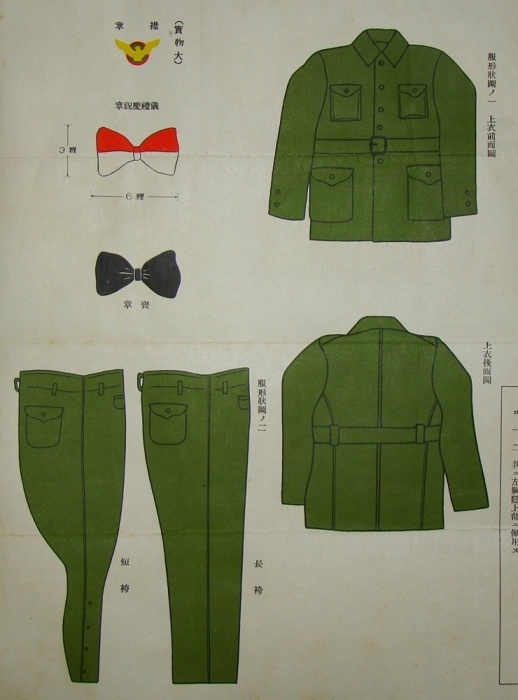
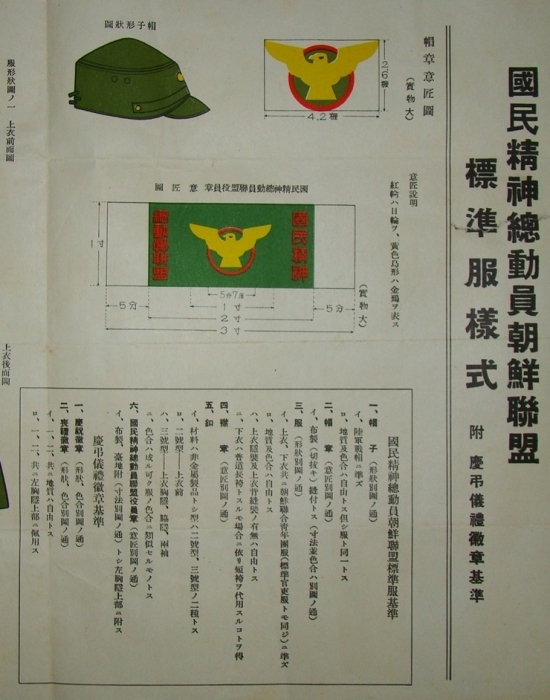
Please see the “Clothing Standards” 標準服樣式 (표준복양식) below. The difference appears to be in the red circle. In paratrooper badges the bottom of the circle is in front or behind the tailfeathers, often with a red perch on which the bird is roosting. In the volunteer badges, the bottom of the circle is below the tail feathers.
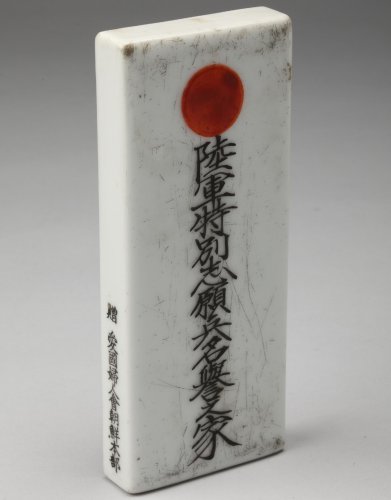
Front Inscription: 陸軍特別志願兵名譽之家 (육군특별지원병명예지가) Army Special Volunteer Home of Honor
There is a similar door plate without the sun symbol and with the 愛國班長 (애국반장) “Patriotic Group Leader” inscription.
Side Inscription: 贈 愛國婦人会朝鮮本部 (증 애국부인회조선본부)
Donated (by) Headquarters of the Chosŏn Patriotic Women’s Association. Ceramic, 16 × 7 cm
Photo source: Korean emuseum
國民精神 總動員 朝鮮聯盟 (국민정신 총동원 조선련맹)
Clothing Standards 標準服樣式 (표준복양식)
Size: 39×27 cm (Enlargements to right)
Japan’s Declaration of War on the United States and Great Britain
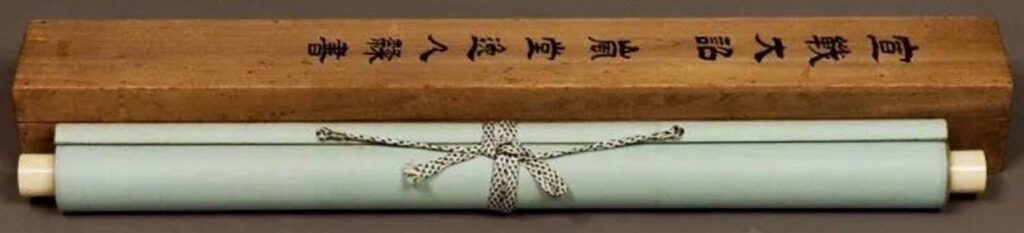
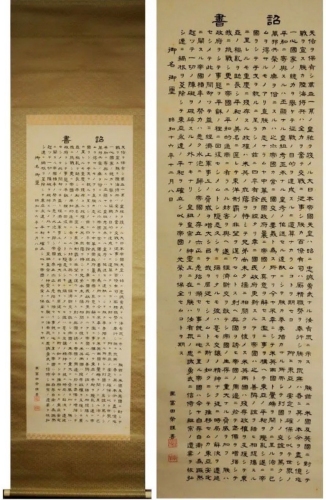
In Japan, on Dec. 8th (Showa 16), the morning of the attack on Pearl Harbor, Emperor Hirohito made a “Declaration of War on the United States and Britain” (米國及英國ニ對スル宣戰ノ詔書).3 It was publicly recited throughout Japan, marking the nation’s official entry into World War II. That evening, it was also printed on the front page of all Japanese newspapers. The newspapers also republished it monthly on the 8th during the war, and it was recited at neighborhood meetings to reinforce support for the conflict. It reaffirmed the national resolve and public support for the war. These practices continued until Japan’s surrender in 1945.
This is an original WWII hanging scroll of the Imperial Japanese “Declaration of War on the United States and Britain” (米國及英國ニ對スル宣戰ノ詔書). The calligraphy was done by Tomita Eigo (冨田栄護, also known as Arandō) in the spring of 1942 (Showa 17). The scroll is a verbatim calligraphic rendering, faithfully reproducing the Imperial Edict (詔勅 Shōchoku). The artist was a respected Japanese calligrapher active during the early Showa era. He produced official works for public and educational displays and was known for his precise brush control and deeply spiritual expression. The edict urged all citizens and soldiers to unite as one for the defense and survival of the empire. It was displayed in schools, government offices, and military institutions throughout wartime Japan as a spiritual and patriotic symbol. The scroll is ink on silk and approx. 204 × 56 cm in overall size with the original wooden storage box, signed and inscribed by the artist. Complete examples with the box and signature are exceptionally rare. This particular example was for sale on eBay and was sold by “Imperial Japanese Store Kamikaze 神風.“
If you are interested in Japanese hanging scrolls, here are a couple of terms you might find useful.
掛軸: (J. Kakejiku) “Hanging scroll.”
掛物: (J. Kakemono) “Hanging thing.”
巻物: (J. Makimono) “Rolled thing,” is a horizontal type of Japanese scroll.
共箱: (J. Tomobako) is a custom-made wooden box used for storing and preserving Japanese artworks. They are more than just protective packaging, and function as a certificate of authenticity for the piece they hold. The tradition of creating and signing these boxes is a long-standing practice that adds to the provenance and value of a work of art. Typically crafted from paulownia wood (J. kiri 桐), which is prized for its low weight, resistance to rot, and ability to prevent warping or cracking. High-end boxes can also be made from other woods like cedar or sometimes be lacquered. The lid or underside of the box is typically inscribed with calligraphy done by the artist or a well-known authority on the subject at hand. This documents the artwork’s details, including its name, the artist’s name and signature, and sometimes the kiln or style. These inscriptions serve as the official certificate of authenticity.
Military Conscription
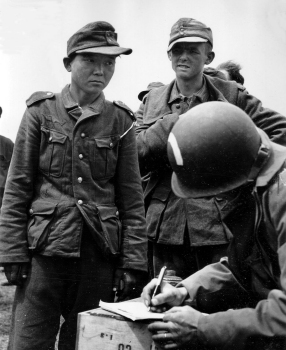
Japan’s attack on Pearl Harbor led to an increased demand for Korean manpower. On May 9, 1942, the Governor General of Korea (GGK) announced that beginning in December 1944, twenty-year-old Korean males would be conscripted into the Japanese military. On October 20, 1943, “Rules for Temporary Recruitment of Special Forces of the Army (Army No. 48)” 육군특별지원병 임시 채용규칙 (육군성령 제48호) was promulgated, and the Student Volunteer Service Act 학도지원병제 was implemented for college students and vocational school students who had previously been exempted from military service. It is believed that between the volunteer soldiers and the conscription systems, the total number of Korean men who served in the Japanese military was 213,719. Some 22,182 of these Korean soldiers were killed during WWII. Several sources state that because of the length of time needed to train recruits, few Koreans were actually sent to the war front before Japan’s surrender in August 1945. Even so, approx. 10.4% were killed in action.
The 20th Division 第20師団 was an army garrison division originally stationed in Yongsan, Seoul, Korea. It was called the “Morning 朝 Division 兵団,” a play on Chosŏn 朝鮮, which is the term that the Japanese used for Korea.4 It was made up of both Japanese and Koreans. In October 1943, the division was transferred to the Japanese 18th Army in the Southern Area Command (New Guinea) until the end of the war. Of the approximately 25,000 men in the 20th Division, only 1,711 survived the war. More men died in New Guinea from malaria and malnutrition than from combat with the Americans or Australians. Of the 1,901 Koreans in the 20th Division, 1,285 were reported as killed in action.
There are various claims that Korean military conscripts were utilized as ‘Bullet Eaters’ 총알 먹는 사람 (食彈者) or ‘Bullet Catchers’ 총알 포수 (子彈捕手). In English, the generally accepted term is “cannon fodder.” They were placed in the front ranks of Japanese Banzai charges or in the rear ranks during strategic withdrawals/retreats. Supposedly without weapons or ammunition because the Japanese did not trust them. Their sole duty was to catch a bullet meant for a Japanese soldier. Thousands of Korean laborers were sent to build fortifications for the Japanese but were also trained to perform combat roles. There are reports that many Japanese did not feel that they could rely on Korean laborers to fight alongside them and, purportedly, on some islands, killed their conscripted laborers when the Americans landed. Some of these claims have been proven spurious. A modern Korean term for cannon fodder is 총알받이 (子彈筒). In English, it can be translated as “Bullet Canister” or “Bullet Bait” or even “Raw Recruit.” All these terms refer to something that is expendable. The U.S. Marines use the term “bullet sponge” for someone who is likely to soak up bullets.
Between volunteers and conscripts, both military and labor, by the end of colonial rule, approximately 12% of Korea’s total population found themselves outside of Korea. For the young males between 20 and 25 years of age, the figure is probably 20 to 25%.5 At the end of the war, 5,400,000 Koreans were directly supporting the Japanese war effort in the civilian sector.
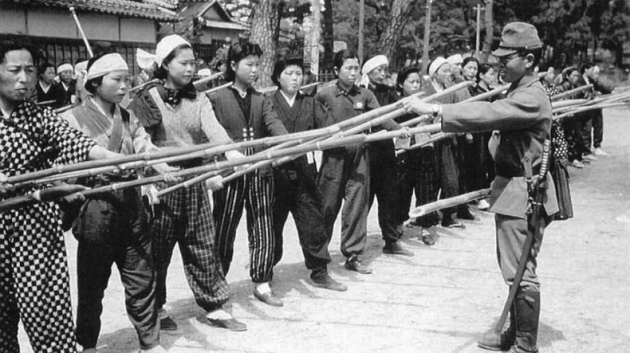
Japanese conscription in WWII began with a standard military draft but expanded drastically as the war progressed. Eventually the age requirements were expanded for males (15-60) and females (17-40). Women were included in the final “National Volunteer Combat Force” 国民義勇戦闘隊 of 1945, which was a civilian militia armed with basic weapons like bamboo spears. The system was a response to mounting military losses and the threat of an Allied invasion, designed to mobilize a massive number of people for homeland defense. At the end of June 1945, some 28 million men and women were considered “combat capable”, but only about 2 million of them had been recruited by the time the war ended.
One of the most famous Korean conscript stories of World War II is that of Yang Kyoung-jong 양경종. He was born in Shin Euijoo, Northwestern Korea, on March 3, 1920. The story starts with his conscription into the Imperial Japanese Kwangtung Army in 1938. He was captured by the Soviet Red Army and claimed that he was a communist who was forcibly conscripted by the Japanese. He was then sent to Russia’s western front to fight the Germans. He was subsequently captured by the German Wehrmacht and sent to France to help construct defenses at Normandy. Purportedly, he told the Germans that he was in the Japanese army and therefore an Axis ally. Then, he was captured by the US Army at Utah Beach on June 6, 1944 (D-Day), imprisoned in England, and then transferred to a POW camp in the United States. Eventually, he became a U.S. citizen, moved to Illinois, got married, had children, and lived there until his death on April 7, 1992. He only told his story to his wife and was never interviewed before his death, so the veracity of his exploits is widely debated.
For a far more exhaustive source of information on this subject, you should read the book “Fighting for the Enemy, Koreans in Japan’s War, 1937-1945,” by Brandon Palmer.6
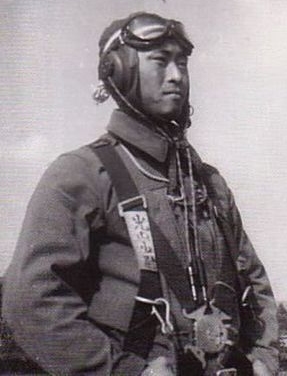
Korean Kamikazes in WWII
Kamikaze translates as ‘Divine Wind.” It originated as the word for the typhoons that stopped a Mongolian invasion of Japan in 1274. Today it has entered the public consciousness as the name for pilots who carried out suicide attacks against American warships. It can also be used to refer to other Japanese “suicide missions,” like the ones in submarines (Kaiten 回天; variously translated as “Change the World”, “Returning to Heaven” or “Heaven-shaker”also Kairyū 海龍; “Sea Dragon”), speedboats (Shin’yō 震洋; “Sea Quake”) and suicide divers (伏龍, Fukuryū; “Crouching Dragons”).7 In Japanese, the formal name for these attackers is “Special Attack Units” (特別攻撃隊, tokubetsu kōgeki tai; often abbreviated to 特攻隊 tokkōtai). In the Battle of Leyte Gulf (October 1944), Japan saw the efficacy of the specialized units, which were able to achieve results with limited resources. Historians generally describe the kamikaze campaign as a failure, since only about 11% of the missions were successful. During the Pacific campaign, American sailors were not familiar with the term “kamikaze” but called suicide pilots “One-Way Charlies.”
Yes, there were Koreans who died as kamikaze pilots. The youngest known Korean kamikaze pilot was a conscripted Korean named Park Dong-hun 박동훈 (Japanese name: Okawa Masaaki 오카와 마사아키). According to one source, on his death on March 29, 1945, he was the first Korean to die as a kamikaze pilot, but that has never been authenticated. The oldest Korean to die on a suicide mission was purportedly only 27. If you are wondering about their Japanese names, under the 1939 and 1940 Soshi-kaimei 創氏改名 (창씨개명) ordinances, Koreans were compelled to create family registries and to take Japanese personal names.8 How many Koreans who are listed as WWII dead under their Japanese names and not their Korean names is unknown. In Japan, there is a museum devoted to the kamikaze. It’s the Chiran Peace Museum for Kamikaze Pilots in Chiran, southern Kyushu’s Kagoshima Prefecture. (There are several Korean blogs that ask, “How do you combine the word ‘peace’ with ‘kamikaze’?”) The museum has identified 1,036 of the estimated 3,900 kamikaze pilots who died in WWII. Eleven of them have been identified as being Korean. There are several information sources that state that at least 17 Korean men were kamikaze pilots, but the Korea Times reports a figure of 16, while the Japan Times says there were 18. The exact number is probably higher. Three of the Koreans known to the museum are listed only by their Japanese names, as their Korean names have not been found. Some of these men may have died as Japanese ultranationalists, but most of them are believed to have been coerced, possibly to secure better living conditions for their families back home. Off Okinawa, the destroyer USS Luce picked up a downed kamikaze pilot who said he was a Korean farmer who’d been conscripted and forced to fly. The South Korean government takes the stand that regardless of circumstances, all Korean kamikaze pilots died because of their patriotism to Japan. Because of this, South Korea refuses to designate Korean kamikaze pilots as colonial-era victims, which denies their families the right to government compensation. At the same time, Japanese kamikaze pilots who could not complete their missions (due to mechanical failure, interception, etc.) were stigmatized after the war for their lack of patriotism. Two sides of the same coin.
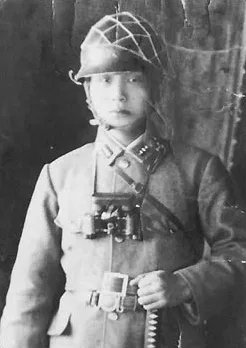
The kamikaze pilot in the picture to your right is Tak Kyung-hyeon 탁경현 (1920-1945 卓庚鉉) (Japanese name Fumihiro Mitsuyama 후미히로 미츠야마). He was coerced into enlisting in 1943. He completed basic training, flight training, and combat training, and on Oct. 1, 1944, he was commissioned a second lieutenant. On May 11, 1945, he was deployed to a special kamikaze attack operation. He sortied at 8 a.m., and a little after 9 a.m., he was shot down over Okinawa. He was posthumously promoted two ranks to captain (大尉). He was 25 years old at the time of his death. There were two movies that drew their inspiration from this kamikaze pilot, Tak Kyung-hyeon.
Rear Admiral Takijiro Onishi 大西 瀧治郎 (1891-1945) is known as the father of the Kamikaze. On Aug. 16, 1945, upon hearing the Emperor’s announcement of Japan’s surrender (the Jeweled Voice Broadcast 玉音放送), he committed seppuku. In his suicide note he apologized for all the pilots that he had sent to their deaths. To emphasize that point, he did not use the traditional kaishaku (介錯) and lingered in agony for fifteen hours. 9 An interesting little side note: Seppuku was officially banned as a judicial punishment by the Japanese Government in 1873.
Labor Conscription or Labor Requisition
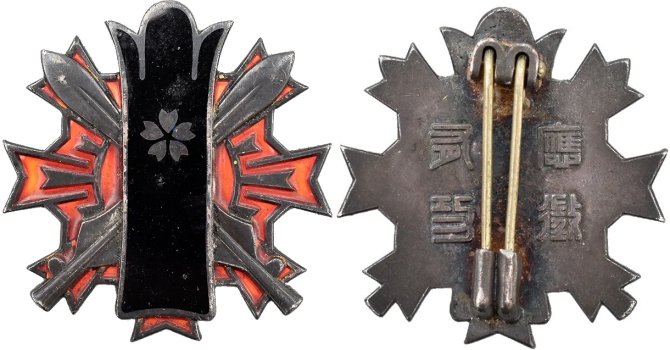
The Reverse Inscription, in Seal Script reads:
應徴 Requisitioned (Lit. Responding to requisition)
and 有功 Merit
There is another type with no enamel and with a reverse inscription of simply 應徴 Requisitioned (Lit. Responding to requisition). These were issued to those who had successfully completed their service.
Photo courtesy of Medals of Asia Website
At the onset of the Second Sino-Japanese War in 1937, Japan had not yet transitioned to a wartime economy, and many civilian sectors were outside of government control. In April 1938, Prime Minister Fumimaro Konoe 近衞 文麿 pushed for the enactment of the National Mobilization Act 国家総動員法.10 Despite heavy domestic opposition but with strong pressure from the military, the law was passed on March 24, 1938, and took effect on May 5th. The act declared a state of emergency and allowed the central government to control all manpower, material, and the rationing of raw materials in the Japanese market. The National Service Draft Ordinance, 国民徴用令 (Imperial Ordinance No. 451), also known as the National Requisition Ordinance, was issued on July 8, 1939. This imperial edict went into effect on July 15th and was applied to Japan, Sakhalin, Taiwan, and Korea; however, in Korea, it did not go into effect until Oct. 1, 1939. This ordinance was a supplemental law also promulgated by Prime Minister Konoe. It gave the Minister of Health and Welfare the power to forcibly conscript personnel to ensure an adequate supply of labor for strategic war industries. The only exceptions allowed were for cases of physical or mental disability. The Japanese often skew the numbers of conscripted laborers in their favor, but the same can be said of the Koreans. Some Korean workers were mobilized through a recruitment process that started in September 1939 and continued until January 1942. The Japanese list these workers as volunteers and not as conscripted workers, while the Koreans consider these workers to have been forced into the recruitment process. Many other Koreans were classified as émigrés, with Japanese claims that many of these individuals intended to be with family members already established in Japan. But regardless of their status, Koreans were severely limited in their choice of work. The Japanese government tried to direct the flow of Korean workers primarily to the coal and metal mines and even to the bauxite mines in Palau (Micronesia). The South Korean Truth Commission on Forced Mobilization announced in February 2010 that most of the 6,000 Korean conscripts mobilized to Micronesia between 1939 and 1941 died before the war’s end.
Legally binding conscription began in Korea in September 1944, when the Japanese began using conscription warrants issued for specific individuals. The program was organized under the Ministry of Welfare, and at its peak, 1,600,000 men and women were conscripted, and 4,500,000 existing workers were reclassified as conscripted workers. Conscripted workers were not allowed to quit their jobs. Eighteen of the fifty articles within the law outlined penalties for violations. By the end of 1938, a year before the start of the wartime mobilization of Koreans, 800,000 Koreans were living in Japan. At the end of 1944, there were 1,911,409 Koreans in mainland Japan (excluding Karafuto Prefecture, present-day Sakhalin, Russia). Some sources claim that there were 6.16 million conscripted workers at the end of World War II, which included Japanese, Koreans, Chinese, and possibly military POWs. Some ordinances had long-term effects on the Japanese economy, resulting in policies such as lifetime employment and the implementation of the “seniority wage” system. After the surrender of Japan, ending World War II, the National Mobilization Act and the National Service Draft Ordinance were abolished under Law #44 on December 20, 1945, by the American occupation authorities. The hardships endured by the conscripted Koreans did not end with liberation. After its defeat, Japan did not assist any Koreans wanting to return home.
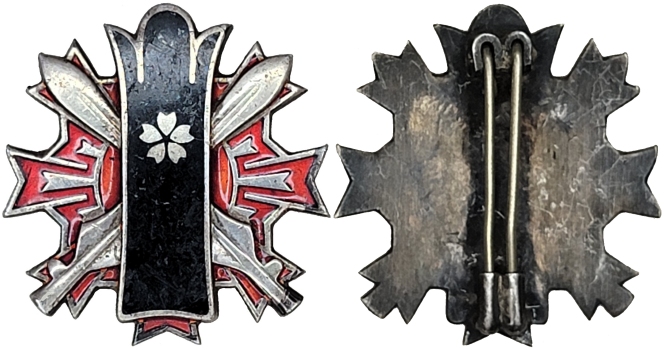
The Inscription on Reverse has been ground off. Why?
30 x 30 mm
Honouliuli National Historical Site, near the town of Waipahu on the Hawaiian island of O’ahu, was a World War II internment camp for Japanese Americans. The camp also served as a home for approximately 2,700 Korean prisoners of war. These were mostly non-combatant civilian laborers who had been forced to work for the Japanese war effort and were captured during the Pacific Islands campaign. The last of the Korean POWs was repatriated back to Korea in December of 1945.11
The conscripted labor program had no symbol for the first 4 years of its existence and only received an emblem in August 1943. The Conscripted Worker’s Patch was instituted on Aug. 10, 1943. The Conscripted Worker’s Badge 応徴士徽章 (응징사휘장) was instituted six months later on Feb. 26, 1944, by Japan’s Ministry of Welfare. It was given to workers conscripted into wartime production service. In a factory consisting of regular employees as well as conscripted workers, only the latter were allowed to wear this insignia, which was to be worn on the left chest of the work uniform. Many Koreans refer to the wartime mobilization based on the laws of the time as an inhumane form of “slave labor.” It is not surprising that many Koreans treat this insignia in a manner similar to the way that Jews treat the Star of David patches of Nazi Germany. However, it was worn by both Japanese and Koreans alike. This badge is often described as a Civilian Wound Badge. The badge has nothing to do with having been wounded or being a reservist. It is in the same league as the kamikaze headbands for female student factory workers.
On June 22, 1965, the “Treaty on Basic Relations Between the Republic of Korea and Japan” 한일기본조약 (韓日基本條約) was signed, and it was ratified on August 14 by the Korean National Assembly. This treaty normalized the diplomatic relations between South Korea and Japan. Japan paid South Korea 300 million dollars with no strings attached in accordance with the Agreement Concerning the Settlement of Problems in Regard to Property and Claims and Economic Cooperation. The treaty also gave $200 million to Korea in low-interest loans as a ‘reparation fee.’ With this payment, both countries confirmed that all post-war claims, including those of Koreans who participated in wartime mobilization, had been settled “completely and finally.” Interestingly enough, Japan initially had offered individual compensation, but the South Korean government rejected the offer. Of the $300 million, only about 2% went to the victims. The treaty has always been a source of derision within Korea. During the negotiations, the Park Chung-hee regime declared martial law to suppress dissenting voices. Korea did not disclose to the public that Japan’s personal compensation was to be used for infrastructure investment. This later created a rift in Korea-Japan relations due to differences of opinion on compensation claims. The subject of “Wartime Conscripted Labor” is a hot potato topic between Japan and Korea. There has been a constant call from the South Korean public that Japan should compensate Korean individuals who suffered from Japanese colonial rule. Lawsuits have been filed in Korean courts. In October 2018, the Supreme Court of Korea issued a ruling that ordered Mitsubishi Heavy to compensate the victims of forced labor. The company has not done so, with Japan arguing the matter was settled under the 1965 treaty. The Japanese Government has maintained that this ruling, along with the one made on Japan’s position in relation to the Korean comfort women (‘forced sexual slavery’) in January 2021, is a breach of the 1965 treaty. The U.N. Commission on Human Rights has advocated the South Korean government’s perspective by defining that the comfort women issue is a matter of human rights; the 1965 treaty only regulated property claims and not personal damages. North Korea claims that the Korea-Japan Basic Treaty is null and void as it was concluded between South Korea, a so-called “puppet” of the United States, and Japan, a “colonial power.” This primary opposition from the North is because the Korea-Japan Basic Treaty recognizes the Republic of Korea as the only legitimate government on the peninsula.
In March 2023, South Korean Foreign Minister Park Jin announced that the South Korean government would compensate those individuals who worked as conscripted wartime labor for the Japanese. The government plan is to take money from major South Korean companies that benefited from a 1965 reparations deal with Tokyo and use it to compensate the victims and their families. As a result of the announcement, there have been a number of South Korean protests.
On Jan. 22, 2008, the remains of 101 Korean military conscripts killed in nearly a dozen countries were returned to South Korea from Yutenji Temple in Tokyo. Another 1,034 sets of Korean bones are still stored at Yutenji Temple and are slated to be returned later in the year to South Korea and, perhaps, subsequently, to North Korea, the ancestral home of 431 of the war dead. The remains belong mostly to military conscripts killed on overseas battlefields, but they include civilians (some of them women and children) who died in the sinking of the Ukishima Maru 浮島丸 transport ship.12 In 2017/18, the remains of 101 Korean conscript laborers were returned to Korea. It is believed that another 200 sets of remains are currently in Japan.
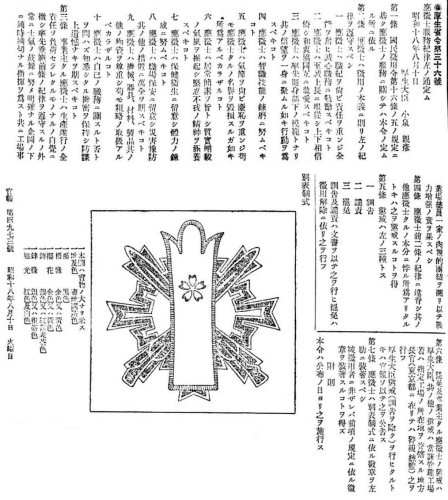
Japanese Government Gazette, Aug. 10, 1943.
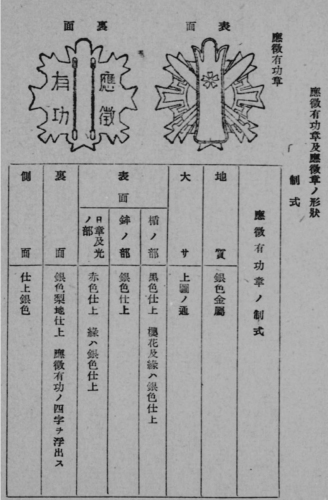
Photo courtesy of Medals of Asia Website
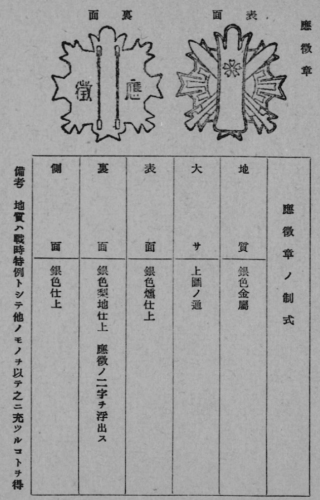
Photo courtesy of Medals of Asia Website
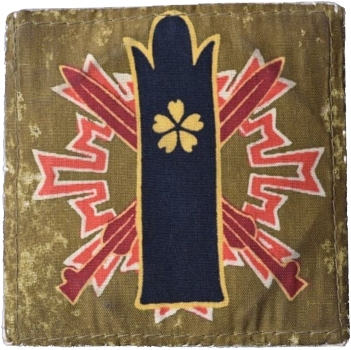
These patches worn on the left chest were ordered by the National Requisition Support Society 国民徴用援護会 and were issued to the workers starting in October 1943.
Photo courtesy of Medals of Asia Website
“Comfort Women”
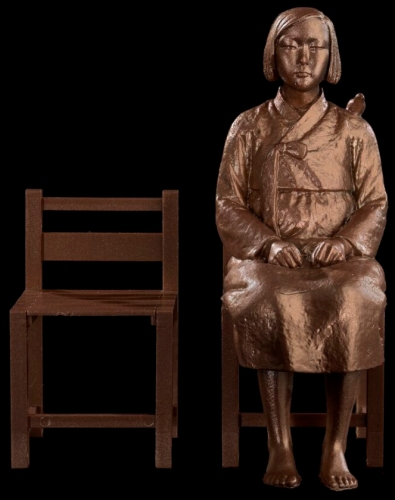
A quick distinction needs to be made. The “Spirit Labor Corps” 근로정신대 (勤勞挺身隊) refers to women who were conscripted by the Japanese government and forced to perform ordinary labor, whereas the Japanese military “comfort women” 慰安婦 (위안부) refers to women who were forced to perform sexual acts instead of ordinary labor. The “Spirit” 挺身 (정신) in “Spirit Labor Corps” means “to stand up, to take the lead, and to lead.”
“Comfort women” 慰安婦 (위안부) is a euphemism for the estimated 400,000 girls and women who were forced into sexual slavery by the Imperial Japanese military. The military brothels were known as “comfort stations” before and during World War II (1932–1945). The Japanese dictionary “Kojien” 廣辭苑 defines comfort women as “women who accompanied the army to the battlefield to comfort officers and soldiers”, but most historians define comfort women as “women who were forced to serve as sexual slaves of the Japanese military.”
In 1919, when the Japanese army was dispatched to Siberia, one of the seven divisions became disabled due to venereal diseases. The Japanese military did not want a repeat. In November 1931, after the Manchurian Incident, the Japanese Navy designated four brothels operated by Japanese residents in Hongkou, Shanghai 上海虹口, as special “comfort stations” for Japanese Navy personnel. Among them, “Daichi Salon” 大一沙龍 was the world’s first Japanese military comfort station and also the longest-lasting. The other three were “小松亭” (소송정) Sosongjeong, “永樂館” (영악관) Yeongakkwan, and “三好館” (삼호관) Samhokwan. In December 1937, after the Japanese army occupied Nanjing, there were numerous sexual assaults, which made the Chinese people more hostile towards Japan. At the same time, international public opinion was very vocal in condemning Japan. As a result, Japan began to widely promote the Shanghai (brothel) model in China, marking the formal formation of the comfort women system. The system was established with the stated aims of reducing wartime rape and the spread of venereal diseases among soldiers and preventing intelligence leaks to civilians in private brothels. The Japanese Ministry of Foreign Affairs resisted the issuance of travel visas for Japanese prostitutes, feeling it tarnished the image of the Japanese Empire. The comfort station system ultimately constituted institutionalized sexual slavery with horrific human rights abuses. It is the largest case of government-sponsored human trafficking and sexual slavery in modern history.
The women were often recruited through deception, such as false promises of factory work or nursing jobs, or were outright abducted and coerced by Japanese soldiers and civilian brokers. These civilian brokers were often the victims’ own countrymen. The women came from countries and regions occupied by or under Japanese colonial rule, primarily Korea and China, but also the Philippines, Indonesia, Malaysia, Taiwan, Burma, Thailand, and included some Dutch and Australian women. Once in the comfort stations, the women were subjected to brutal conditions, including repeated rapes (10 to 50 soldiers daily), physical and psychological abuse, starvation, and forced abortions. Many died during the war from mistreatment, botched abortions, disease, or suicide. Medical care for the women was sporadic and cursory.
For decades after the war, the issue was largely kept silent due to the victims’ shame and societal stigma. The plight of the “comfort women” only came to international attention when survivors began speaking out publicly in the early 1990s, with Kim Hak-sun, a Korean woman, being the first to do so in 1991.
In 1993, Japan issued the “Kono Statement,” acknowledging the military’s involvement in the comfort stations and apologizing to the victims. On August 31, 1994, the Japanese Prime Minister Tomiichi Murayama’s government issued a statement apologizing to the comfort women. In addition, in 1996, Prime Minister Ryutaro Hashimoto also sent a letter of apology to the comfort women. However, subsequent Japanese administrations and some public figures have at times appeared to question or backtrack on the sincerity of this apology and the extent of state coercion, leading to continued criticism from the survivors and their advocates. Furthermore, Japan claims that the issue had been legally resolved through “The Treaty of Peace with Japan” (日本国との平和条約, San Francisco, Sept. 8, 1951) and various other treaties such as the “Treaty on Basic Relations between the Republic of Korea and Japan” (大韓民國-日本國間-基本關係-關-條約, June 22, 1965). Survivors and human rights organizations argue the claims were not fully settled because the women were not included in the original treaty negotiations. They demand a formal, state-sponsored apology that accepts full legal responsibility, direct government compensation, and the accurate teaching of this history in Japanese textbooks.
There is a weekly protest led by “Korean Women’s Council for Military Sex Slaves Conscripted by Japan” 일본에 의해 징집된 군사 성노예를 위한 한국 여성 협의회, commonly referred to as the Korean Council. The demonstrations take place at noon every Wednesday, at the busiest time of the day, across the street from the Japanese Embassy. The first demonstration was held on January 8, 1992, for the visit of then Prime Minister of Japan Kiichi Miyazawa. The only Wednesday protest that has been missed was during the Kobe earthquake in Japan in 1995. The Wednesday demonstration was listed in March 2002 in the Guinness Book of Records as the world’s oldest rally on a single theme.
The issue remains a contentious diplomatic and historical dispute.
Memorials have been erected in cities worldwide to commemorate the victims and educate the public about human trafficking and sexual violence during wartime.
A Woman Labor Conscript
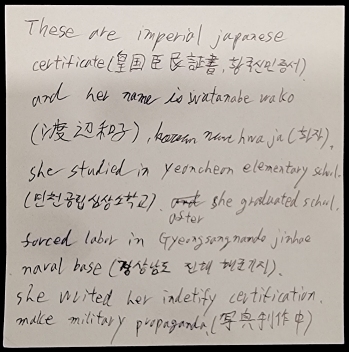
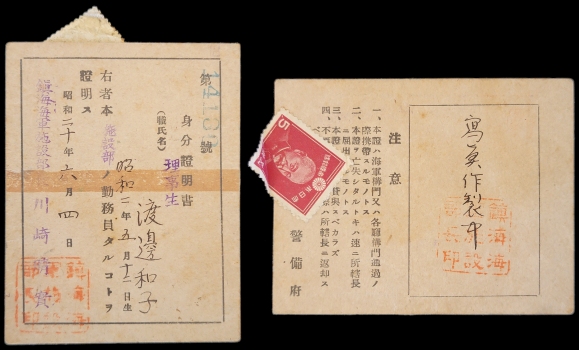
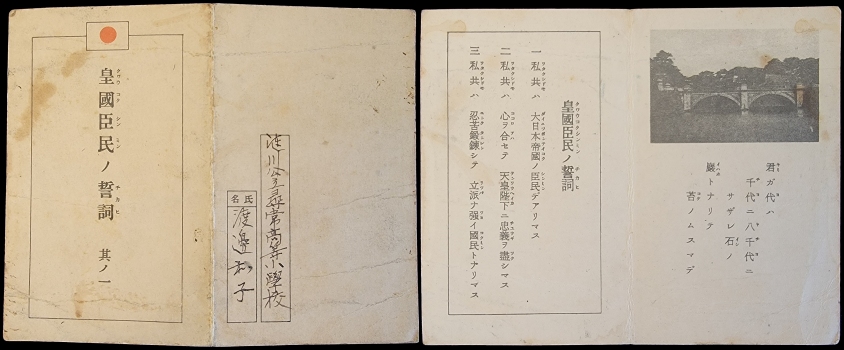
This collection was the property of a Korean woman who was conscripted by the Japanese to work in a military-related facility. Under Sōshi-kaimei 創氏改名 (일본식 성명 강요, 창씨개명), she was required to change her Korean name to a Japanese name.13 Her Japanese name was Watanabe Wako 渡邊和子 (도변화자). Her Korean given name was Hwa-Ja (화자), but unfortunately we do not know her family name, but it may have been Yu or Ryu (유 or 류). She graduated from Yeoncheon Elementary School 연천공립심상초학교 (漣川公立尋常小學校). At 18 years old, she found herself conscripted to work at the Japanese Naval Shipyard 海軍基地 (해군기지) in Jinhae 진해, Gyeongsangnam Province 경상남도, where she was assigned to produce photographic materials to be used for military propaganda.
This collection includes a number of items:
- Notes, purportedly from her family.
- Her Identification Card 身分證明書 (신분증명서). It was signed by her on June 4, 1945 昭和二十年六月四日, and it shows her date of birth as May 20, 1927 (昭和二年五月十二日).
- A card with the ‘Oath of the Imperial Subjects Part 1’ 皇國臣民ノ誓詞 其ノ一 and signed by her on the back side.
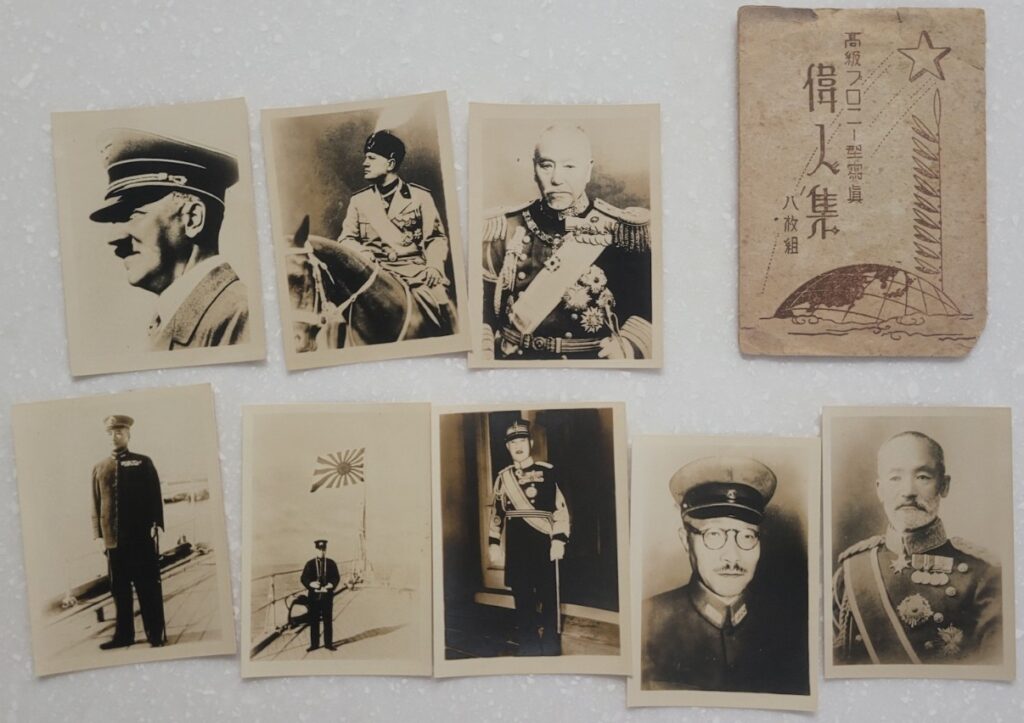
- Picture collection of Great Men 偉人集. The collection includes eight pictures of great men and includes photographs of Adolf Hitler (1889–1945) and Benito Mussolini (1883–1945).
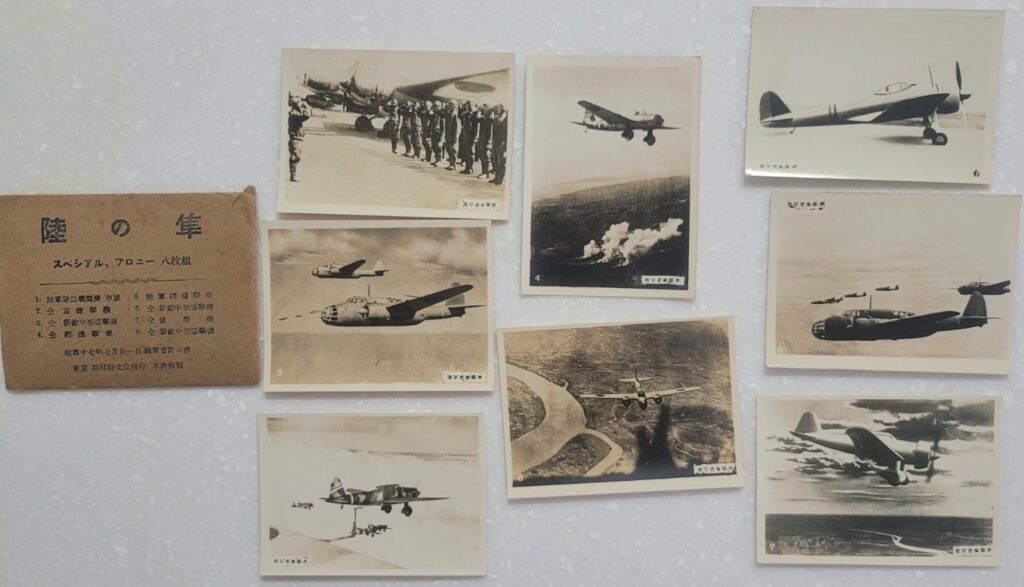
- Picture collection of Land Falcon (Airplanes) 陸の隼.14 The collection contains eight pictures of Japanese military aircraft.
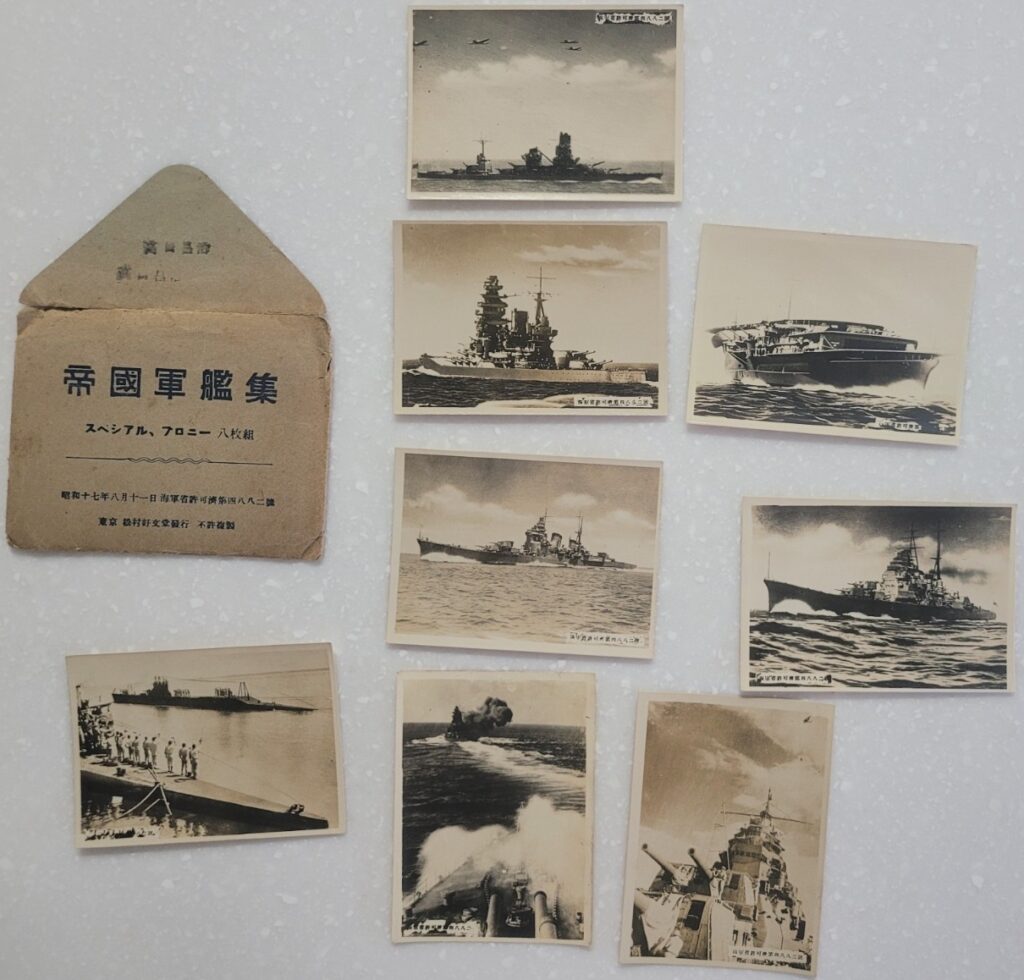
- Picture collection of Imperial Warships 帝國軍艦集. The collection contains eight pictures of the Japanese Navy.
Koreans in the United States
Korea started to come under Japanese colonial rule in 1905, and a fair number of Koreans emigrated for new opportunities, financial reasons, political freedom, or to simply escape Japanese oppression. On March 23, 1908, the pro-Japanese diplomat Durham White Stevens 수지분 (須知芬 or 須知分; 1851–1908)15 was assassinated in San Francisco by two Korean immigrants, Jang In-hwan 장인환 (張仁煥; 1875-1930)16 and Jeon Myeong-un 전명운 (田明雲; 1884-1947)17. Korean organizations in both Hawaii and on the US mainland saw the need to protect the rights of the two alleged assailants. On October 30, 1908, a meeting was held to discuss the unification of the various Korean organizations, and on Feb. 1, 1909, the Korean National Association (KNA) 대한인국민회 (大韓人國民會) was founded in San Francisco. In addition to the national headquarters in San Francisco, there were regional centers in Honolulu, Hawaii; Mexico City, Mexico; and Havana, Cuba (founded June 14, 1921). In 1914, Ahn Chang-ho, 안창호 (安昌浩; 1878-1938), was elected president of the Central General Assembly.18 The KNA was put to the test on June 13, 1914, when a group of Korean Americans working at a farm in Hemet, California, was attacked by locals who didn’t want Asians working in the area. Initially, the Japanese consulate interceded on behalf of the Korean immigrants, but that caused outrage within the Korean American community. David Lee, the president of the North American branch of the KNA, sent a telegram to US Secretary of State William Jennings Bryan (1860-1925), requesting that the Japanese government no longer represent Koreans in America. Bryan was a fierce opponent of imperialism, especially American imperialism, and despite pressure from Japanese diplomats in Washington, DC, Bryan ruled in the KNA’s favor. After which, matters pertaining to Korean immigrants or students were handled by the KNA. Because of demographic changes within the Korean American population, it was deemed necessary to move the KNA Headquarters to Los Angeles. A fundraiser was officially started on Dec. 27, 1936, and the opening ceremony for their new building at 1368 West Jefferson Boulevard, Los Angeles, was held on April 17, 1938.19
Ahn Chang-ho was posthumously awarded the Order of National Foundation, Jung Jang 중장 (重章) Medal on Mar. 1, 1962. In 1967 this 1st Class award was renamed the ‘Republic of Korea’ Class 대한민국장. His wife, Helen Ahn (née Lee) 이혜련 (李惠鍊; 1884-1969), was awarded the Order of National Foundation, National Class 건국훈장 애족장, on Aug. 15, 2008. Ahn Chang-ho’s family home was relocated and renovated and sits today on the campus of the University of Southern California, Los Angeles, CA. Both Jang In-hwan and Jeon Myeong-un would also receive posthumous awards of the Order of National Foundation on Mar. 1, 1962. They received the Bok Jang 건국훈장 복장 (複章) class. In 1967, this 2nd Class award was renamed the ‘Presidential Class’ 대통령장.
Because of Japanese colonial rule, Koreans in the United States were officially Japanese citizens, but, because of lobbying by the Korean American community, Koreans could select “Korean” on the 1920 and later U.S. censuses.20 The 1940 census showed a Korean population of 8,652 (6,851 in the territory of Hawaii and 1,711 living in the continental United States.) Since the census allowed Koreans to identify their ethnicity as Korean, they were not subject to internment during World War II.21 Following the Cairo Conference (Nov. 22–26, 1943), the government issued U.S. Military Order No. 45 on December 4, 1943. It officially removed Koreans from the “Enemy Alien” status. This alleviated some of the restrictions and discrimination they faced earlier in the war.
In April 1941, the United Korean Committee (UKC; 한미협회) was formed to unify all Korean groups in the United States and Hawaii. With the union of nine organizations, it became the single largest independence movement organization in the Korean American community. Ahn Chang-ho 安致三 (안치삼) was a key player in its formation. The UKC mandate was to support both the Korean Provisional Government (KPG) in China and Syngman Rhee 李承晩 (이승만), who was director of the KPG’s Korean Commission in Washington, D.C. The ultimate goal of the UKC was to ensure Korean independence.
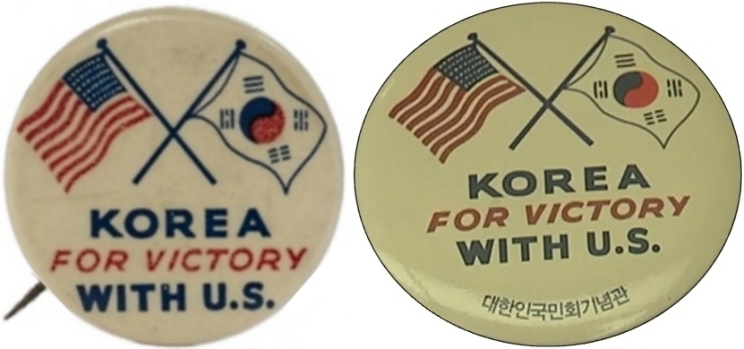
After the Japanese surprise attack on Pearl Harbor 진주만 해군기지, the UKC made it clear that the Korean American community would support the United States in their war against Japan. With the declaration of war, Korean Americans faced a very real threat of violence if mistaken for Japanese nationals. The UKC began a campaign to publicly distinguish Koreans from Japanese Americans. They issued buttons reading “Korea for Victory with U.S.” as well as car decals and identification cards. The Los Angeles office of the UKC issued numbered identification cards. I have seen pictures of numbered “Korea” buttons, purportedly issued by the UKC, but I have not been able to connect the numbered buttons to the numbered identity cards. The identification cards were not ‘official’ forms of documentation, and many Korean Americans were subjected to arbitrary stops and questioning by authorities. In the Los Angeles Herald Examiner Photo Collection at the Los Angeles Public Library, there is a picture showing the lapel button, the auto sticker, and the front and back of the pocket identification card. Unfortunately, the cost to use the picture on this website is far too exorbitant.
The United Korean Committee also established a National Defense Department within its executive branch and, on Dec. 22, 1941, submitted a plan to form a Korean National Defense Corps as part of the U.S. Army Command. Approval was obtained from the army, and recruitment began, with the first batch of approximately 50 applicants being handed over to the California State Guard on December 29. A further 100 applicants were recruited to form the Tiger Unit 맹호군, and the Korean National Defense Corps was established on February 15, 1942. Shortly after its formation, on February 20th, the unit received approval from the Korean Provisional Government in China and held its first military parade during the March 1st Independence Movement Day ceremonies. Although the Korean Guard Unit was “established,” it was not officially launched until April 26th, when it received its certificate of authorization from the state of California. Unfortunately, they were too late to participate in the Battle of Los Angeles (February 24/25, 1942). The unit drilled outside the Exposition Park Armory and consisted of 109 enlistees, which was purportedly one-fifth of the male Korean population in Los Angeles at the time.22 Jeon Myeong-un, who was involved in the assassination of Durham White Stevens, voluntarily enlisted in the Korean Defense Tiger Unit. There is a distinction between the California State Guard and the California National Guard. One is a “state only” military force, while the other can be federalized by the U.S. government. The U.S. has 19 active state defense forces. As authorized by federal law, the state defense forces report only to their respective governors and not to the president.
The committee encouraged Korean Americans to support the U.S. war effort. Women were actively encouraged to assist the Red Cross by whatever means possible. The UKC also organized U.S. War Bond Campaigns and raised $840,000 for the American war effort. That is a considerable amount of money, considering that in 1942, the average weekly wage across all workers in private industry was approximately $32.58.
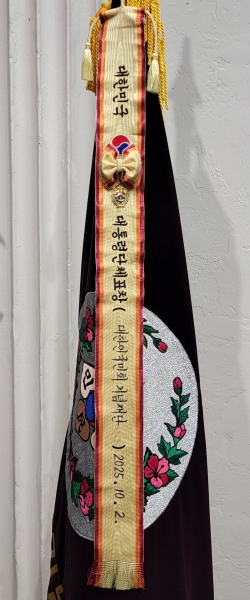
대한민국 대통령단체표창 (대한인국민회 기념재단) 2025.10.2.
Republic of Korea Presidential Group Citation (Korean National Association Memorial Foundation) 2025.10.2.
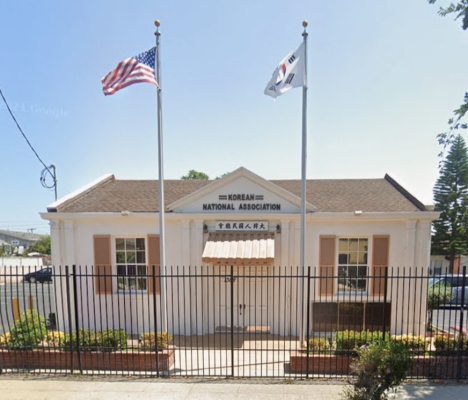
During a renovation of the building, it was discovered that 18,150 pages of material had been stored in the attic crawlspace. These items were digitized by USC before being shipped to the Independence Hall 독립기념관 (獨立紀念館) in Cheonan, South Chungcheong Province, Korea.
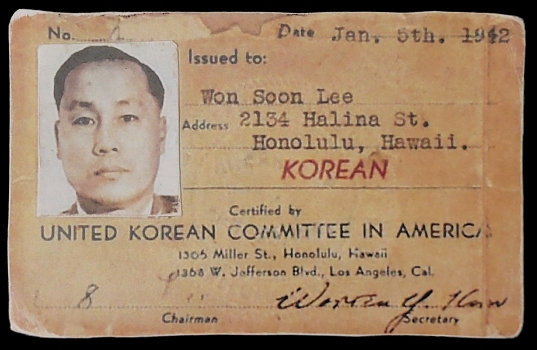
The UKC issued “numbered” identification cards, and I have seen very poor quality pictures of numbered “Korea” buttons, with crossed Korean and American flags, that were purportedly issued by the UKC. But I have not been able to connect the numbered buttons to the numbered identity cards. Nor have I been able to get good pictures of the “Korea” buttons.
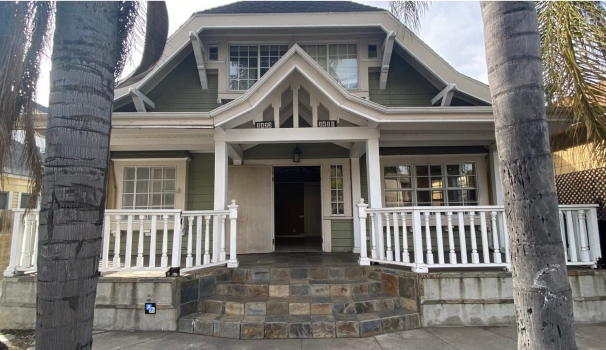
Young Korean Academy 흥사단
While not an imposing structure, the property at 3421-3423 South Catalina Street in Los Angeles is historically significant. It was once the headquarters of the Young Korean Academy 흥사단 (興士團; literally, “reformed Confucian scholars”). It was the first permanent location for the influential Korean independence movement organization founded by Dosan Ahn Chang Ho and served as a civic, cultural, and housing hub for Korean immigrants from the 1930s to the 1970s.
The Young Korea Academy (YKA) was originally established in San Francisco in 1913 but moved to Los Angeles in 1915 and was headquartered in Ahn’s home. In 1929 the YKA leased and relocated to 3421 S. Catalina St. near USC. Two years later, in 1931, the YKA purchased the Catalina St. property for $2,500, and it remained their headquarters until 1948, when the organization moved to Seoul, Korea. It is now owned by the Ministry of Patriots and Veterans Affairs of the Republic of Korea (MPVA), which purchased the property in Jan. 2023 for $2.95 million. Plans are underway to develop the property as a Korean community center, with completion scheduled for 2026. In 2023 the building was designated as Los Angeles Historic-Cultural Monument No. 1274 and is now a rare surviving example of early Korean American institutions in Los Angeles.
The property is located just 0.2 miles from the Korean National Association Memorial at 1368 West Jefferson Boulevard.
The Ahn Family
During WWII, the Korean independence activist Ahn Chang-ho 안창호 (安昌浩, 1878-1938) had 3 children who served in the U.S. military. Susan Ahn Cuddy 안수산 (安繡山, 1915-2015) became the first Korean-American woman in the U.S. Navy, eventually reaching the rank of lieutenant and becoming the Navy’s first female gunnery officer. Her brother Philip Ahn 안필립 (安必立, 1905-1978) joined the Army, while another brother, Ralph Ahn 안필영 (安必英, 1926-2022), joined the Navy. The family fully understood that Japan was responsible for the imprisonment and death of their father.
Both Philip and Ralph went on to have successful careers as actors. As a civilian, Susan Ahn Cuddy worked as an intelligence analyst and section chief at the National Security Agency during the Cold War. She led over 300 experts in Russian affairs and managed top-secret Defense Department projects.
To indicate the family’s role in the Korean struggle for independence, the father, Ahn Chang-ho, was posthumously awarded the Korean Order of Merit for National Foundation 건국훈장 (建國勳章), Republic of Korea Medal 대한민국장 (大韓民國章) (a 1st Class) in 1968. His wife, Helen Ahn (née Lee, 이혜련, 李惠鍊, 1884–1969), was posthumously awarded the Order of Merit for National Foundation 건국훈장 (建國勳章), Independent Class 독립장 (獨立章) (a 3rd Class) in 2008.
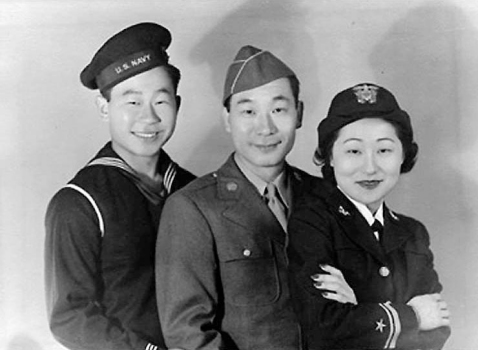
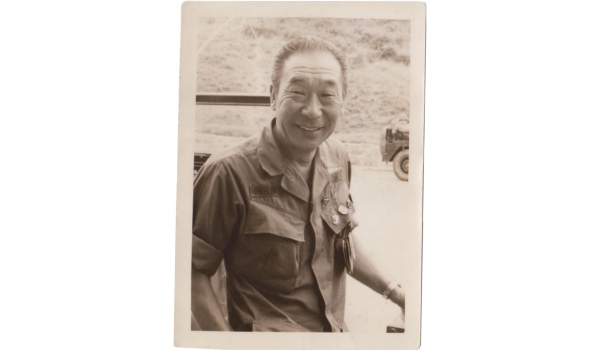
Philip Ahn was born in Los Angeles and is widely considered the first American-born child of Korean parents. He is also widely regarded as the first Korean American film actor in Hollywood and the first Asian American to receive a star on the Hollywood Walk of Fame.
During World War II, Ahn often played Japanese villains in war films, and received several death threats in the process.23 Late in WWII, he enlisted in the U.S. Army and served in the Special Services division as an entertainer. During the Korean War he served as an Interpreter & Liaison officer. Ahn worked for the U.S. Army’s 17th Regiment and in 1951 he joined the Korean army and served as a lieutenant in the liaison corps, where he interpreted for the Korean Military Advisory Group (KMAG). The picture above was taken in July 1968, when Ahn made a USO tour to South Vietnam, visiting both American and South Korean troops.
Ahn was actively involved in the Korean-American community of Los Angeles.
The Aftermath of World War II
Following World War II, war crimes trials were held throughout Asia. Some 5,700 Class-B/C Japanese war criminals were charged with abusing and torturing civilians and war prisoners. Approximately 900 were executed. During the war, Japan recruited approx. 3,000 Koreans as prisoner-of-war guards and assigned them to prison camps in the Philippines, Thailand, Malaysia, and Java. Among those prosecuted for war crimes were 148 Koreans, of whom 23 were executed. There are unconfirmed stories that during the war, the Japanese would routinely execute the entire family of any Korean soldier who failed to obey orders, which, if true, would help to explain, but not excuse, their behavior towards prisoners of war. The Japanese guards treated Korean guards no better than prisoners, “like another breed of mongrel dog to be kicked.”
Since recovering its sovereignty under the San Francisco Peace Treaty, Japan revived military pensions in 1953. Eligible for these pensions were the convicted war criminals and their families. Korean veterans were excluded.
To the distress of many Koreans, there are officially 21,181 ethnic Koreans who died in the service of Japan’s military, and regardless of whether they were volunteers or conscripts, they are enshrined as ‘Guardian Spirits’ (신 神) in the Yasukuni Shrine 靖国神社 or 靖國神社 in Chiyoda, Tokyo, Japan. The Yasukuni Shrine has been dedicated to the war dead since the start of the 1853 Meiji Restoration. Beginning in 1939, Koreans were required to take Japanese names under the Sōshi-kaimei Policy 創氏改名 (일본식 성명 강요) or face unfavorable conditions and harassment. Without supporting documents, ethnic Koreans who took Japanese names are not distinguishable from ethnic Japanese, so the number of enshrined ethnic Koreans is undoubtedly higher.24 Also enshrined are all the convicted and executed Class A, B & C War Criminals as well as any War Criminals who died while in custody or while serving their sentences.25 Class B & C executed war criminals were enshrined in April 1959, and Class A war criminals were enshrined on Oct. 17, 1978.[/efn_note] On June 29, 2001, a total of 252 surviving family members of former military personnel from South Korea and Taiwan filed a lawsuit seeking over 2.4 billion yen in compensation from Japan for damages they suffered during the war. Of these plaintiffs, 55 sought the cancellation of the enshrinement, arguing that “the enshrinement of our war-dead relatives at Yasukuni Shrine is against our will and is a violation of our personal rights.” The plaintiffs lost the case. In July 2011, the Tokyo District Court ruled against the plaintiffs in a lawsuit filed by the families of Korean men who had been conscripted as Japanese soldiers and civilian employees of the Japanese military and died in the war, seeking the cancellation of the enshrinement of their dead and compensation for damages. In a separate lawsuit, in November 2011, Japan’s Supreme Court dismissed an appeal by the families of Koreans who had been conscripted as Japanese soldiers and civilian employees of the Japanese military and died in battle, seeking the cancellation of the enshrinement and compensation for damages. Another lawsuit was filed in September of 2025.
Many Koreans serving in the Manchukuo army simply disappeared at the end of World War II. In August 1945, Manchukuo was destroyed by the advance of the Soviet army. At the time, many pro-Japanese collaborators in Manchukuo were either executed by people’s courts or taken into exile in the Soviet Union. Many of those who were able to stay alive and return to Korea simply created new identities to hide their pro-Japanese past.
The Japanese government, despite having mobilized Koreans as “Japanese” during the war, excluded them from any assistance and compensation that “Japanese” soldiers and bereaved families received. Japan’s 1947 Alien Registration Law, established after World War II, mandated that all non-Japanese nationals, including former colonial subjects like Koreans and Taiwanese, register with local authorities and carry registration certificates. In effect, it reclassified ethnic Koreans as foreigners, although they were still technically Japanese citizens. Koreans were registered as “Chōsen-seki,” 朝鮮籍; lit. ’Korean domicile,’ which was a placeholder status for Koreans rather than a nationality. The San Francisco Peace Treaty of April 28, 1952, formally revoked Japanese sovereignty over Korea. Consequently, ethnic Koreans residing in Japan completely lost their Japanese citizenship and became stateless. The Alien Registration Law, Act No. 125 of 1952, required fingerprinting and registration for all foreigners living in Japan, including Korean residents. As non-nationals, Koreans were excluded from national social security programs, veterans’ benefits, and other welfare benefits. One former soldier lamented, “We are no longer Japanese; 우리는 이미 일본인이 아니다.” Of the estimated 2 million Koreans living in Japan at the end of World War II, approximately 500,000 remained in Japan. Special Permanent Resident Status was achieved by the 1991 Special Law on Immigration Control, and the 1993 amendments finally granted Special Permanent Resident status to those Koreans who had lived in Japan since the colonial period and their descendants.
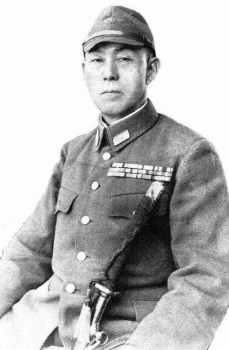
At the end of World War II, a number of former Japanese Army officers had successful careers in post-colonial South Korea. This would include Park Chung-hee 박정희 (朴正熙) (Japanese name Takagi Masao 고목정웅, 高木正雄), who became president of South Korea from 1961 to 1979; Chung Il-kwon (정일권, 丁一權), who became the prime minister of Korea from 1964 to 1970; and General Paik Sun-yup 백선엽 (白善燁). All ten of the original Chiefs of Staff of the South Korean Army were graduates of the Imperial Japanese Army Academies.
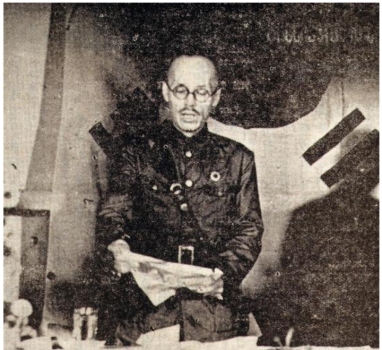
Yi Cheong-cheon 지청천 (池靑天) was a 1914 graduate of the Imperial Japanese Army Academy. In 1919, he defected to the Korean guerrilla forces fighting in China against the Japanese. He brought with him knowledge of Japan’s modern military techniques. He became the commander-in-chief of the Korean Liberation Army (KLA) 한국광복군 (韓國光復軍) when it was established on September 17, 1940.26 The KLA was the armed forces of the Provisional Government of the Republic of Korea. Yi Cheong-cheon was a friend and former classmate of Japanese Lieutenant General Hong Sa-ik 홍사익 (洪思翊, 1889-1946) and tried to get him to defect to the Korean Liberation Army. However, Hong Sa-ik remained in the Japanese Imperial Army and was executed in 1945 for war crimes. During the war, Yi Cheong-cheon used several aliases to protect his family, which was trapped in Korea. Hong Sa-ik was known to have funneled money to Yi Cheong-cheon’s family in Korea before and during World War II.27 Following Korea’s liberation at the end of World War II, Yi Cheong-cheon served as a member of the South Korean National Assembly. In 1962, he was posthumously honored with the Third Class of the Korean Order of National Foundation.
The Republic of Korea was officially established on August 15, 1948, exactly three years to the day after the Japanese surrender, which ended WWII. South Korean Independence Day is also celebrated on August 15th.
Although Japan was the party that started the Pacific War, the dropping of the atomic bomb, which led to their surrender, created the widely held perception among the Japanese that they were the victims of the war. For many years, any Koreans who were injured or killed by the atomic bombs at Hiroshima and Nagasaki were not listed by the Japanese as casualties. Before 2008, Koreans who survived the bombing could not get paid medical care from the Japanese government.28 It took 4 decades for a Japanese survivor of the bomb to identify 12 American POWs who were killed by the atomic bombs. See The Secret History of the American POWs Killed by the Atomic Bomb by Shigeaki Mori. It is unknown how many other POWs from the U.S. and other nations were killed at Hiroshima and Nagasaki, and the Japanese are not willing to do the research.29
A survey conducted by the Asahi Shimbun newspaper in cooperation with the Japan Confederation of A- and H-bomb Sufferers Organizations (Nihon Hidankyo) found that 50% of hibakusha (atomic bomb survivors) believe both the U.S. and Japanese governments were responsible for the atomic bombings. Only 28% believed the U.S. government was solely responsible. Some observers note that the Japanese national psyche views its people as victims of the war that was started by jingoistic leaders, which contrasts with Western portrayals of a fanatical military. Historian Tsuyoshi Hasegawa argues that the prolonged silence and inaction by Japanese policymakers in the summer of 1945—caused by their insistence on a negotiated surrender to preserve the emperor—made them more responsible for the war’s destructive end than American or Soviet leaders.
Footnotes:
- Seppuku 切腹 refers to the traditional “ritual” of committing suicide by cutting the stomach open, while Harakiri 腹切り refers to the action of cutting the stomach open. The word Harakiri is not generally used in Japan.
- Published in “The Official Gazette of the Governor-General of Chosŏn” on February 26, 1938, and amended on October 16, 1944, enforcement began on April 3.
- Japan is on the other side of the International Date Line from the U.S., so December 7th in the U.S. is December 8th in Japan.
- 朝鮮 meaning “Morning Calm.” It was originally a Chinese term indicating that Korea was to the East of China.
- Robert Repetto, Tai Hwan Kwon, Son-ung Kim, Dae Young Kim, John E. Solboda, and Peter J. Donaldson, Economic Development, Population Policy, and Demographic Transition in the Republic of Korea (Cambridge, Mass. and London: Harvard University Press, 1981), 44-6,48.
- University of Washington Press, 2023
- These divers were a part of the Special Attack Units prepared to resist the invasion of the Japanese home islands by Allied forces. This weapon is only known to have been used a few times operationally.
- Refusal to comply with sōshi-kaimei typically came with serious, negative consequences.
- In seppuku, after a person slits their stomach, a family member or close friend quickly beheads the person so that they do not suffer pain over an extended period of time. The term 介錯 means beheading (as the ending to a seppuku ritual) but also means assistance or help. Kaishakunin refers to the traditional process of beheading a person who has committed seppuku. The person who performs the seppuku process is called “Kaishakuhito” (勁いしゃくひと). Harakiri means “cutting the belly” and is a part of the seppuku ritual, not the entire ritual. The Japanese consider the use of the word Harakiri to describe the ritual of seppuku as vulgar.
- At the start of the Allied occupation of Japan, Fumimaro Konoe served in the cabinet of Prince Naruhiko Higashikuni. After being suspected of war crimes, Konoe committed suicide in December 1945 by ingesting potassium cyanide.
- For more information on the Honouliuli Internment Camp and a list of names of the internees, see “Korean Prisoners of War in the Honouliuli Internment Camp, 1943–1946,” Center for Korean Studies, University of Hawai‘i at Mānoa, November 2015. See also “Korean Prisoners-of-War in Hawaii During World War II and the Case of US Navy Abduction of Three Korean Fishermen”, University of Hawaii at Manoa, Yong-ho Ch’oe, November 30, 2009.
- The Ukishima Maru was a Japanese naval transport vessel originally built as a passenger ship in March 1937. On Aug. 24, 1945, seven days after the surrender of Japan, ending WWII, it was on a voyage to repatriate Koreans. It hit a mine, exploded, and sank in the harbor of Maizuru, Kyoto Prefecture.
- Sōshi-kaimei was a policy of pressuring Koreans under Japanese rule to adopt Japanese names and identify as such. The primary reason for the policy was to forcibly assimilate Koreans. The Sōshi-kaimei has been deemed by historians as one of the many aspects of cultural genocide that the Japanese attempted to impose on their non-Japanese territories. In 1939 and 1940, a new name-change policy came into effect through Ordinances No. 19 and 20.
- In the Japanese language, the hiragana character の is a particle showing possession. So, the correct translation is Lands’ Falcon.The Japanese term 陸の隼 has a specific, well-known historical reference. It was widely recognized as the nickname and popular designation for the Nakajima Ki-43 aircraft, which was a single-engine fighter plane used by the Imperial Japanese Army Air Force during World War II. Its official designation was Army Type 1 Fighter, and its formal name was Ki-43 Hayabusa (隼, “Peregrine Falcon”). The nickname “Land Falcon” was used to distinguish it from “Sea Falcon” 海の隼, which was sometimes used for the Mitsubishi A6M Zero, which was used by the Imperial Japanese Navy Air Service.
- As an example of Stevens’s interests, after the signing of the Eulsa Treaty on November 17, 1905, Stevens made a bet with Kiuchi Jūshirō 木内 重四郎 (1866–1925), a Japanese official in Korea, about the length of time before Japan would annex Korea. Kiuchi expected it would take three years; Stevens’s guess of five years would turn out to be more accurate, as the Annexation Treaty was signed on August 22, 1910. However, Stevens would not survive long enough to collect on the bet.
- Jang In-hwan was convicted of second-degree murder and sentenced to 25 years at San Quentin State Prison but was paroled in 1919 after serving 10 years. He was repatriated to Korea and established an orphanage, but the Japanese government of Korea forced him to flee. He returned to the United States, an impoverished and broken man, and committed suicide in San Francisco in 1930. Jang In-hwan’s body was repatriated to Korea in 1975 and was reinterred in the Dong Jak Dong National Cemetery 국립서울현충원 (國立서울顯忠院) in Seoul, Korea.
- In June 1908, a judge ruled that there was insufficient evidence to try Jeon Myeong-un for murder or as an accessory to murder. He allowed Jeon to be released from custody without bail, after which Jeon fled to Siberia. After Jang’s trial, Jeon returned to San Francisco and became a naturalized American citizen. He lived long enough to see Korea free and died in Los Angeles in 1947. Originally buried in Los Angeles, in April of 1994, the South Korean government repatriated his remains to the Dong Jak Dong National Cemetery 국립서울현충원 (國立서울顯忠院) in Seoul, Korea.
- Ahn Chang-ho is often called Dosan Ahn Chang-ho. “Dosan” 도산 (島山) refers to his pen name and means “island mountain” symbolizing a mountain rising from the sea.
- This area of Los Angeles is sometimes called “Old Koreatown,” bounded by Adams Boulevard (North), Slauson Avenue (South), Western Avenue (West), and Vermont Avenue (East). This was based on racial covenant laws that were in force at the time. The U.S. Supreme Court made them legally unenforceable in 1948 (in Shelley v. Kraemer), and eventually, ‘Koreatown” 코리아타운 moved farther north. The city of Los Angeles officially defines Koreatown in Los Angeles as being bordered by Vermont Avenue (East), Western Avenue (West), 3rd Street (North), and Olympic Boulevard (South).
- The choices offered on the 1940 census were “White, Negro, Indian, Chinese, Japanese, Filipino, Hindu, and Korean.” Many groups, such as Latino and Hispanic Americans, were not recorded at all.
- Executive Order 9066 was signed by Franklin D. Roosevelt on Feb. 19, 194.
- There are references that state that the most famous member of the Tiger Unit was Young-Oak Kim 김영옥. However, Kim’s draft number was one of the first called, and he entered the Army a year earlier, in January 1941.
- Ahn saw playing treacherous Japanese villains during WWII as a way to sway American public opinion against Japan. Koreans found his Japanese portrayals funny when he was supposed to be Japanese but spoke in Korean.
- After the liberation of Korea from Japanese rule, the Name Restoration Order was issued on October 23, 1946, by the United States Army Military Government in Korea (USAMGIK), enabling Koreans to restore their Korean names if they wished to.
- Of the 14 Class A War Criminals who were enshrined, seven were executed. They were Hideki Tojo, Koki Hirota, Iwane Matsui, Kenji Doihara, Seishiro Itagaki, Heitaro Kimura, and Akira Muto. The other seven Class A war criminals died in custody or while they were serving their sentences. They were Yoshijiro Umezu, Kuniaki Koiso, Kiichiro Hiranuma, Shigenori Togo, Toshio Shiratori, Yosuke Matsuoka, and Osami Nagano.
- Also known as the Korean Independence Army 한국독립군 (韓國獨立軍).
- The Korean Government under Syngman Rhee felt that the sins of Hong Sa-ik were inheritable and persecuted his son and daughter. They fled the country and moved to the United States.
- It is believed that some 30,000 to 70,000 Koreans, mostly conscripted laborers, were killed by the atomic bombs, although the Japanese numbers are far lower, with about 5,000–8,000 Koreans killed in Hiroshima and 1,500–2,000 in Nagasaki.
- According to Wikipedia, “Twelve American airmen were imprisoned at the Chugoku Military Police Headquarters, about 400 meters (1,300 ft) from the hypocenter of the blast. Most died instantly, although two were reported to have been executed by their captors, and two prisoners badly injured by the bombing were left next to the Aioi Bridge by the Kempei Tai, where they were stoned to death. Eight U.S. prisoners of war killed as part of the medical experiments program at Kyushu University were falsely reported by Japanese authorities as having been killed in the atomic blast as part of an attempted cover-up.”