
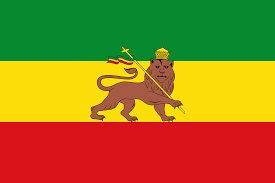
Ethiopia 이디오피아 (에티오피아) ኢትዮጵያ was successful in keeping its sovereignty while so many African nations were colonized by foreign powers, but the struggle was not easy. The Ethiopian Emperor Haile Selassie I felt betrayed when on Dec. 14, 1925, the United Kingdom signed a secret pact with Italy that gave Italy the authority and dominance over the Horn of Africa (Somali Peninsula).1 In particular, the pact allowed Italy to build a railway connecting Somalia with Eritrea. Ethiopia had become a member of the League of Nations after WWI, but it condemned the League of Nations for its inability to respond to the Ethiopian crisis. The terror of communist and fascist ideologies became well known in Ethiopia when Italy’s Benito Mussolini led a brutal campaign and occupation of Ethiopia from 1935 to 1941. The Italians had an advanced, modern military that included a large air force. The Italians also employed chemical weapons throughout the conflict, even targeting Red Cross field hospitals in violation of the Geneva Conventions. The Ethiopian emperor was forced into exile. Nevertheless, Ethiopia eventually regained its independence, followed by Emperor Selassie seeking new allies in the West. After World War II, Ethiopia became a charter member of the United Nations. In July 1950, UN Secretary-General Trygve Halvdan Lie asked for support of South Korea, especially for troops to fight as part of the United Nations Command. Emperor Haile Selassie was an ardent supporter of collective security. The emperor obliged and offered five battalions from his personal Imperial Bodyguard (Kebur Zabagna or Zebenya ክቡር ዘበኛ, lit. “Honorable Guard”) to fight in Korea. It would be the first time that Ethiopia was to be involved in a war outside the African continent. The infantry division was an elite unit that had received advanced training from Belgium, France, and the Swedish military in the 1930s. In the early 1950s, the Armed Forces of the Ethiopian Empire consisted of the elite Imperial Bodyguard Division, three army divisions, a budding air force and a provincial/territorial/reserve army. Ethiopians would make up the 8th largest group to fight for the ROK. The battalion trained in the mountainous areas of Ethiopia for eight months to get acclimated to mountain fighting. Upon their arrival in Korea, on May 6, 1951, they were provided U.S. equipment and received an additional eight weeks of training in American tactics and weapons.
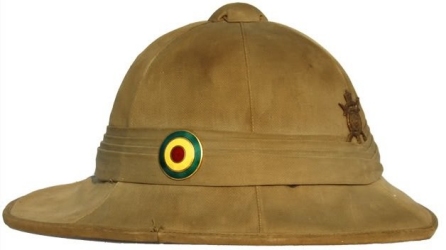
These were worn by the 1st Kagnew Battalion when they arrived in Korea.
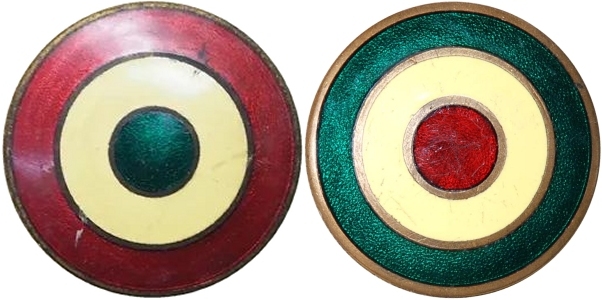
In Korea, they would be known as the Kagnew Battalion.2 Initially they were viewed with a degree of skepticism by American officers, but the Ethiopian soldiers soon gained a reputation. The Chinese feared them. The Kagnew Battalion never left a man behind, wounded or dead, and none of their soldiers, wounded or dead, was ever captured by the enemy. The Kagnews served with great distinction, principally alongside the 7th Infantry Division. The Chinese and North Koreans heard rumors of cannibalism by the Ethiopians. The rumor only made the Kagnew Battalion even more terrifying to the enemy. Almost all the men in the Kagnew Battalion were Coptic Christians. Their faith has dietary restrictions similar to that of Orthodox Jews. Pork was definitely not on the menu. Before departing for Korea, the top Coptic religious leaders had to give the Kagnew battalion a special dispensation to allow them to consume American rations.
While American troops were still overcoming desegregation within their ranks, the Ethiopians valued merit over skin color. In time, Kagnew was no longer a “red-headed step-child” but a prestige unit, and there was a long line of American officers looking to become a liaison officer to one of the hottest units in Korea.
From April 12, 1951, to July 27, 1953, approximately 3,150 Ethiopians fought in Korea during the war in 253 separate battles. In all those battles, they never lost an inch of ground unless they were ordered to retreat. The Ethiopians had the best night patrol record of any force in Korea. On extremely dark nights, the Kagnew held hands in column. American night patrols often became separated in the darkness, with disastrous consequences. The Ethiopians felt that the risk of being bunched up was better than the risk of being divided. The Kagnew Battalions rotated yearly, with the first battalion arriving at the front in 1951. The third Kagnew Battalion, which arrived in 1953, stayed through the signing of the armistice into 1954. Over the next two years, more Ethiopians guarded the stalemate in Korea as part of the Fourth and Fifth Kagnew Battalions. All 121 Ethiopian soldiers who were killed and the 536 who were wounded were brought home. In all, 6,037 Ethiopian soldiers served in Korea. Some publications indicate Ethiopians remained in Korea until 1965, but in fact, a small number remained as part of the United Nations Command until 1975.
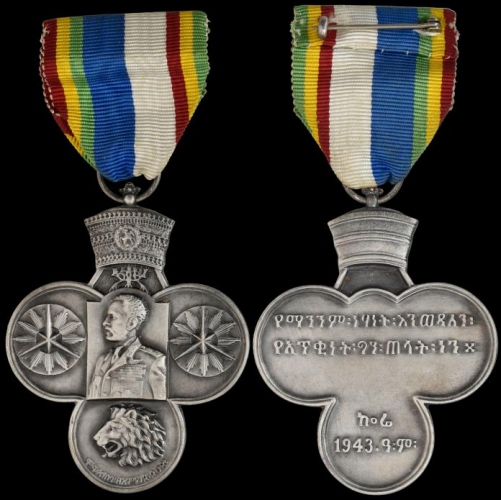
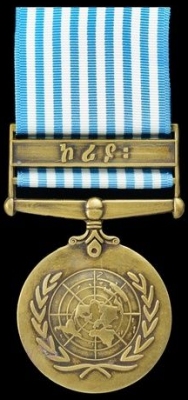
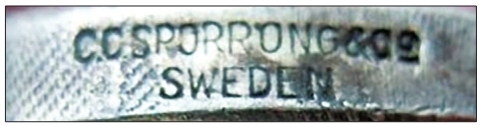
Two Kagnew members, Lieutenant Colonel Teshome Irgetu and 2nd Lt. Haptewold Mamo, were awarded the highest Ethiopian gallantry award and became “Knights of the Order of Emperor Menelik II.”3 All members of the Kagnew Battalion who served during the war received the Ethiopian “Memorial Medal of the Korean War.” The Ethiopian Government Decree No. 12 of 1952 instituted the “Memorial Medal of the Korean War.” On the obverse, in the center, the medal has the image of His Majesty Haile Selassie I in uniform. The Ethiopian royal crown is above. Around the center are three lobes. There is a star with rays on each of the lobes on the left and right sides of the image. On the bottom lobe is the head of a lion just above an Amharic inscription of “CONQUERING LION OF THE TRIBE OF JUDAH.” On the reverse there is the Amharic inscription “WE LOVE UNIVERSAL LIBERTY BUT ARE ENEMIES OF AGGRESSION.” At the bottom is another Amharic inscription: “KOREA 1952.” Dennis Gill, in his book “The Coinage of Ethiopia, Eritrea, and Italian Somalia,” translates the inscriptions as follows: obverse: “The Lion of Judah hath conquered,” and the reverse as “We love freedom for everyone; we are opposed to aggression—Korea 1952, year of mercy.” The ribbon is bordered by the Ethiopian colors (red, yellow, and green), with the two middle stripes being white and blue, representing the colors of the United Nations. There are three types of the medal, with each manufactured by a different company: in Addis Ababa by Sevadjian, in Sweden by Sporrong (with the C.C. SPORRONG & CO. / SWEDEN stamped on the rim) and in France by Bertrand (the latter is distinguished by a smooth cross atop the imperial crown and slightly different text font). Originals are struck in silver, while later strikes were manufactured in silver-plated bronze. The pendants are quite popular with the Ras Tafari Movement, and reproductions are common (the movement takes its name from the Emperor Selassie’s pre-coronation name, Ras Tafari).
The battalion was awarded the Republic of Korea Presidential Unit Citation on May 19, 1953. The ROK also awarded 4 Orders of Military Merit, Ulchi Class; 1 Order of Military Merit, Wharang Class with Silver Star; and 2 Orders of Military Merit, Wharang Class.
The battalion was awarded a U.S. Presidential Unit Citation on Oct. 15, 1952. In addition, the U.S. government awarded 4 Legions of Merit, 9 Silver Stars, 42 Bronze Star Medals for Valor, 41 Bronze Star Medals for Meritorious Service, and one Soldier’s Medal.4 When the US established a military base in the newly federated Eritrea in 1953, they named the base “Kagnew Station” in honor of the officers and men who served in Korea.
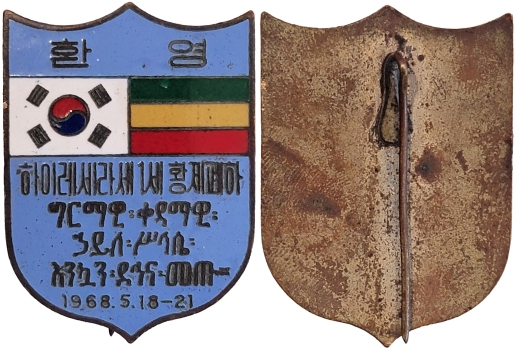
The Korean translates as: 환영 Welcome 하이레세라세1세황제폐하 Haile Sellasi 1 Emperor. The Amharic ግርማዊ ቀዳማዊ ኃይለ ሥላሴ እንኳን ደንና መጡ repeats the same message “Welcome Your Imperial Majesty Haile Selassie I”
At the bottom are the dates of his visit May 18-21, 1968.
I want to thank Jim Marshall’s Reggae and Ethiopian Archives for their help in translating the Amharic.
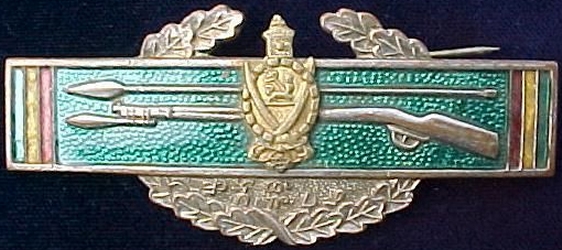
The Ethiopian CIB was probably modeled on the U.S. Army’s CIB which was created on Nov. 15, 1943.
When the Communist Junta of Mengistu Hailemariam came to power in 1974, it did everything to erase the record of the Kagnew’s service against the communists. As part of its aid package, North Korea demanded Mengistu officially disavow the Kagnew battalion. The Korean War veterans were stripped of all military decorations and had their pensions revoked. The Kagnew veteran’s association was banned, and monuments to the battalion were destroyed. Ethiopia’s participation in the Korean War was redacted from school textbooks. In May 1991, Mengistu was driven into exile. The post-communist government of Ethiopia reversed all of his decisions regarding the Kagnew battalion veterans. Unfortunately, Ethiopia was essentially bankrupt, and Kagnew veteran pensions went unpaid. Little else was done for them. In 1996, the South Korean government passed legislation that South Korea would pay the pensions of all surviving Kagnew Battalion members for the remainder of their lives. Legislation was passed to give preferential admission to South Korean universities for the grandchildren of the Kagnew veterans. In 2007, a memorial hall to the Kagnew battalion was opened in Chuncheon, South Korea. In 2010, South Korean donations paid for forty Kagnew veterans to visit the country for the first time since the Korean War. South Korean financial aid helped build a new Korean War memorial in Ethiopia to replace the ones Mengistu had destroyed. In May 2016, South Korean president Park Geun-hye spoke at the dedication of the Korean War Monument in Addis Ababa, the capital of Ethiopia.
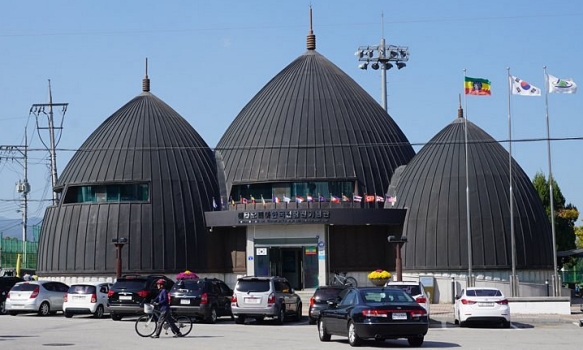
In Korea, an Ethiopian monument was established on May 7, 1968, by the Association of UN Participated Nations and the citizens of Chuncheon 춘천. The ROK Association of Reservists and the Korean Finance Group donated the money for its construction. On May 19, 1968, the Ethiopian Emperor, Haile Selassie, attended the opening ceremony. Across the road from the monument is the “Ethiopian Korean War Memorial Hall” 에티오피아한국전참전기념관. It was built in 2007 by the citizens of Chuncheon. They were the first Korean city to build a memorial dedicated to foreign troops. There is another monument, the Jeokgeunsan District Battle Monument 적근산지구 전투전적비 in Hwacheon-gun, Gangwon-do 화천군, 강원도, dedicated to the 3rd Ethiopian Battalion, who fought in the battle. It was built on Oct. 27, 1983, by the 15th Division of the Korean Army.
As of late summer 2016, there were fewer than 300 Ethiopian veterans of the Korean War still alive. As of June 2025, that number has dropped to fewer than 60 survivors.
On June 23, 2025, the South Korean conglomerate LG Electronics said that it is providing food, daily necessities, and financial support to 54 surviving Korean War veterans in Ethiopia. Since 2013, the Korean tech giant has provided scholarships for 230 descendants of Korean War veterans in Ethiopia. It has also been operating the LG-KOICA Hope Technical and Vocational Education and Training College in the country’s capital, Addis Ababa, with the Korea International Cooperation Agency. Established in 2014, the vocational school provides free training and IT and electrical engineering education, along with lunch and transportation so that students can focus on their studies.
If you would like to learn more about the Kagnew Battalion, I strongly recommend “Emperor’s Own: The History of the Ethiopian Imperial Bodyguard Battalion in the Korean War,” published in 2019 by Helion & Company as part of their Asia@War series.
The Journal of the Orders and Medals Society of America (JOMSA)
The following information came from an article “THE ETHIOPIAN MEMORIAL MEDAL OF THE KOREAN WAR” written by Owain Raw-Rees and published in the Journal of the Orders and Medals Society of America (JOMSA), July-Aug. 2020, Vol. 71, No. 4, pp. 3-11.
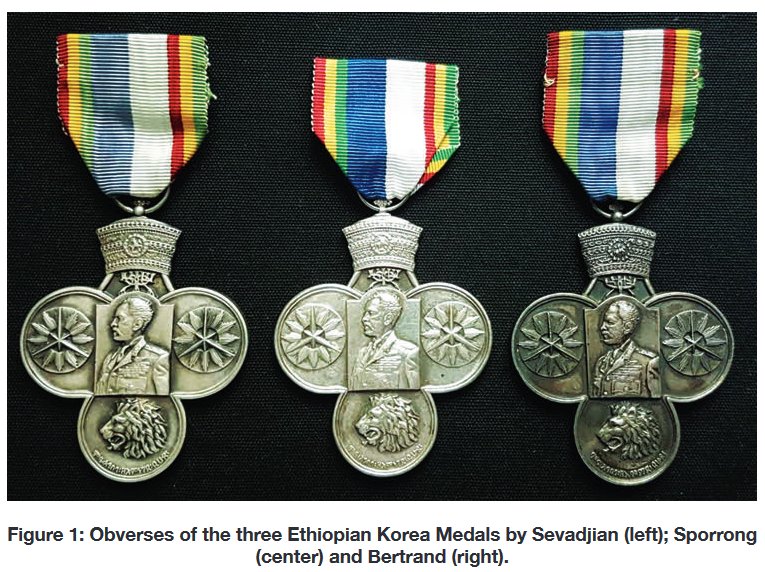

The Korean War Memorial Medals were manufactured by Bedros Sevadjian in Ethiopia, by C.C. Sporrong in Sweden , and by Arthus-Bertrand in France.
Sevadjian’s work is often hallmarked with “B.A. SEVADJIAN” and “MADE IN ETHIOPIA.” The Ethiopian Derg regime (1974-1987) reportedly confiscated and damaged Sevadjian’s workshop, marking the end of his prominent role in Ethiopian production. C.C. Sporrong in Sweden was founded in the 17th century and has more than 350 years of experience. Their medals are often hallmarked CC SPORRONG & CO STOCKHOLM. Bertrand was founded in 1803 in Paris by Claude Arthus-Bertrand (1769-1840), a French Revolution army officer. and is a long-standing and respected French company specializing in the manufacture of various types of medals, decorations, and jewelry. One common hallmark is a small square hallmark with “A*B &Cie” used since 1917. Another seen on some pieces, particularly Military Crosses, is a rhombus with a star above a wheel between the letters A.B. & Co. If you have an Ethiopian Korean War medal with a Sevadjian or Bertrand hallmark, please send me pictures, and I will correct this webpage.
Footnotes:
- Emperor Haile Selassie I ቀዳማዊ ኀይለ ሥላሴ was the 225th and last Ethiopian Emperor of the Solomonic Dynasty of Ethiopia.
- The term ‘Kagnew’ in Ahmaric (ቃኘው) has two meanings; the first being “to bring order out of chaos” and the second, “to overthrow,” according to Kimon Skordiles, who has conducted extensive research on this battalion during the Korean War.
- Lt. General Teshome Irgetu, who commanded the first Kagnew Battalion, was killed by Eritrean terrorists in 1970.
- Information source: The Ethiopian Memorial Medal of the Korean War, article by Owain Raw Rees, Journal of the Orders and Medals Society of America (JOMSA) July-August 2020, Vol. 71, No. 4