
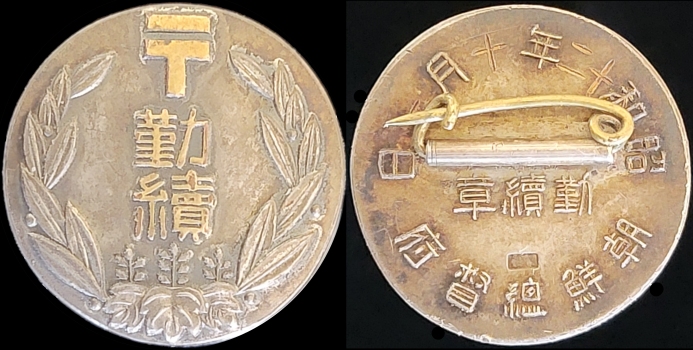
Chosŏn Governor General’s Long Service Postal Medal – 1937
The Japanese symbol at the top of the obverse 〒 is officially called the yūbin kigō “Postal Symbol” (郵便記号) and is used by the Japanese Ministry of Communications 逓信省. The mark is the stylized katakana character テ, pronounced ‘te’, from the word 逓信 (J. テイシン) pronounced ‘teishin’ and translated as ‘communications.’ A commonly used Japanese term that also refers to the Japanese postal symbol 〒 is yūbin māku (郵便マーク). The name comes from the word yūbin (郵便), meaning “mail” or “postal service,” and the English loanword “mark.” The Japanese postal symbol was introduced on February 8, 1887 (Meiji 20.2.8), and is still in use today.
Down the center of the obverse is “Service Medal” 勤続 (근속). The emblem at the bottom is the logo of the Chosŏn governor general. On the reverse, at the top is the date “Oct. 1, 1937” 昭和年十二月十日一. Notice that the numbers in the date have been engraved. Across the center is “Long Service Medal” 勤続章 (근속장), and at the bottom is the “Chosŏn Governor-General’s Office” 朝鮮総督府 (조선총독부). While it is practically unreadable, the small rectangle in the center at the bottom appears to be the stamped mark for “Pure Silver” 純銀.
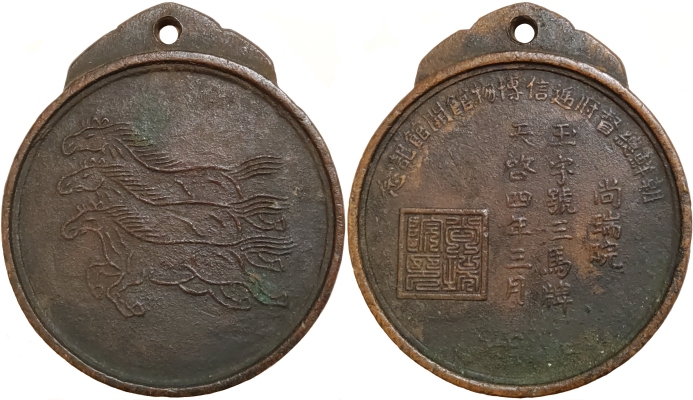
Opening of the Governor-General’s Office of Korea Post and Communications Museum 朝鮮總督府逓信博物館開館記念 .
Commemorative Medal—Korean Horse Warrant Motif—July 28, 1937
The arc across the top reads as “Opening of the Governor-General’s Office of Korea Post and Communications Museum” 朝鮮總督府逓信博物館開館記念 .
The three vertical lines and the seal are a reproduction of a MaP’ae (Horse Warrant):
1. 尚瑞院—Sangseowon was an institution under the Ministry of Personnel during the Chosŏn Dynasty, in charge of the seals, sacred objects, treasures of the king, etc.
2. 玉字號三馬牌 – Three Jade Horses Medal (lit. 玉字號 = Jade Mark),
3. 天啓四年三月 – March 1624 The Chinese Emperor Cheongye (Ming dynasty 天啓 천계 1623–1627 CE) used Tianqi as his adopted era name.
And finally, the official government mint seal with the characters 尙瑞院印 rendered in Seal Script, within a boxed frame.
Part of the George Notarpole Collection.
For more information, see “Cast Coinage of Korea” by Edgar J. Mandel, page 129.
Translation courtesy of Nick at Medals of Asia.