
Hwanghae Province 黃海道 (황해도) Police Medal
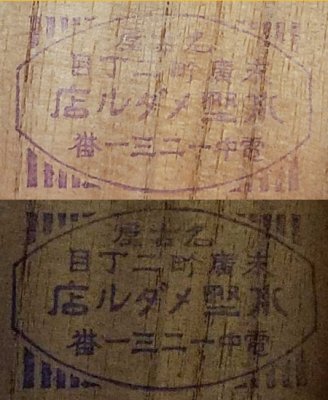
名古屋 Nagoya (Japan)
末廣町二丁 Suehirocho 2nd District
水堅メダル店 Mizukata Medal Shop
電中一二三一番 Telephone number 中1231.
Translation courtesy of Nick at Medals of Asia.
From March 3 to Sept. 3, 1921, Crown Prince Hirohito made official visits to the United Kingdom, France, the Netherlands, Belgium, Italy, and Vatican City. This was the first time that anyone in the immediate Japanese Royal Family had made an official visit outside of Japan proper. On Nov. 25, 1921, shortly after his return, Hirohito became Regent of Japan, in place of his ailing father, the Emperor Taisho. Mental illness had seriously affected his father’s ability to execute his duties. On Dec. 25, 1926, Hirohito immediately ascended the throne upon the death of his father. Hirohito took the era name Shōwa (Enlightened Peace). It wasn’t until November 1928 that the new emperor was ceremonially confirmed. These ceremonies should not be construed as an “enthronement” or “coronation” ceremony but are more accurately a public “confirmation” of his accession to the throne. There are sources that claim that the delay from his accession to the confirmation ceremonies was caused by financial problems. This is simply not true. After the death of a Japanese emperor, a new emperor immediately ascends the throne, but the main ceremonies are deferred under the provisions of the Imperial Household Law. Two distinct items cause this deferral. First, there is the official national mourning period of one year. This is followed by the sacred rice needed for the confirmation ceremony. The rice must be planted, grown, and harvested after the official end of the national mourning period to avoid any contamination from the death of the previous emperor.
Hirohito’s confirmation celebrations were widespread in Japan, but not in Korea. “Celebrations in Korea were more restrained, though several special events were held. Koreans in Japan were a particular target of preventive arrests, as they were considered subversive; by the same token, Japanese newspapers reported the “enthusiastic” response of Koreans and their organizations to Hirohito’s succession, as if anxious to assure readers that colonial subjects were equally patriotic as those born in Japan. The press in Korea itself displayed a notable ambivalence about the enthronement, with the official radio and the official Korean-language newspaper covering the ceremonies, but other Korean newspapers refusing to give space to the ritual events and instead publishing articles about increased repression and preemptive arrests of Koreans.” 1
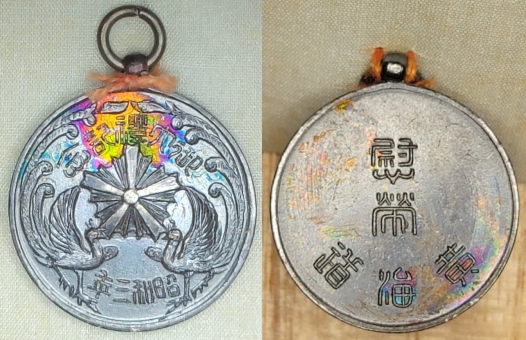
The silver medal pictured above is a recognition medal, probably issued to a Japanese police officer working in Hwanghae Province. The top obverse inscription is 御大禮記念 (어대례기념), Imperial Ceremony Commemoration, while at the bottom, the inscription is 昭和三年 (소화삼년), Showa 3rd Year (1928). The emblem at the center of the obverse is the Asahikage 朝日影, literally “morning sunlight.” It is the emblem of the Japanese National Police. The reverse inscription, down the center, is 慰勞 (위로), “Recognition of one’s services.” The bottom inscription is 黃海道 (황해도 Hwanghae Province). The discoloration on the badge is toning by the silver and is highly desirable by coin collectors.
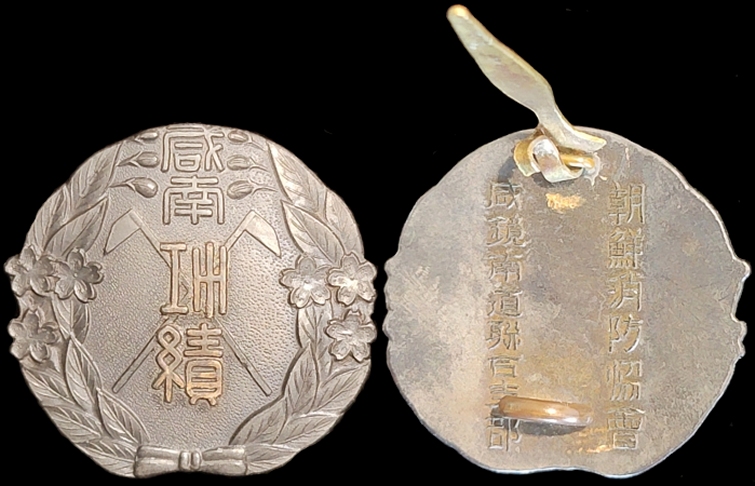
Reverse: 1st line: Chosŏn Firefighting Association 朝鮮 消防協會 (조선 소방협회)
2nd Line: Hamgyeongnam-do Joint Support branch 咸境南道聯合支部 (함경남도련합지부)
30.4 x 31.8 mm, 13.3 g.
Chosŏn Firefighting Association
The Chosŏn Firefighting Association (朝鮮消防協會) was a quasi-public firefighting-related organization/foundation under the Government-General of Korea. On June 23, 1915, “Firefighting Team Rules” were enacted and implemented.2 The Chosŏn Firefighting Association was officially established on Dec. 2, 1928, when it held its founding meeting. As a quasi-public organization, it was responsible for raising its own funding. At the beginning of its establishment, the association raised about 206,000 yen and eventually reached a basic funding of 400,000 yen. Firefighting activities were institutionalized, and volunteer fire brigade maintenance and technology standardization were sought. The association was responsible for organizing and training firefighting teams, defense teams, and volunteer firefighting units across the country. It also disseminated technology and education for such equipment as the introduction of automobile pumps.3 It was responsible for hosting commendation and control events. The organization also distributed arson prevention posters and educational materials. It was under the control of the General Affairs Bureau (総務局) of the Japanese Government-General of Korea (朝鮮総督) (located in Gyeongseong-bu, present-day Seoul). There were joint branches established at each provincial police department, police station, and fire station. Membership included full members (正會員), honorary members (名譽會員), special members (特別會員), and sponsors (贊助員), totaling more than 63,000 people in 1929. In 1935, a ‘Flood Response Team’ (洪水響應小組, 홍수대응팀) was established to prepare for the summer rainy season and floods, which have historically plagued Korea. After the outbreak of the Sino-Japanese War in 1937, the fire brigades (소방조), fire corps (수방단), and defense brigades (방호단) were integrated and reorganized into the light defense brigade (경방단). Functions of the fire department within the police force were expanded and used as a means of educating about air defense ideology and strengthening security. Immediately after liberation in 1945, the Chosŏn Firefighting Association was disbanded. Its assets were transferred to an organization under the police department and provincial governor.
Hamgyeongnam-do (咸境南道) was an administrative district in the northern region of the Chosŏn Dynasty, located in present-day North Korea. This region served as an important administrative and geographical boundary in the northeastern part of the peninsula from the Koryo Dynasty to the Chosŏn Dynasty and especially included a large area extending from the lower reaches of the Yalu River to Yeonpo (Yeonheungbu) on the east coast. During the Chosŏn Dynasty, it was a key point for national defense. The Great Wall of China 虎山长城, which stretched from the Yalu River to the east coast, passed through this area. In Korea, it is known as the Ch’ŏlli changsŏng 천리장성 (千里長城) or Great Wall of Korea. Hamgyeong Province was established in 1896 and divided it into a north province (buk 北) and a south province (nam 南).
Footnotes:
- For a more extensive treatment of Hirohito’s enthronement, see the journal article :Enthroning Hirohito: Culture and Nation in the 1920s Japan by Sandra Wilson, Journal of Japanese Studies, Vol. 37, No. 2 (Summer 2011), pp. 289-323, published by The Society for Japanese Studies.
- Ordinance of the Government General of Korea No. 65, 韓國總督府令第 65 號, 조선총독부령 제65호
- An automobile pump is a vehicle with a power take-off (PTO). It is a mechanical device that transfers power from the vehicle’s drivetrain and is used to operate water pumps mounted on the vehicle. As time progressed, PTOs were incorporated in aerial trucks (ladder trucks) and tankers (which transfer water to areas without hydrants or immediate water sources).