
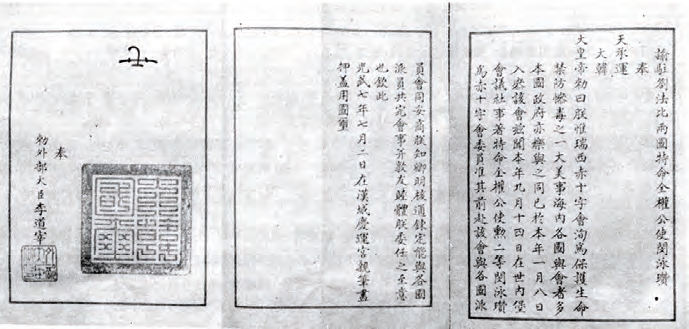
Koreans first became aware of the Red Cross, due to the activities of the Japanese Red Cross in the Sino-Japanese War of 1894. The general population of Korea gained greater awareness of the International Red Cross with the publication of an editorial in the “Independence Newspaper” (독립신문) on Sept. 19, 18991. Starting in 1901, the Korean government began seriously seeking information on the Geneva Conventions and was also seeking participation in the Universal Peace Conference, which served as the foundation for the Red Cross Society. Emperor Kwangmu2 was particularly interested in the neutrality aspects contained within the Geneva Conventions. As a result of a series of newspaper articles, and information received from Switzerland, the Korean government, on January 8, 1903, instructed Min Young-chan 민영찬 (閔泳瓚), then Deputy Minister in France, to sign the “Geneva Conventions of 1864.” On February 7, Korea joined the Hague Convention. On July 4, Minister Min Young-chan was appointed as a member of the Red Cross and was sent to The Hague to sign the “Convention on Hospital Vessels” (병원선(病院船)에 관한 협약).
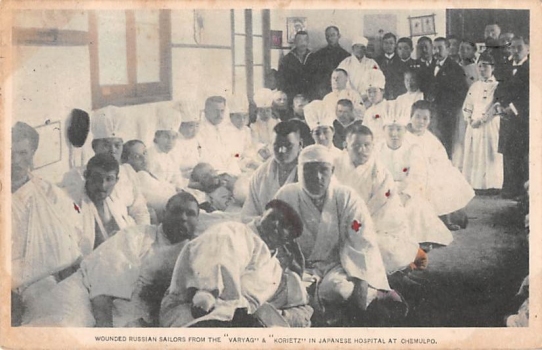
Wounded Russian Sailors from the “Varyag”and “Korietz” in Japanese Hospital in Chemulpo (Inchon).
Inchon is pronounced as Jinsen (じんせん) in Japanese.
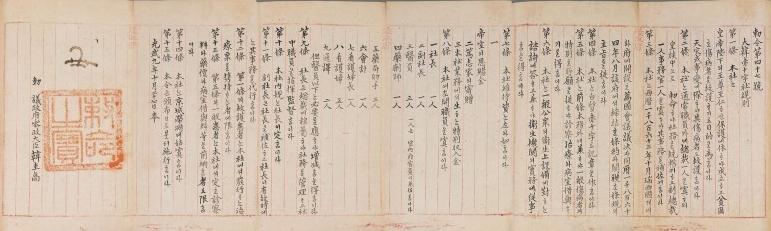
Emperor Kwangmu issued an Imperial Rescript on July 8, 1905, which established a Red Cross Hospital in Seoul. On October 27, the Emperor promulgated Imperial Rescript #47 “Korean Red Cross Rules” (대한적십자사 규칙), which set forth the regulations for the Korean Red Cross Society. On December 12, the Emperor issued Imperial Rescript #54 which set forth the regulations for the Korean Red Cross Hospital in Seoul. In 1906, the Korean Red Cross was located in front of Yeongchumun Gate in Gyeongbokgung Palace. At that time, it had 13 paid employees. When the vice-president of the Japanese Red Cross Society visited Seoul in October 1906, he presented the Korean emperor and the crown prince with honorary Japanese Red Cross membership medals. Korea became a protectorate of Japan with the signing of the Japanese–Korea Treaty of 1905; thereafter, Japan ruled the country indirectly through the Japanese Resident-General of Korea. On July 23, 1909, the Korean Government issued Imperial Ordinance #67, by which all matters concerning the Red Cross Society were transferred to the Red Cross Society of Japan. The 1905 Imperial Rescripts concerning the creation of the Red Cross Hospital and Society were formally annulled. On Dec. 10, 1910, after Japan’s forced annexation of Korea, the Korean Red Cross became a chapter of the Japanese Red Cross, claiming that it was necessary because the Principles of the International Red Cross Movement only allow one national society to be set up in a country.
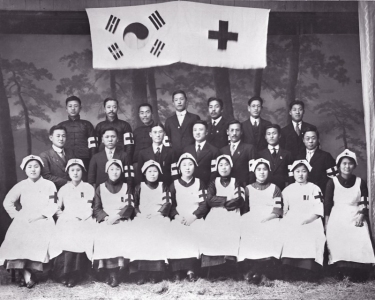
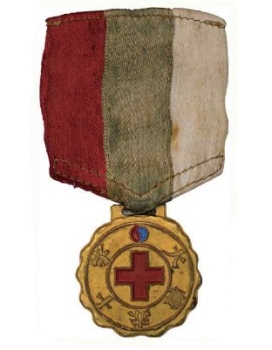
The medal is on permanent display at the Provisional Government Memorial Hall #1.
In 1999, the ROK awarded him with the Order of National Foundation.
Photo courtesy of the Korean Ministry of Patriots and Veterans Affairs.
On Aug. 29, 1919, the Korean Provisional Government (대한민국임시정부, 大韓民國臨時政府) in Shanghai, China, established a new Korean Red Cross Society when it passed Ministry of Home Affairs Law #62. For many years, the current Korean Red Cross Society traced its establishment back to the Korean Provisional Government, but they have since changed the date of establishment to 1905.
On Aug. 25, 1945, after the Japanese surrender ended World War II, the Korean Red Cross started to reorganize on the Korean peninsula. After liberation, the Korean Red Cross was forcibly disbanded by the U.S. Army Military Government in Korea on July 27, 1946, only two months after its re-establishment on the Korean peninsula. The Red Cross Society was reorganized and was firmly re-established on Mar. 16, 1947. The Korean Government gave official recognition to the Korean Red Cross when it passed Law #25 on Apr. 30, 1949 (대한적십자사 조직법 (大韓赤十字社 組織法)). On Oct. 27, 1949, Syngman Rhee, the president of the Republic of Korea, became the honorary president of the Korean Red Cross Society. Dr. Yang Ju-Sam (양주삼, 梁柱三) was elected as president of the society. 3 The Red Cross Society of the Republic of Korea was finally recognized by the International Committee of the Red Cross on May 26, 1955, and was admitted to the International Federation of Red Cross and Red Crescent Societies on Sept. 29, 1955. On Aug. 16, 1966, Korea became the 111th member state of the Red Cross Convention. On July 1, 1981, the Korean government officially entrusted the Korean Red Cross Society with the national blood supply program.
A new president of the Korean Red Cross is appointed from time to time. According to Article 14 of the Korean Red Cross Organization Act, the positions of Honorary President and Honorary Vice President are the incumbent President and Prime Minister of the Republic of Korea, respectively. On May 2, 1992, Korean President Roh Tae-woo became the first incumbent president to donate blood.
All the Red Cross Medals are wearable, but they are generally for display only, and rarely worn.
The Korean Red Cross maintains several websites. The two primary websites are a Korean-language website and an English-language website.
North Korea
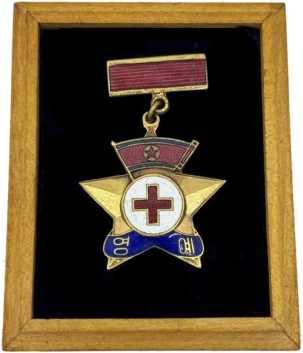
The “Red Cross Society of North Korea” 북한적십자회 (北韓赤十字會) was founded on 18 October 1946. It was renamed the “Red Cross Society of the Democratic People’s Republic of Korea” 조선민주주의인민공화국 적십자회 (朝鮮民主主義人民共和國 赤十字會) in December 1948 by Decision No. 101 of the Cabinet of North Korea. By 1950 it had become a nationwide organization and was admitted into the International Federation of Red Cross and Red Crescent Societies (IFRC) on 11 May 1956. This admittance had significant symbolic importance for North Korea, as the regime had been isolated from virtually all international organizations, such as the United Nations (유엔UN, United Nations), which it finally joined in 1991. In the aftermath of the Korean War, the DPRK RCS held a prominent role and provided the people with food, clothing, bedding, and medical services at provincial hospitals and first aid posts. One of the original tasks for the society was the prevention of diseases that were prevalent such as tuberculosis, typhoid fever, typhus, and cholera.
In 1971, Korean RCS officials from both sides met for the first time during the delivery of a letter from the North Korean Red Cross Society accepting a proposal from the South Korean National Red Cross for a joint investigation of the problems facing families separated by the division of the peninsula. The two societies met about 30 times in the ensuing years, reaching a preliminary agreement, but then in 1973, progress stalled. Eventually 21 family reunions did take place. In September 1985, two reunions were held in Seoul, South Korea, and a corresponding event was held in Pyongyang. All subsequent reunions, starting in 2000 and continuing until the last official event in August 2018, were held at the Mount Kumgang 금강산 (金剛山) resort in North Korea. In all, some 44,000 families were reunited, if only for a couple of days. However, North Korea began dismantling the facilities used for the reunions in early 2025, indicating further deterioration of relations. As of 2021, the average age of South Korean divided family members was 82.4. The North Korean government has refused to include any Korean American citizens in inter-Korean reunions. The number of Korean-Americans who have relatives in North Korea is frequently estimated to be 100,000. For more information, see The National Committee on North Korea (NCNK).
The DPRK RCS was involved in repatriating Japanese Koreans in 1959. In 1993 and 2000, the DPRK RCS was involved in the return of “unconverted long-term prisoners” (North Korean loyalist prisoners being held in South Korean prisons). The Law on the Red Cross Society of the Democratic People’s Republic of Korea further defined its role and was adopted by Decree 2113 of the Presidium of the Supreme People’s Assembly on 10 January 2007.
As of July 2013, there were 3,300 Red Cross volunteers in North Korea. In 2013, its programs reached 8.89 million North Koreans. Healthcare programs focusing on women and children have been implemented in 56 cities. Additionally, it operates the Pyongyang Red Cross Hospital, which is considered among the best in the DPRK.4 In 2016 the society celebrated its 70th anniversary.
Footnotes:
- The date of publication is also reported as Apr. 3, 1899.
- Kojong (고종, 高宗 b. Sept. 8, 1852 – d. Jan. 21, 1919), was the King of Korea from 1864 to 1897 and the first Emperor of Korea from 1897 until 1907. He is known posthumously as the Emperor Kwangmu (광무제, 光武帝). The Japanese, after forcing Emperor Kwangmu to abdicate in 1907, placed his son Sunjong on the throne. Sunjong (순종, 純宗 b. Mar. 25, 1874 – d. Apr. 24, 1926), also called Emperor Yunghui (융희제, 隆熙帝), ruled from 1907 until the coerced annexation of Korea by Japan in 1910. Years earlier, on Sept. 11, 1898, an attempt was made to assassinate the Korean royal family by poisoning their evening coffee. As a result of severe poisoning, Sunjong was not up to the task of kingship and was easily manipulated by the Japanese. Many Koreans feel that Kojong’s sudden death in 1919 was the result of being poisoned by the Japanese, and many regard King Kojong as being the last legitimate king of Korea.
- Yang Ju-Sam is among the 708 major, pro-Japanese figures listed by the Korean National Assembly on Feb. 28, 2002, and is considered by many to be a traitor to Korea. He disappeared during the early days of the Korean War, and it is believed that he was abducted by the North Koreans. His fate is unknown.
- Hospitals in North Korea are described as severely under-resourced, with widespread shortages of medicine, supplies, and reliable electricity, leading to conditions like performing surgery without anesthesia. While the government claims to provide free healthcare, this is often not the case for ordinary citizens, who must provide their own supplies or pay bribes. Access to quality care is highly dependent on social class, with elite hospitals providing better services for the privileged.