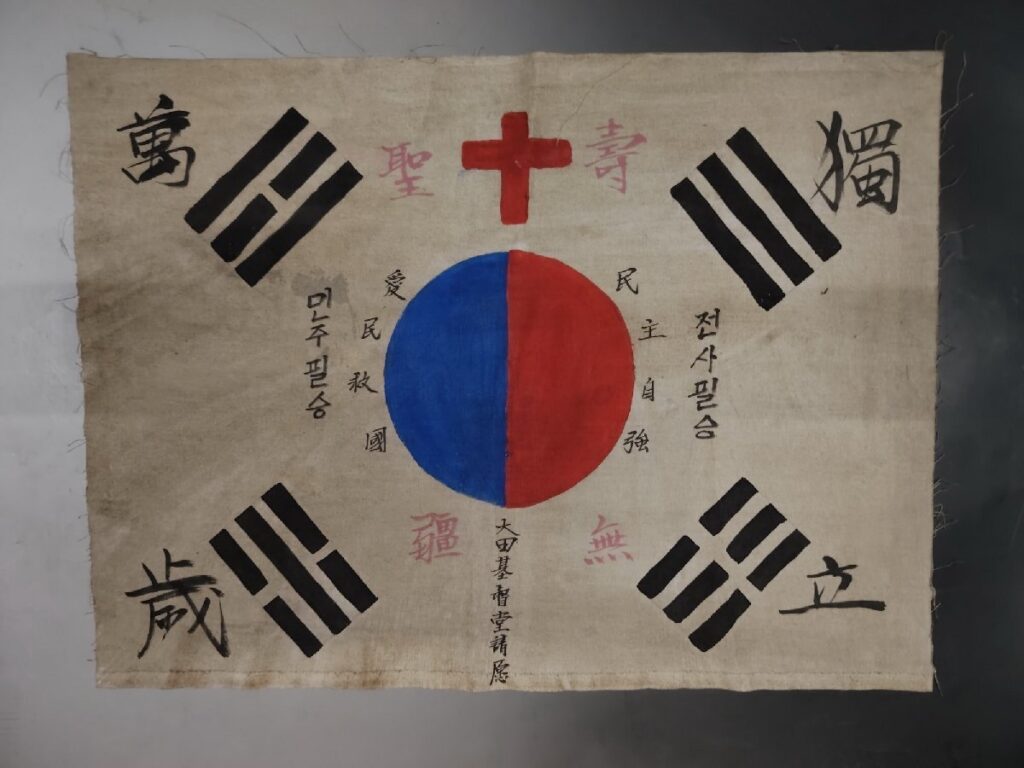
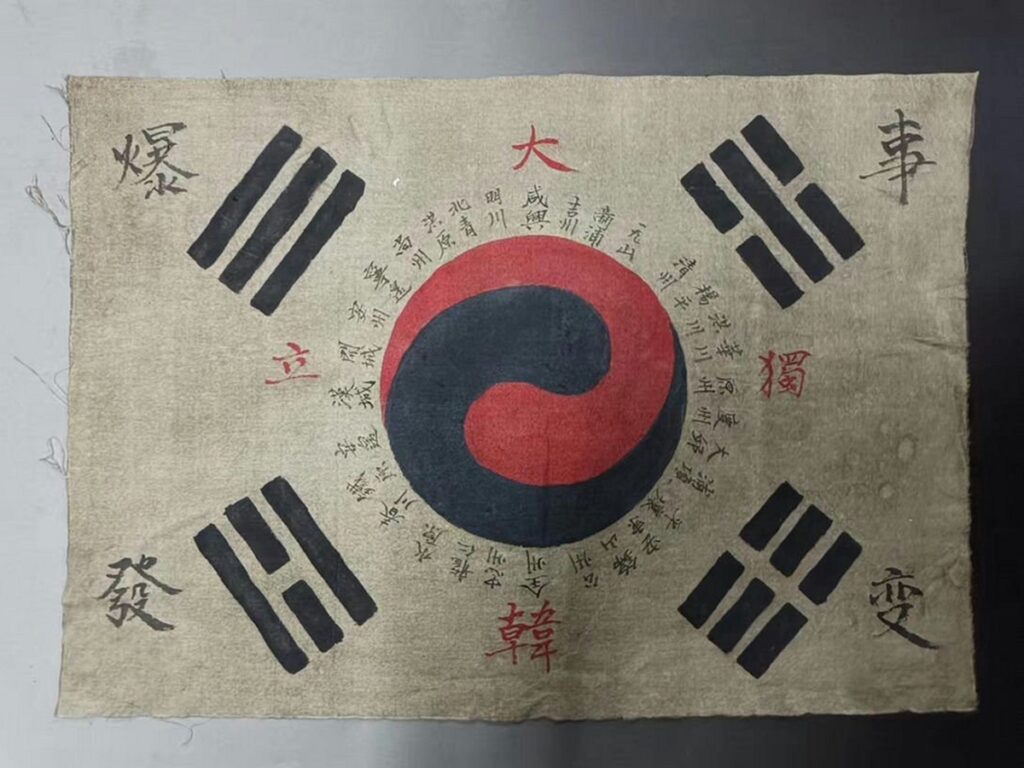
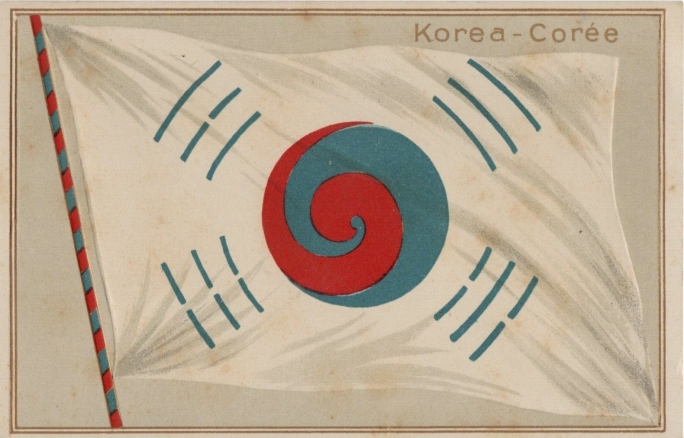
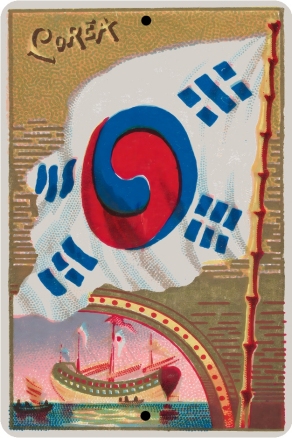
The ‘Denny Taegeukgi’ 데니태극기 (Registered Cultural Property No. 382) is the flag that King Kojong (reigned 1863-1907) presented to Owen Nickerson Denny (1838-1900), an American diplomatic adviser. In 1981, the flag was donated to Korea by William Ralston, a descendant of O. N. Denny. During the negotiations of the United States–Korea Treaty of 1882, also known as the Shufeldt Treaty, the U.S. emissary Robert Wilson Shufeldt suggested that Korea adopt a national flag to represent its sovereignty. Subsequently, the 1882 design of the Korean flag, the Taegukgi 태극기, had a whorl at its center until 1910. It was depicted in 1889, with the whorl in the U.S. Navy book, Flags of Maritime Nations (see below). It is the earliest surviving depiction of the Korean flag.1 Because of the annexation, the flag disappears in the 1914 edition of the book. The current flag of the Republic of Korea first gained popularity when it was used by the Korean Provisional Government starting in 1919. During the March 1st, 1919, demonstration for independence, Korean leaders discouraged the use of the whorled flag because it represented the Korean Empire and was not a sign of modernity.
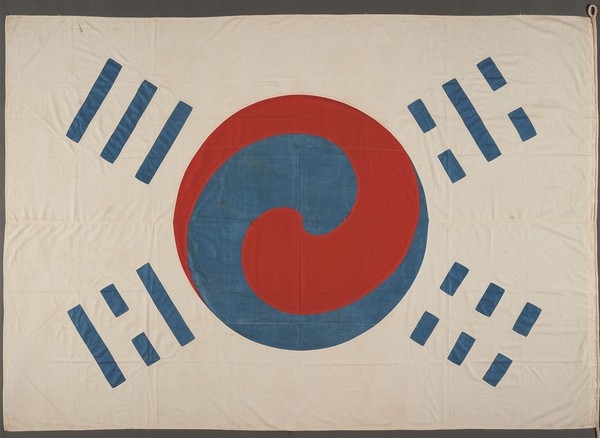
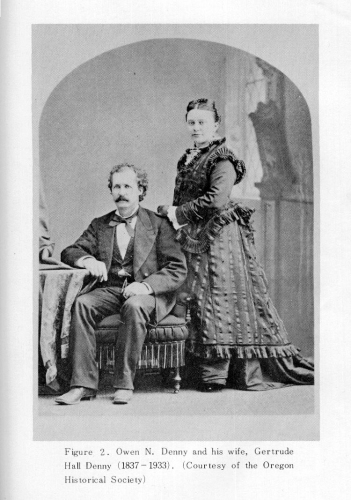
Owen Nickerson Denny (1838-1900)
Denny was an Oregon pioneer, lawyer, judge, tax collector, and diplomat whose acumen and influence in the Far East in the late 19th century was substantial. He is, generally, better known in Asia than he is in the United States. Among other things, he and his wife, Gertrude Jane Hall Denny (1837-1933), imported around 60 Chinese ring-necked pheasants. They arrived on March 13, 1881, at Port Townsend, Washington, aboard the ship Otago. The U.S. consul general had shipped the pheasants, along with other Chinese birds and plants, from Shanghai in hopes of establishing a population in Oregon, their home state. The birds have become so common that they seem to be more of a native species than one that was first established in the U.S. in 1881.
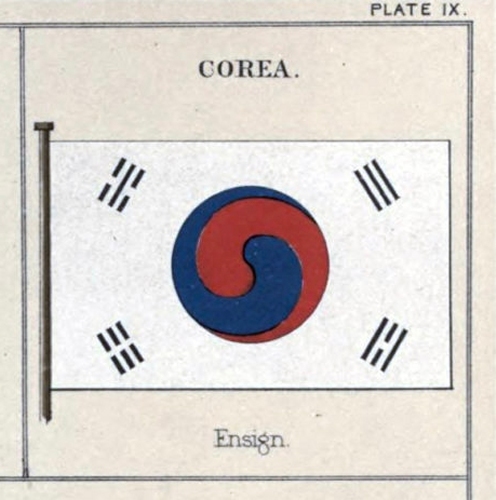
The 1889 illustration
At right is a detail from plate IX of the “Flags of Maritime Nations” showing the national flag of Korea in 1889. The Taegukgi was created in 1882 and made the national flag in 1883. The modern flag of Korea has the three solid trigram bars on the hoist side of the flag. You will notice the flag pictured on plate IX and in the examples above has the 3 solid bars on the fly side. However, a brief look at the Denny flag above shows that the 3 solid trigram bars are indeed on the flag’s fly side.
The South Korean flag in use today is considered by a large part of the country’s citizens to represent the “Korean race” rather than solely the South Korean state; consequently, the desecration of the flag by South Korean citizens is exceptionally rare.
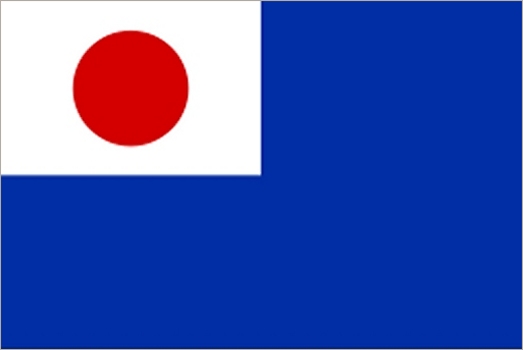
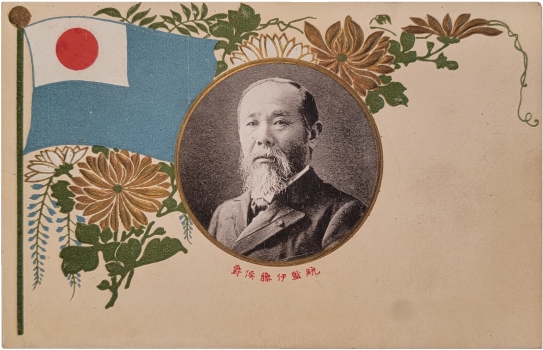
The flag of the Japanese Resident General of Korea.
I have not had the opportunity to translate the following three flags. As soon as I can find the time, I will.