
1949 Prewar Temporary Military Awards: the precursor to the Order of Military Merit
On July 15th, 1949, the Korean Department of Defense announced the establishment of a temporary system of military awards until a more permanent group of medals could be officially instituted by the central government. According to newspaper articles published on June 26, 1949 , this temporary group had 5 different awards, namely, a Distinguished Service Cross 武勳拔群章 (무훈발군장), a Distinguished War Service Medal 戰功章 (전공장), a Combat Service Medal 從軍章 (종군장), a Wound Medal for Permanent Disability 特別常夷軍人 (특별상이군인), and a (Standard) Wound Medal 陸軍軍人常夷 (육군군인상이장). For some additional information, go to the Korea 1945–1950 webpage.
The center picture below came from an exhibition entitled “6.25 War and Military Merit – Special Exhibition of ‘Honor in the Heart’” 6.25전쟁과 무공훈장 – ‘가슴에 단 명예’ 특별기획전시회. This was an exhibition held to commemorate the 71st anniversary of the Korean War. It ran from July 2 to August 29, 2021, and was held in the lobby on the 1st floor of the “UN Forces First Battle” Memorial Hall.1 The United Nation’s First Battle is commonly referred to as the Battle of Osan 오산 전투 (July 5, 1950), where the 540 soldiers of Task Force Smith were trounced. Koreans refer to it as the Battle of Jukmiryeong 죽미령 전투의. Task Force Smith is often used as a metaphor for military unreadiness or unpreparedness. The exhibition has since moved on to other venues around the country.
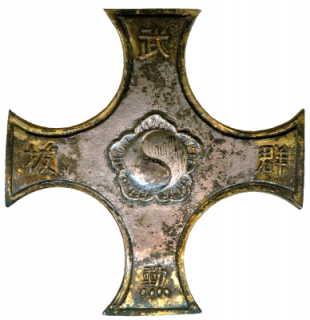
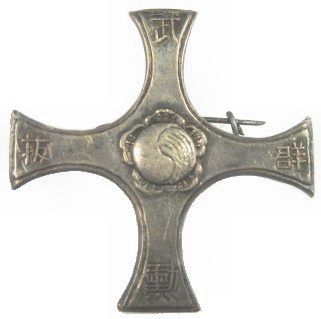
武勳拔群章 (무훈발군장) There is a stamped number on the reverse, but I am unsure if it is a serial number or production number.
There is no indication of the May 1951 Series.
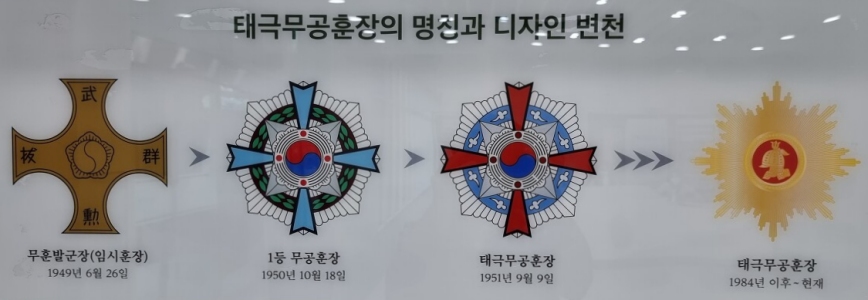
The title at the top of the cener picture above translates as “Name and design changes of the Taeguk Order of Military Merit” 태극무공훈장의 명칭과 디자인 변경. This drawing clearly indicates that the 1949 “Distinguished Service Cross,” 무훈 발군장, is regarded as an award equivalent to the Order of Military Merit, Taeguk Class. The three arrows before the last image indicate that there were other design versions of the Taeguk Class Medal between 1951 and 1984. The lower part of the picture reads as: Distinguished Service Medal (Temporary Medal) June 26, 1949 > 1st Class Military Merit Medal October 18, 1950 > Taeguk Order of Military Merit September 9, 1951 >>> Taeguk Order of Military Merit 1984~Present. 2
We now know that Korea considers the 1949 Distinguished Service Cross 武勳拔群章 (무훈발군장) as the predecessor and equivalent of the Order of Military Merit, Taeguk Class (1st Class).
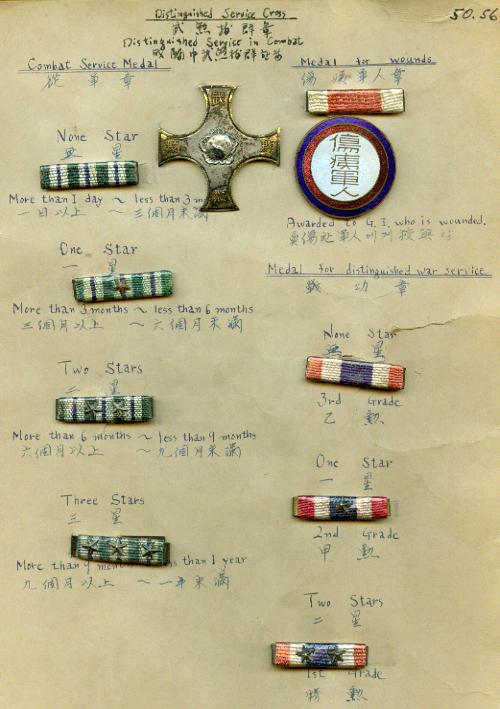
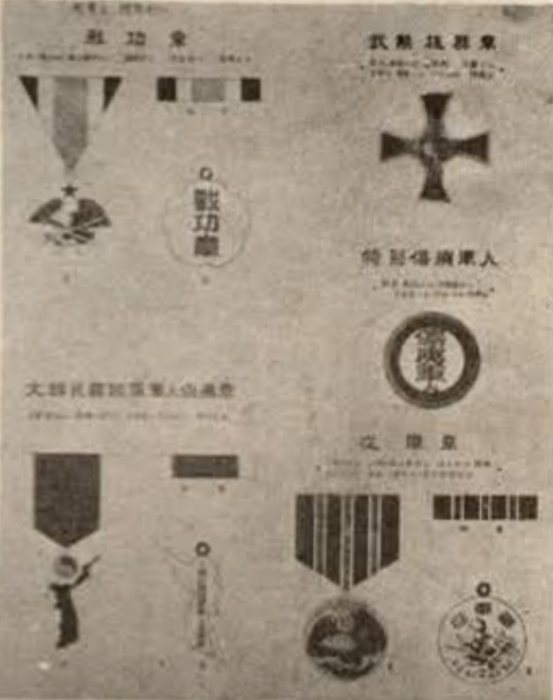
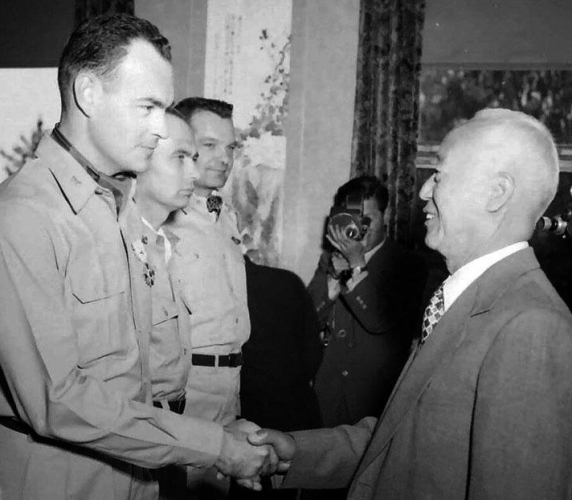
In June 1949, Major General Edgar Erskine Hume (1889-1952) was appointed Director General of Medical Services for the U.S. Far East Command under General Douglas MacArthur. The nature of his work required extensive traveling and afforded him many opportunities to obtain orders and medals for his collection. By the time he reached the end of his career, he not only had a large medal collection, but he was also the most decorated medical officer in the Army.3 Pictured to your right is the set of Korean Military Awards that Major General Hume acquired from the Korean military. He donated this set to the American Numismatic Society in December 1949. The annotations and ribbon bars on this document add a significant amount of information to the aforementioned newspaper articles. It indicates that the Combat Service Medal 從軍章 (종군장) had four different ribbon bars that were awarded based on time served. It also indicates that the Distinguished War Service Medal 戰功章 (전공장, literally, War Merit Medal) had three different ribbon bars but unfortunately does not give the award criteria. It has the Distinguished Service Cross 武勳拔群章 (무훈발군장), as well as the Special Wound Medal awarded for Permanent Disability 特別常夷軍人 (특별상이군인) and the ribbon bar for the (Standard) Wound Medal 陸軍軍人常夷 (육군군인상이장). There is no mention of the award criteria for the Distinguished Service Cross. Try as I might, I have not been able to find any additional information on these awards. Attempts to contact the Korean military have been futile. The only additional information that the ANS has is a copy of the original letter from Major General Hume, as well as the acquisition and de-acquisition dates. Major General Hume received the Korean Order of Military Merit, Ulchi Class, on 8/21/1951.
The Korean Medal Roll only shows one Order of Military Merit, 1st Class, being issued before the Order was created on October 18, 1950, and that went to Douglas MacArthur. Both Distinguished Service Crosses have stamped numbers on the reverse, and it is unclear if these were serial numbers or production numbers.
The award criteria for the three classes of the Distinguished War Service Medal are unknown, but they could be the predecessors of the 2nd, 3rd, and 4th classes of the Order of Military Merit. The Korean Medal Roll is now available to the public. Surprisingly, it lists 13 people who were awarded 3rd and 4th Classes of the Order of Military Merit before the Korean Government established the Order. The Korean Medal Roll shows that 3rd Classes were awarded on Oct. 1st (1 ea.) and Oct. 15th (1 ea.) and that 4th Classes were awarded on July 1st (9 ea.), July 3rd (1 ea.), and Oct. 10th (1 ea.). Since we know that the Koreans consider the Distinguished Service Cross as the 1st Class of the Order of Military Merit, it is possible that the three ribbon bars for the Distinguished Service Medal are equivalent to the 2nd, 3rd, and 4th Classes of the Order of Military Merit.
To your right is the set of medals donated by Maj. General Hume to the American Numismatic Society in New York City. The ANS sold this group at Morton and Eden Auction #26 in April 2007. Lot #252 brought £320 (approx. $640 U.S.) plus a 15% buyer’s fee of £48 (approx. $96 U.S.).
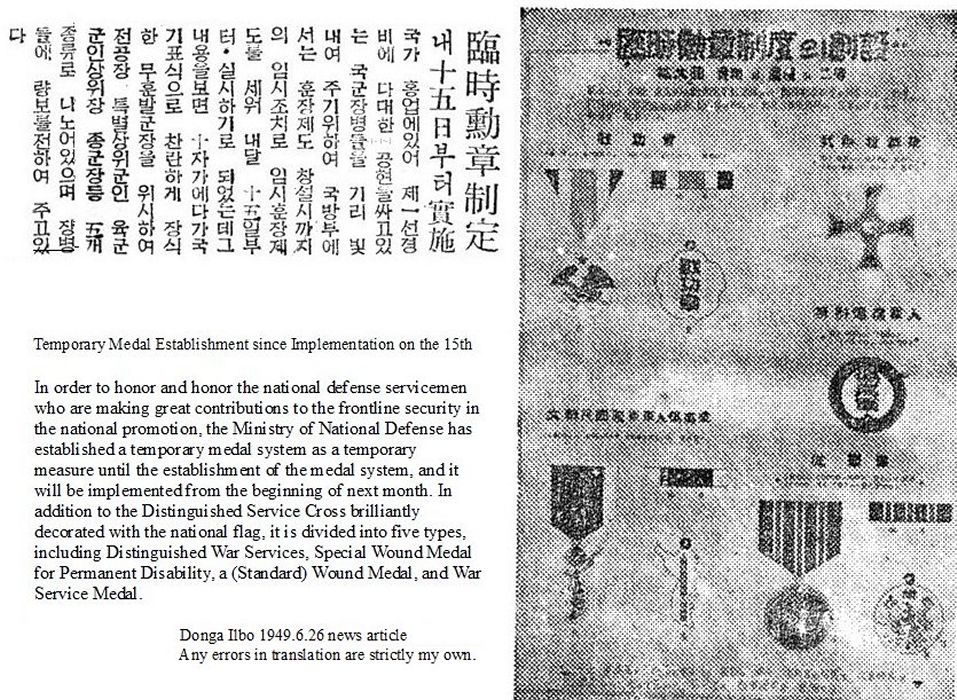
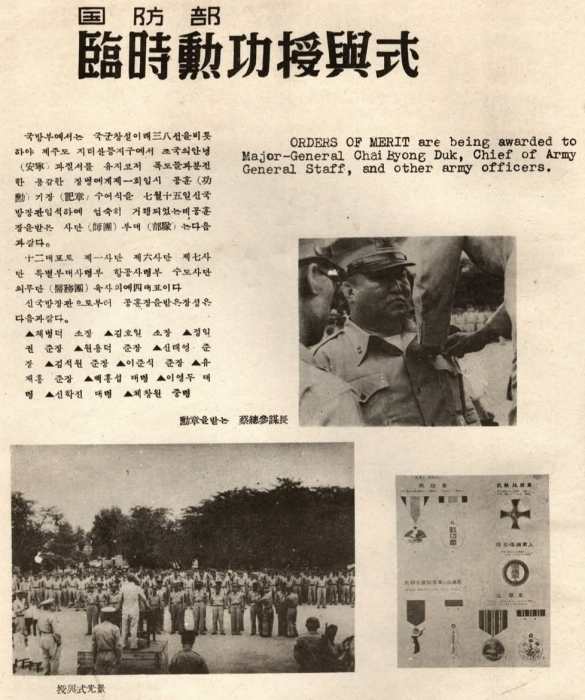
Translation of the July 15, 1949, newspaper article, pictured at left.
Ministry of National Defense 國防部
Temporary Merit Award Ceremony 臨時勳功授與式
The Ministry of National Defense solemnly held its First Temporary Merit Service Medal Conferral Ceremony on July 15th in the presence of the newly appointed Minister of National Defense. The ceremony honored the brave officers and men who, since the founding of the National Armed Forces, fought courageously against rioters to maintain the peace and order of the fatherland along the 38th parallel as well as in areas such as Jeju Island and Mount Jiri. The divisions and units that received these medals of merit are as follows:
Representing the 12 selected units are the 1st Division, 6th Division, 7th Division, Special Forces Command, Air Command, Capital Division, Medical Corps, and four representative units from the Korea Military Academy.
The generals and high-ranking officers who received the medals of merit from the new Minister of National Defense are as follows.
▲Major-General Chai Byong Duk ▲Major-General Kim Ho Il ▲Brigadier General Chung Il Kwon ▲Brigadier General Won Yong Duk ▲Brigadier General Shin Tae Young ▲Brigadier General Kim Suk Won ▲Brigadier General Lee Jun Shik ▲Brigadier General Yu Jae Hung
▲Colonel Baek Hong Seop ▲Colonel Lee Young Doo ▲Colonel Shin Hak Jin ▲Lieutenant Colonel Chae Chang Won
(I assume that the generals and high-ranking officers mentioned above received the Distinguished Service Cross 武勳拔群章 (무훈발군장).)
The National Institute of Korean History (NIKH) adds an interesting footnote to this story. It has an entry on the same day as the newspaper article (above) about the award ceremony on July 15, 1949, entitled “For the first time since the founding of the military, the Ministry of National Defense held the first award ceremony for 28,000 soldiers”. It goes on to say:
The Ministry of National Defense held the first temporary merit medal award ceremony since the founding of the Armed Forces for each soldier in the forecourt of the headquarters building at 11:30 a.m. on the 15th.
The ceremony first included a salute to Minister of National Defense Shin Song-mo 신성모 (申性模), followed by the singing of the national anthem, meditation, and a congratulatory message sent from President Syngman Rhee to the commander of the 3rd combat district from Minister of National Defense Shin Song-mo to Brigadier General Won Yong-deok 원용덕 (元容德), commander of the Honam District Combat Command, Brigadier General Jeong Il-kwon 정일권 (丁一權), commander of the Jirisan District Combat Command, and Jeju Island District Combat Commander. The awards were made by the order of Brigadier General Yu Jae-hung 유재흥 (劉載興), followed by the Major General’s Medal and the Military Commander’s Medal. The recipients of the bronze medal were Major General Chae Beong-deok 채병덕 (蔡秉德),4 Brigadier General Jeong Il-kwon 정일권, Brigadier General Won Yong-deok 원용덕, Brigadier General Shin Tae-yeong 신태영 (申泰永), Brigadier General Kim Seok-won 김석원 (金錫源), Brigadier General Yi Yeong-mu 이영무 (李英茂), Brigadier General Choi Yoo Chang-eon 최창언 (崔昌彦), Colonel Baek Hong-seok 백홍석 (白洪錫), Colonel Yi Yeong-mu 이영무 (李英茂), There was an order from the next minister, awarded in that order to Lieutenant Colonel Choi Chang-yeon 최창언 (崔昌彦), and after a visit by the Chief of the General Staff, Chief of Staff Choi, the awarding ceremony ended at 12 o’clock with the award of medals to each unit. There are three types of awards: 24,303 recipients for the Combat Service Medal 從軍章 (종군장), 1,860 for the Distinguished War Service Medal 戰功章 (전공장), and 2,009 receiving the Disability Medal 傷痍章. A total of 28,172 people were awarded certificates of merit.
The above article would seem to indicate that there should be 28,000+ of the temporary medals existing and available to collectors. But, as the last line says, “A total of 28,172 people were awarded certificates of merit.” Even so, there should be 28,000+ documents available to collectors, but since no documents and only two medals have been found, it is believed that the recipients merely had the awards logged in their personnel files.
For additional information on the Wound Medal and ribbon bar, go to my Wound Medals Page.
The Substitute Order of Military Merit (the non-legislated Order of Military Merit.)
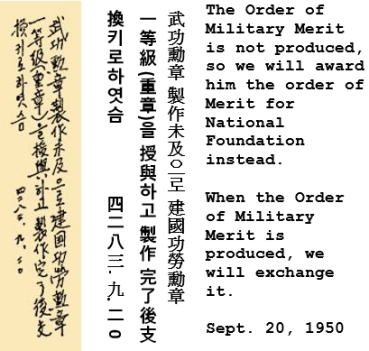
(Original at left, my translation at center and right.
Any errors in translation are strictly my own.)
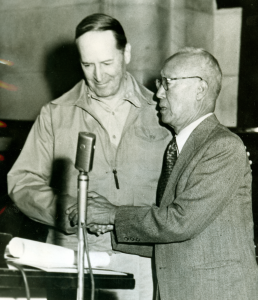
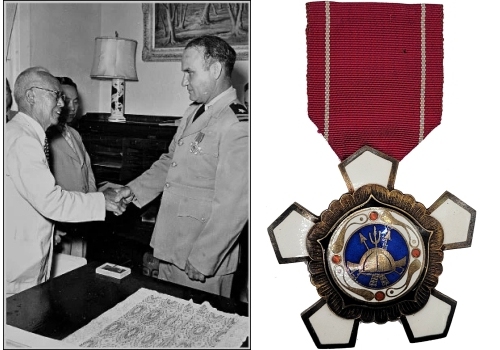
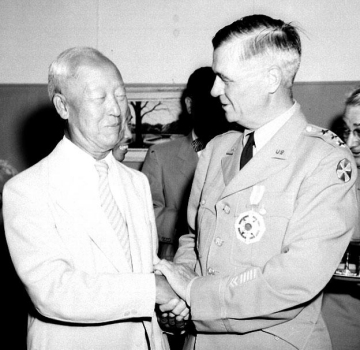
The history of Korea’s actual “Order of Military Merit” begins with General Douglas MacArthur. On Sept. 29, 1950, there was a formal ceremony during which the general officially returned the city of Seoul to the Republic of Korea. President Syngman Rhee wanted to award a medal to the general, but the Korean government had never authorized an Order of Military Merit. The President authorized the addition of a star to the Order of National Foundation, which he planned to present to Douglas MacArthur as the Order of Military Merit along with a document. Unfortunately, the Order did not arrive in time for the ceremony. In 1951, General George C. Kenney published a book in which he discusses the Sept. 29th ceremony. He writes, “MacArthur sat down. Syngman Rhee rose and walked to the rostrum, wiped his eyes, and read his speech. He speaks excellent English, but it was difficult to understand him. Emotion had gripped him too. His voice was broken and at times hardly audible. He finished and presented a scroll to General MacArthur, which was the award of the Order of Merit of the Republic of Korea, their highest decoration. You found yourself sorry for Rhee when he apologized for not having the medal itself or even a ribbon to give MacArthur.”5 The picture on the left was taken immediately after Syngman Rhee presented the Document for the Order of Military Merit to Douglas MacArthur. You can see the document sitting on the lectern before them. There is a distinct possibility that the general never took physical possession of his Korean Order of Military Merit, 1st Class. The Douglas MacArthur Memorial in Norfolk, Virginia, does not have the medal. Their records and correspondence from that period would seem to indicate that Douglas MacArthur never received it, and there are no pictures of him wearing the medal. It is difficult to believe that the Korean government would not have given him the medal. There are internet sources that state that the medal was presented to the general in Japan on December 23, 1950, by Mr. Jang Ki-young 장기영 (張基榮 1916-1977). However, in 1950, he was the Deputy Governor of the Bank of Korea. If anyone would have presented the medal, it would have been a representative of the Korean Diplomatic Mission in Japan, either Kim Yong-sik or Kim Yong-ju, and there certainly would have been pictures taken of the event.6 There are other internet sources that state that letters from the Ministry of National Defense (Army) in 1950 and 1951 mention that MacArthur did not receive the medal. I have been unable to substantiate these remarks.
A quick update: Several Korean news agencies have recently stated that the Korean Government gave MacArthur an Order of National Foundation Merit as a substitute until the Order of Military Merit was established. However, they do not give a time or place when the original or the replacement medal was given, and some news reports specifically state that his “actual replacement” Order of Military Merit was never delivered. On Jan. 26, 2024, Korea remedied this situation when, in a formal ceremony, they delivered a (current series) Order of Military Merit, Taeguk medal to Norfolk, Virginia, Mayor Kenneth Alexander. He accepted the award on behalf of the General MacArthur Foundation and the MacArthur Memorial. The MacArthur Memorial Hall is where General MacArthur and his second wife, Jean MacArthur, are buried. January 26th was selected for the presentation ceremony because it is the birthday of General MacArthur (Jan. 26, 1880) and the 60th anniversary of the establishment of the MacArthur Memorial Hall. Douglas MacArthur’s son, Arthur MacArthur IV (1938-), was unable to attend the ceremony. The website for the MacArthur Memorial is at https://www.macarthurmemorial.org/. Donations to the memorial can be made at https://macarthurmemorial.org/538/Donate. In an article by Yunhap News 연합뉴스, they reported that the originally awarded medal would be put on display shortly. However, years ago, in speaking with the memorial, they stated that the original medal was missing, and the museum has no records to indicate that it was ever in their possession. I recently contacted the memorial, and they still do not have the original award. There is a YouTube video showing the recent award ceremony. It is located at https://www.youtube.com/watch?v=6kAnnCpFUgA. One interesting little detail: with all the Korean dignitaries in attendance, no one noticed that the Breast Star, Ribbon Bar, and Lapel Pin were displayed upside down.
Even though an Order of Military Merit was instituted on Oct. 18, 1950, the Korean government continued to issue the substitute Order of National Foundation with the attached star and with a document stating that it was the “Order of Military Merit with Gold or Silver Star.” All of these substituted medals went to high-ranking American officers. It is assumed that the Korean Government wanted to keep some form of continuity between American officers when wearing their Korean Orders. Non-American officers received the newly created Order of Military Merit.
The substituted awards all came with either a Gold Star 금성 (金星) for a 1st Class Award or a Silver Star 은성 (銀星) for a 2nd Class Award. There were no 3rd or 4th Class substitute awards.7 Without the star, there is no way to differentiate between an Order of Military Merit and an Order of National Foundation unless one has a document stating otherwise; however, according to the Korean Medal Roll, there were no 1949 Series, 2nd Class, Orders of National Foundation issued.
It’s not difficult to see the logic in their solution of substituting the Order of National Foundation for the Order of Military Merit. The Republic of Korea was less than two years old when the war started. Defending the country can be viewed as maintaining the foundation of the nation. On Dec. 22, 1951, the Korean government enacted Presidential Decree #583 for the Order of National Foundation. That legislation added a small change to the award criteria. The legislation states, “Those who are qualified to receive the Taeguk Class of the Order of Military Merit and whose achievements are “Particularly Remarkable” may be awarded the 1st Class Order of Merit for National Foundation.”
The Korean War Museum in Seoul has no examples of the substituted medals.
There is another possibility for General MacArthur’s missing medal. All of the substitute 2nd class medals were using the 2nd class of the Order of National Foundation. They may have wanted MacArthur’s 1st Class to use a 1st Class of the Order of National Foundation, and they simply did not have one in stock.
There is another little twist to this story. At least one of the substituted medals was purportedly issued to the American 5th Air Force as a Presidential Unit Citation 대통령부대표창 (大統領部隊表彰) on Jan. 31, 1951. I do not believe this is true, and unfortunately, the 5th Air Force is unable to locate the medal and its associated paperwork.
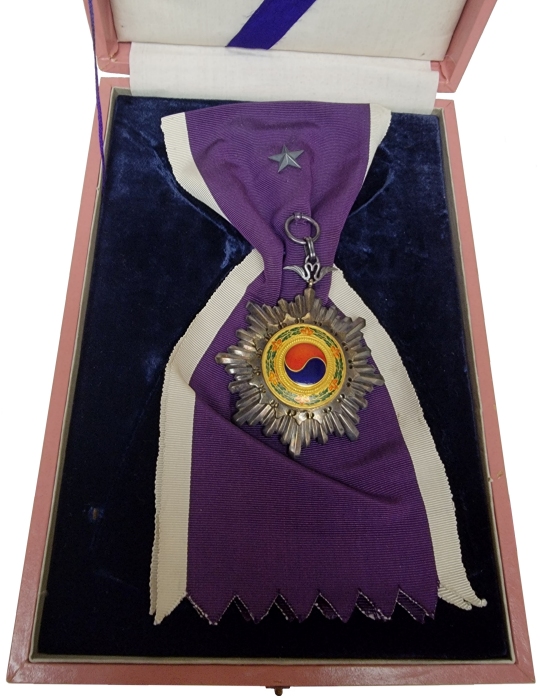
Part of the Frank Draskovic Collection.
| Gold Star (Taeguk) | Silver Star (Ulchi) | Medal Roll Date | Assignment | |
|---|---|---|---|---|
| Douglas MacArthur | 9/29/1950 | Army Headquarters Far East Allied Forces General Headquarters Command | ||
| Walton Harris Walker | 12/19/1950 | Army Headquarters, U.S. Army in Korea, 8th Corps Command | ||
| George E. Stratemeyer | 12/19/1950 | Air Force Headquarters U.S. Air Force Unit | ||
| Earle Everard Partridge | 12/25/1950 | Air Force Headquarters 5th Air Force, Commander-in-Chief | ||
| Edward M. Almond | 12/25/1950 | Army Headquarters U.S. X Corps Stationed in Korea | ||
| Emmett O'Donnell | 12/25/1950 | Air Force Headquarters U.S. Air Force Far East Bombardment Squadron | ||
| Charles T. Joy | 12/25/1950 | Naval Headquarters Commander, U.S. Navy Far East Command | ||
| Arthur Dewey Struble | 1/30/1951 | Naval Headquarters Navy 7th Fleet Command | ||
| Allan E. Smith | 2/3/1951 | Naval Headquarters UN Maritime Corps | ||
| Edward J. Timberlake | 4/10/1951 | Air Force Headquarters U.S. 5th Air Force | ||
| Oliver Prince "O.P." Smith | 4/26/1951 | Commander, U.S. Marine Corps Command, Naval Headquarters | ||
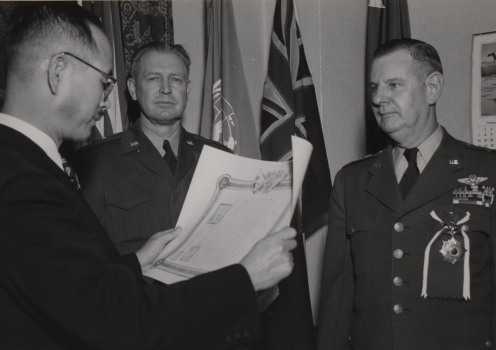
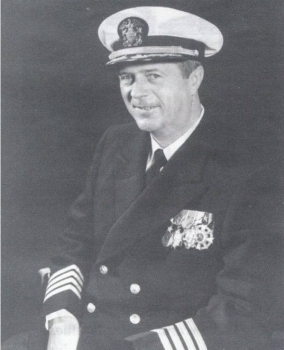
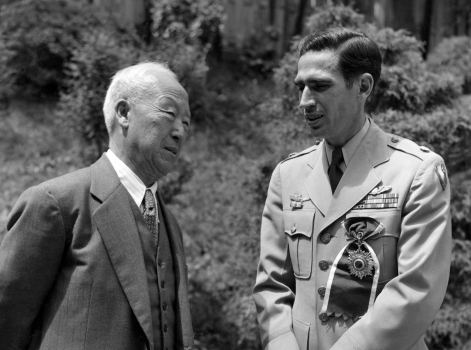
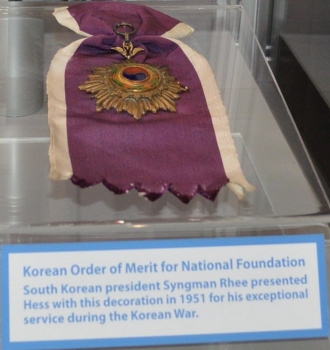
| Dean E. Hess | 5/29/1951 | Air Force Headquarters Air Force Advisor | ||
| Frank W. Milburn | 7/17/1951 | Army Headquarters 1st Corps | ||
| Michael Joseph Luosey | 7/24/1951 | Naval Headquarters U.S. Naval Command in Korea | ||
| David C. Holly | 7/24/1951 | Naval Headquarters U.S. Naval Command in Korea | ||
| William F. Dean | 7/24/1951 | Army Headquarters US 8th Corps | ||
| Notes In the early days of the Korean War, the only non-Koreans to be awarded the first or second classes of the Order of military Merit were Americans. This is a complete list of Americans taken from the korean medal roll between June 25, 1950 and Aug. 19, 1951. Dean Hess is the last confirmed award, and I strongly suspect that the awards before him were all substitutes. According to this list, there were 12 substituted OMMs. Originally, I also suspected that the 4 names after Dean Hess were also substitute awards and that the Korean government did not quit this practice until the new Order of Military Merit Decree (Presidential Decree #522) was enacted on Aug. 19, 1951. However, a picture (shown below) of Michael Joseph Luosey has surfaced that shows him wearing the Ulchi Medal from the May 1951 Series. Since David C. Holly and William F. Dean were also decorated on the same day, I now believe they did not receive a substituted medal. There is also a picture below of Lt. Gen. John Breitling Coulter being awarded the Taeguk medal on 8/21/51 (after the series change). However, he is wearing a medal from the earlier May 1951 Series. General O. P. Smith's decoration is confirmed in the article "YOUR KOREAN DECORATIONS", Marine Corps Gazette, Author: Jane F. Blakene, Dated Mar 1954, P.36. The medal roll date may not be the same as the actual date of the award ceremony. If you can confirm any of the other awards, either with a picture of the person's medal group or a picture of the recipient with the award, please drop me a line. |
||||
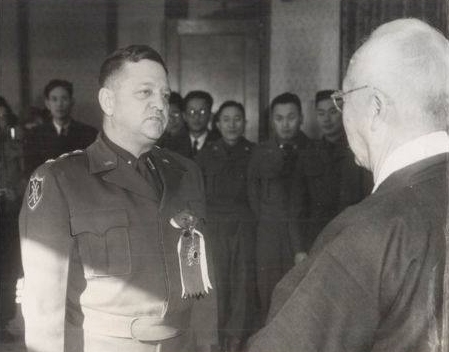
He was the very first recipient of the Order of Military Merit, with Silver Star (2nd Class), Dec, 19, 1950. He died in a traffic accident five days later on Dec. 24th. The U.S. Army posthumously promoted him to full General. The Korean government awarded him a second Order of Military Merit, Ulchi, on Jan. 3, 1953.
Shown in the list above, he has been awarded the Order of Military Merit, 2nd Class from the May 1951 Series and not the substitute medal.
The Order of Military Merit 무공훈장 (武功勳章)
From this point forward, I deal with the standardized/legislated Order of Military Merit.
The Order of Military Merit is the primary award for the Korean military. Originally, it was issued for either combat or non-combat actions. Beginning in 1967, it was only issued for actions in wartime or under a state of emergency. Non-combat military actions are awarded the Order of National Security Merit.
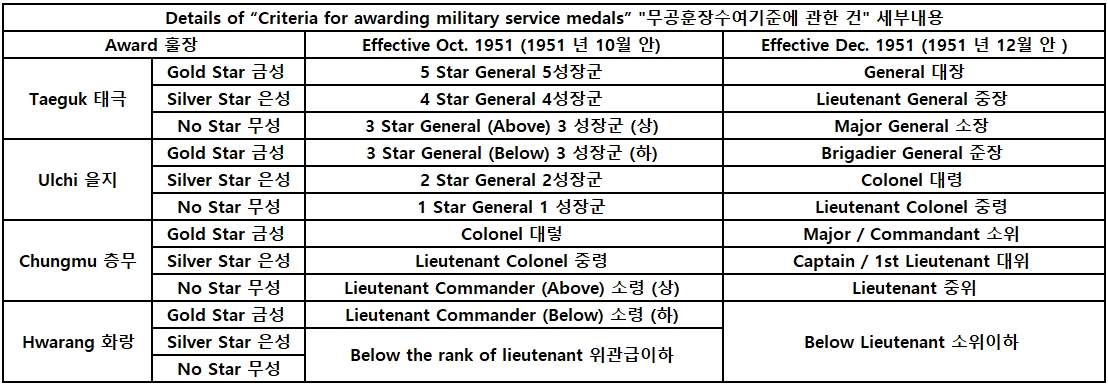
The vast majority of Korean Orders of Military Merit (as well as the Order of National Security) are awarded based on the recipient’s rank. Generals get the Taeguk Medal, pilots get the Chungmu Medal, enlisted men get the Hwarang Medal, etc. For a more detail explanation, see the table on your right, titled ‘Details of “Criteria for awarding military service medals”’ “무공훈장수여기준에 관한 건” 세부내용.11
One thing that is unique about ‘Special Veteran Status’ in South Korea. You do not have to be in the military to receive veteran status if you have provided significant information on enemy activities or helped the war effort by some other substantial measure. There is at least one story of an Order of Military Merit that was given to a child who reported the location of a band of North Korean guerrillas in South Korea. I have not been able to confirm this. It is documented that women and children who aided the struggle against the North Koreans received “Special Veteran Status.” 12
The KOREAN JOURNAL OF HERITAGE: HISTORY & SCIENCE had an article entitled “A Study on the Regulations and Extant Objects”. It deals with the changes to the Korean Order of Military Merit over time. Click here for English, or Click here for Korean.
OCTOBER 1950 SERIES
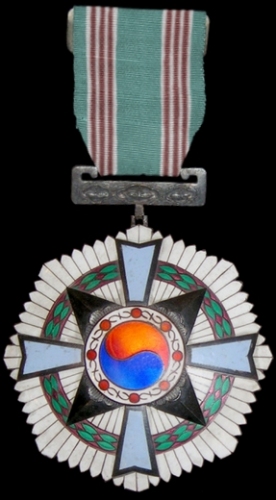
I have been told that this is a composited picture. I would appreciate it, if someone can put me in contact with the owner.

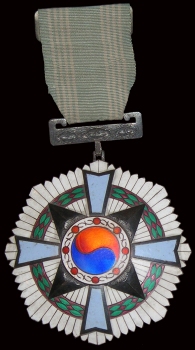
On Oct. 18, 1950, under Presidential Decree #385, the Republic of Korea instituted its first Order of Military Merit. A remarkable feat, considering that the government was busy fighting a war and that the center of government had been forced to move South as the front lines of the war had advanced. This first, officially sanctioned, Order of Military Merit consisted of four numbered classes. To date, only one medal from this series has surfaced, and it is rumored to be a composite picture.
On Apr. 26, 2007, the American Numismatic Society sold their Korean medals at auction. One of the lots included the first three ribbon bars, pictured at right. 13 Also included in the picture is the 4th Class ribbon bar that was presented to Captain Meredith J. Larson.14
- 1st Class: The pendant has a diameter of 80 mm and is suspended from a 36 × 46 mm breast ribbon. The base color of the ribbon is light blue. The ribbon has six 1 mm red (적색) stripes and eight 1 mm white (백색) stripes. The 11 × 36 mm ribbon bar has the same stripe colors and widths as the ribbon. The Taeguk symbol on the ribbon bar is 8 mm in size.
- 2nd Class: The pendant has a diameter of 60 mm and is suspended from a 36 × 46 mm breast ribbon. The base color of the ribbon is light blue. The ribbon has four 1 mm red stripes and six 1 mm white 백색 stripes. The 11 × 36 mm ribbon bar has the same stripe colors and widths as the ribbon. The Taeguk symbol on the ribbon bar is 8 mm in size.
- 3rd Class: The pendant has a diameter of 60 mm and is suspended from a 36 × 46 mm breast ribbon. The base color of the ribbon is light blue. The ribbon has two 1 mm red stripes and four 1 mm white stripes. The 11 × 36 mm ribbon bar has the same stripe colors and widths as the ribbon. The Taeguk symbol on the ribbon is 8 mm in size.
- 4th Class: The pendant has a diameter of 60 mm and is suspended from a 36 × 46 mm breast ribbon. The base color of the ribbon is light blue. The ribbon has two 1 mm red stripes and two 1 mm white stripes. The 11 × 36 mm ribbon bar has the same stripe colors and widths as the ribbon. The Taeguk symbol on the ribbon is 8 mm in size.
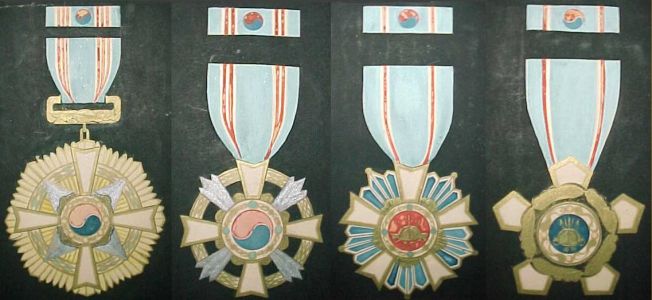
Drawings courtesy of the Korean Office of Protocol, Orders, and Medals Dept (1999).
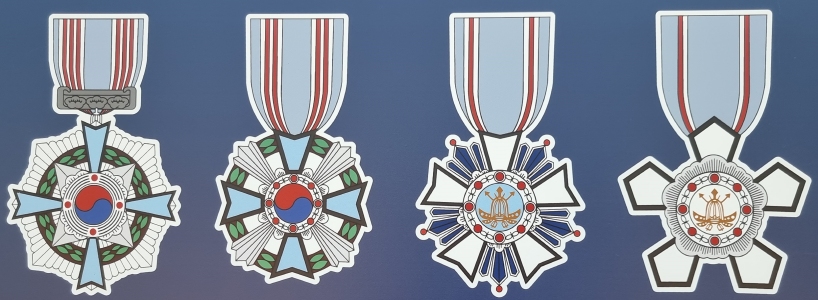
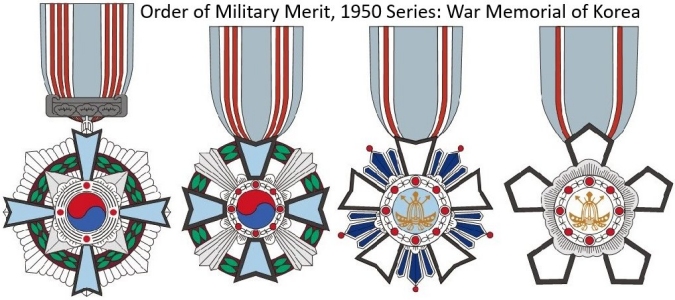
Source: War Memorial of Korea
DECEMBER 1950 SERIES
Under Presidential Decree #427, the Order of Military Merit Decree 무공훈장령, dated Dec. 29, 1950, the Korean government made no changes to the dimensions or design of the medals for military merit. The only change was that each of the four classes was to be further broken down into 3 grades, with the use of a Gold Star 금성 (金星), Silver Star 은성 (銀星), or No Star (Starless) 무성 (無星).15 In effect, this created an Order of Military Merit with 12 grades and allowed an enormous amount of latitude in the selection of an appropriate award for an individual. For those classes that were awarded with a Gold or Silver Star, the stars affixed to the drape were 1.8 cm in size. Smaller Gold or Silver Stars were also affixed to the ribbon bar. Those medals without stars cannot be differentiated from the previous series. The ribbon bars are 11 x 36 mm in size. Purely speculation, but the Koreans may have been trying to keep some continuity with the Substitute Awards (above), which had a Gold or Silver Star. Mugunghwa leaves were used on the ribbon bars to indicate multiple awards of the same medal. However, no Mugunghwa leaves have been observed to indicate a multiple award of a specific order. There are a lot of Korean medal groups with multiples of a particular class and grade. (For an example of one such group, take a look at my “Miniature Medals” page.) Mugunghwa leaves have been observed on other awards, such as the wound medal.
Regarding the Korean Medal Roll there is a ‘fly in the ointment’ concerning the “Star System.” The online medal roll does not list any awards as being Gold Star or Silver Star. For example, the Order of Military Merit, 1st Class awards are listed as Taeguk Medals. According to “A Study on the Regulations and Extant Objects of the Republic of Korea’s Military Decorations” 대한민국 무공훈장의 제식과 실물 연구, concerning the 1st Class. it states: “There are 52 cases of Gold Star, 69 cases of Silver Star, 225 cases of No Star, and 12 cases marked as First Class Order of Military Merit.”16 All of them are listed as Taeguk medals. The same is true for the remaining three classes.
There are internet sources that state that the red stripes were removed from the ribbons and ribbon bars at this time; however, this is simply not true.
MAY 1951 SERIES
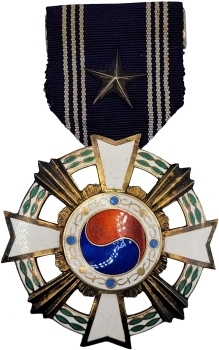
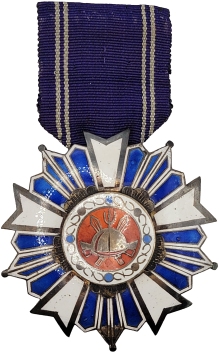
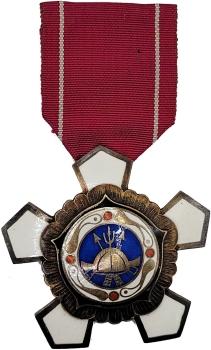
On May 21, 1951, under Presidential Decree #501, the Korean government changed the ribbon and ribbon bar colors. The pendants remained the same as the previous series. All the ribbon bars have an 8 mm Taeguk symbol in the center, with the red in a superior position above the blue. If a medal is awarded with a gold or silver star, then a 1.8 cm gold or silver star is placed in the center of the drape. A smaller star is placed in the center of the ribbon bar, obscuring the Taeguk symbol.

Drawing courtesy of the Korean Office of Protocol, Orders, and Medals Dept.
- 1st Class 일등장. The pendant has a diameter of 80 mm and is suspended from a 36 × 46 mm breast ribbon. The base color of the ribbon is light blue 담청색 (淡靑色). The ribbon has eight 1 mm white 백색 stripes, with four on each side of the center. The 11 × 36 mm ribbon bar has the same stripe colors and widths as the ribbon.
- 2nd Class Medal 이등장. The pendant has a diameter of 60 mm and is suspended from a 36 × 46 mm breast ribbon. The base color of the ribbon is purple/violet 자색 (紫色). The ribbon has six 1 mm white 백색, with three on each side of the center. The 11 × 36 mm ribbon bar has the same stripe colors and widths as the ribbon.
- 3rd Class Medal 삼등장. The pendant has a diameter of 60 mm and is suspended from a 36 × 46 mm breast ribbon. The base color of the ribbon is indigo blue 남색. The ribbon has four 1 mm white stripes, with two on each side of the center. The 11 × 36 mm ribbon bar has the same stripe colors and widths as the ribbon.
- 4th Class Medal 사등장. The pendant has a diameter of 60 mm and is suspended from a 36 × 46 mm breast ribbon. The base color of the ribbon is red 홍색 (紅色). The ribbon has two 1 mm white stripes, with one on each side of the center. The 11 × 36 mm ribbon bar has the same stripe colors and widths as the ribbon.
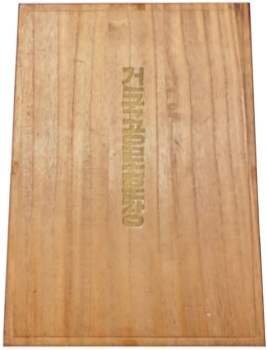
There is speculation that this series was produced in Japan, but there is no confirmation of this. The Korean War had severely limited Korea’s production facilities. However, those original issue cases that have been observed are similar to the wooden cases issued by the Japanese for many of their awards. To date, I have not seen this series in the dark blue cardboard boxes that were common for many of Korea’s other medals.
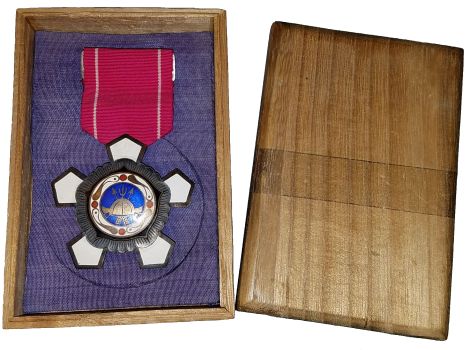
AUGUST 1951 SERIES
The previous versions of the Order of Military Merit had one major flaw: they were too heavy for the pins to support, resulting in many of those early medals having enamel damage. There was also the fact that the sheer size of the awards was incongruent when mounted with other medals. For example, the pendant/badge for the 1st Class was 8 cm (3⅛”) wide, while a typical pendant/badge is roughly 5 cm (2”), or less, in width. Presidential Decree #522 was enacted on Aug. 19, 1951. The Korean government redesigned the Order of Military Merit. Each class is now markedly different in size from the previous series. The pendant/badge for the 1st Class (now named the Taeguk Medal) dropped to 5 cm (1.97”) in width. All four classes are suspended from 46 × 36 mm breast ribbons and worn over the left breast pocket. If an award is given with a gold or silver star, then a 1.8 mm gold or silver star is placed in the center of the ribbon (drape). Each class also has an 11 × 36 mm ribbon bar with a Taeguk symbol in the center. The Taeguk is always displayed with the red in a superior position above the blue. If the award is given with a gold or silver star, then a small star is placed in the center of the ribbon bar, obscuring the Taeguk symbol.17 The stripe pattern and dimensions on the ribbon bar are the same as the drape. The Korean government also assigned names to each of the four classes.
The Classes are:
- Taeguk 태극 (太極). The diameter of the pendant is 50 mm. The ribbon is a light blue 담청색 (淡靑色) with eight 1 mm white stripes, with four on each side of the center.
- Ulchi 을지 (乙支). The diameter of the pendant is 45 mm. The ribbon is brown 갈색 (褐色) with six 1 mm stripes, three on each side of the center.18
- Chungmu 충무 (忠武). The diameter of the pendant is 41 mm. The ribbon is blue 청색 (靑色) with four 1 mm white stripes, two on each side of the center.
- Hwarang 화랑 (花郞). The diameter of the pendant is 40 mm. The ribbon is described as a reddish yellow (orange) color 황등색 (黃燈色), with two 1 mm white stripes, one on each side of the center.
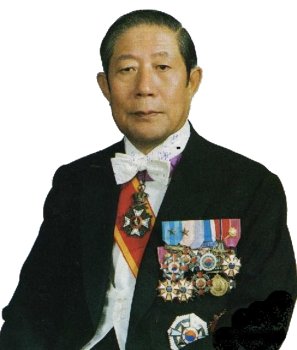
류재흥 (劉載興 1921–2011)
Notice the size difference between his two Orders of Military Merit, Taeguk medals. On the earlier award, he has removed the ribbon and is wearing it as a breast star.19
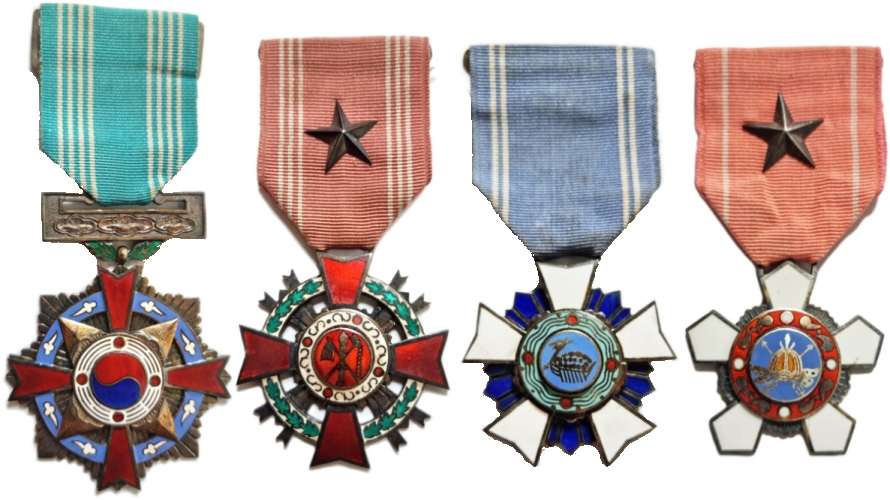
Each of the four classes has its own distinct ribbon color, and although not legal by statute, other colors of ribbons are known to exist.20 This may be due to wartime shortages of ribbon material. The most common colors for the Order are blue for the Taeguk, salmon pink/orange for the Ulchi, pale blue/slate gray for the Chungmu and pink/orange for the Hwarang although some Hwarang Medals have been observed with a deep red ribbon, which may have been ribbon stock left over from the previous series of the Order of Military Merit.
Of all the Korean orders, medals, and decorations, this is the one series that is most often encountered. Thousands of these medals were awarded to Korean and foreign soldiers during the war. By Aug. 15, 1952, almost a year before the war ended, the Korean Government had decorated some 6,288 foreigners. The vast majority of these recipients were members of the military.21 Korean recipients of the earlier series, who remained in service after the war, had their medals exchanged for this series. During the Korean War, 226 Orders of Military Merit, Taeguk Class Medals, were awarded. Out of 88 Korean recipients of the Order of Military Merit, Taeguk Class, all but 6 were veterans of the Korean War or the Vietnam War. Of these 88 Koreans, only 12 were enlisted men, and only 2 of those were below the rank of sergeant. The rest were all generals.
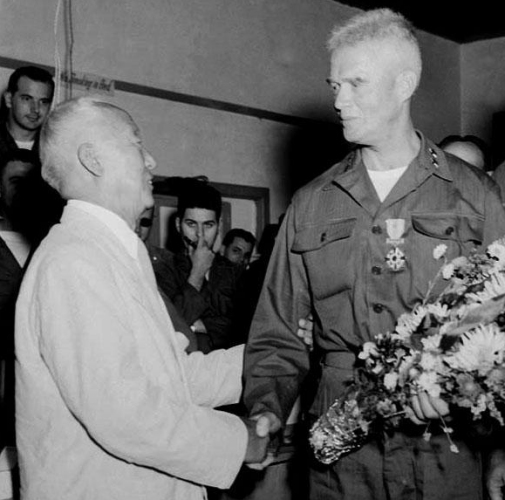
Officially, during the Korean War, 226 Orders of Military Merit, Taeguk Class Medals, were awarded. I found one reference that states that only 15 non-Korean troops have been awarded the Taeguk Medal during the Korean War. The United States topped the list with eight “Taeguk Medals.” The Philippines is second with two, and there is one each for Belgium, South Africa, Turkey, the United Kingdom, and Canada. I found another small reference about Korean soldiers, which stated that “About 60 soldiers received the Taeguk Order of Military Merit during the Korean War.” On April 28, 1951, Colonel Park No-gyu 박노규 (1918-1951) was the first Korean army officer to be awarded the Order of Military Merit, Taeguk Class. He was killed in action in the Battle of Ilwolsan 일월산전투 on Mar. 3, 1951, and posthumously promoted to brigadier general. Later that year, on October 15, 1951, Korean Army Sergeant First Class Lee Myeong-soo 이명수 (1927-2015) became the first Korean enlisted man to be awarded the Order of Military Merit, Taeguk Class, for his actions at the Battle of Yeongdeok 영덕전투 on July 28, 1950. There are sources that state that five Korean police officers also received the Taeguk Medal. I do not know if the Order of Military Merit, First Class, from the previous series is included in the 226 awards enumerated above; however, I believe it is likely. See the caption in the picture at the top of this page. Some of this information, and the picture immediately below, came from “6.25 War and Military Merit – Special exhibition of ‘Honor in the Heart’” 6.25전쟁과 무공훈장 – ‘가슴에 단 명예’ 특별기획전시회. This was a special exhibition held to commemorate the 71st anniversary of the Korean War. It ran from July 2 to August 29, 2021, and was held in the lobby on the 1st floor of the “UN Forces First Battle” Memorial Hall.22 The United Nation’s First Battle is commonly referred to as the Battle of Osan 오산 전투 (July 5, 1950), where the 540 soldiers of Task Force Smith were trounced. Koreans refer to it as the Battle of Jukmiryeong 죽미령 전투의. Task Force Smith is often used as a metaphor for military unreadiness.
When the Armistice agreement was signed on July 27, 1953, the United Nations Command consisted of 590,911 ROK troops and 342,053 foreign soldiers. According to the War Memorial of Korea, “Out of the 769,353 veterans identified in the Korean War, a total of 179,391 Orders of Military Merit were awarded. Among them, 109,005 (60.8%) were awarded during the war, and the remaining 70,386 (39.2%) were additionally bestowed immediately after signing the ceasefire agreement until the end of 1954.” According to these numbers, 1 out of every 4.3 men was decorated with the Order of Military Merit. As these veterans age, large numbers of the Order of Military Merit are surfacing. Keep in mind that, according to several websites, most of the Korean recipients never took physical possession of their Orders. The country could not afford the manufacturing costs. The vast majority of Korean recipients only received the ribbon bar and a document. If they wanted the medal, they were obliged to buy it, but most of these veterans were in the same financial straits as the Korean government—broke. In 2019, it was reported that 56,000 former soldiers who were awarded a medal never received the actual medal. This is due to any number of factors. Since 2019, the Ministry of Defense has led a nationwide campaign to find and present the medals to these individuals or their surviving family members. In the two years since the ‘6·25 Military Merit Finding Investigation Team’ was established in 2019, the team has found about 11,000 Military Merit recipients or their bereaved families. To give an idea of the problems encountered, many of those 11,000 recipients have no idea of why or when they were awarded an Order of Military Merit. The records are not clear. There was a Chinese information source that stated that during the Korean War, 162,950 people were awarded the Order of Military Merit. Of these, 108,259 received the medal, and 54,691 did not. I have been unable to verify this information, and the original webpage is now gone.
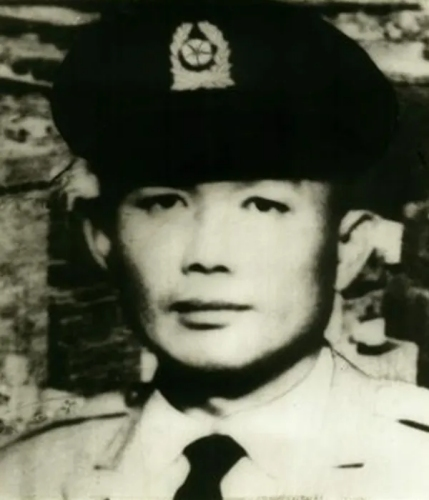
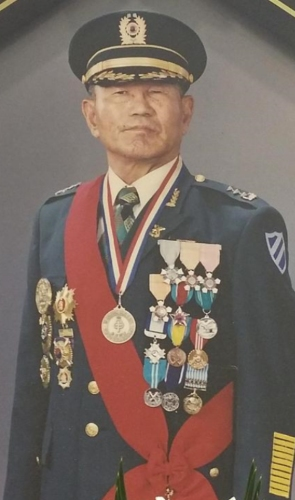
As a Sergeant First Class, he blocked a tank with his bare hands and became the first Korean enlisted soldier to receive the Order of Military Merit, Taeguk Medal (10/15/1951). He became an officer in 1954. He is shown here with a later version of the Order of Military Merit, Taeguk.
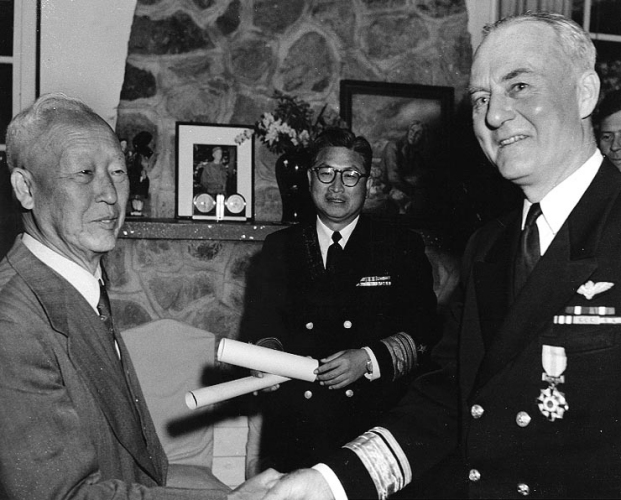
During the Korean War, Vice Admiral Ofstie was Commander of Task Force 77.
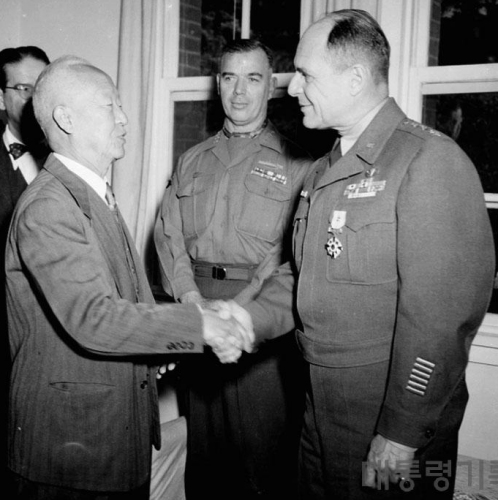
A small footnote: On Dec. 22, 1951, the Korean government enacted Presidential Decree #583 for the Order of National Foundation. Article 2, Subsection ② of that legislation added a small change to the award criteria. The legislation states, “Those who are qualified to receive the Taeguk, Order of Military Merit, and whose achievements are “Particularly Remarkable”, may be awarded the 1st Class Order of Merit for National Foundation.” It’s not difficult to see the logic in this. The Republic of Korea was less than two years old when the war started. Defending the country can be viewed as maintaining the foundation of the nation. It is unknown how many Taeguk award recipients actually received the Order of National Foundation, 1st Class.
1963 SERIES
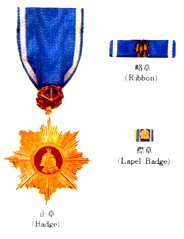
On Dec. 14, 1963, Korea enacted Decorations Law #1519. The Korean government changed the design of their Order of Military Merit. They also added a 5th class named Inhun, named in honor of General Kang Kam Chan 강감찬 (薑邯贊 948~1031). In addition, the Gold, Silver, and No Star system was abandoned. All five classes have an 11 × 36 mm ribbon bar with an 8 mm Taeguk symbol in the center. Except for the Taeguk, the colors and stripe widths on the ribbon bars match those found on their respective ribbons. There are no lapel pins.
- Taeguk Medal 태극장 (太極章). The pendant has a major diameter of 58 mm. It is mounted on a 1900 × 85 mm sash. The ribbon is a light blue color, 담청색, with eight 2 mm white 백색 stripes, with four on each side of the center. The breast star has a major diameter of 75 mm. The 11 × 36 mm ribbon bar has eight 1 mm white stripes, with four on each side of the center.
- Ulchi Medal 을지장 (乙支章). The pendant has a major diameter of 56 mm. It is mounted on a 600 × 36 mm cravat. The ribbon is brown 갈색 and has six 1 mm white stripes, with three on each side of the center. The breast star has a major diameter of 70 mm.
- Chungmu Medal 충무장 (忠武章). The pendant is larger than the previous series, with a major diameter of 52 mm. It is mounted on a 46 × 36 mm breast ribbon. The ribbon is a light blue color 소청색, with four 1 mm white stripes, with two on each side of the center. There is no breast star. The Turtle Ship at the center of the pendant now faces right instead of left.
- Hwarang Medal 화랑장 (花郞章). The pendant has a major diameter of 50 mm. It is mounted on a 46 × 36 mm breast ribbon. The ribbon color is a reddish yellow (orange) 황등색, which often appears to be more pink than orange. There are two 1 mm white stripes, one on each side of the ribbon center.
- Inhun Medal 인헌장 (仁憲章). The pendant has a major diameter of 45 mm. It is suspended on a 46 × 36 mm breast ribbon. The ribbon is a light purple/violet color 보라섹, and has two 1 mm white stripes, one on each side of the center. The sun’s rays symbolize enhancement of national prestige; the Mugunghwa petal, national prosperity; and the round belt and gun, military merit. The purple color of the ribbon symbolizes friendship and steadfastness. Like the Hwarang Medal, it also has two 1 mm white stripes, one on each side of the center.
This series can be difficult to find, since the Korean peninsula was in relative peace during the life of this series, but remember that it was also issued as a non-combat award. On Jun. 21, 1961, a ROK military assistance unit was established in Vietnam, and on Sept. 11, 1964, the first Korean combat troops were dispatched. What started out in 1964 as a 200-man ROK survey (liaison) team quickly became a military combat unit of 50,000 troops. By December 1972, more than 300,000 ROK soldiers had served in Vietnam. At least 100,000 Korean civilians also served in Vietnam, supporting their troops and the Vietnamese civilian population, thus making them eligible for Korean Orders of Military Merit. This series and the following 1967 series were issued in large numbers to Korea’s allies, primarily the South Vietnamese and the United States. However, with the fall of Saigon and the subsequent takeover by the communists, Korean orders and medals issued to the South Vietnamese were either tossed or destroyed. The few pieces that have come out of Vietnam are heavily damaged, generally due to the humidity. There are a number of Koreans who are listed as Missing in Action (MIA). At least two of them were forcibly moved from Vietnam to North Korea and were forced to deliver speeches on North Korean radio. In 2009, South Korea finally recognized Ahn Hak-soo as a prisoner of war, the first Vietnam War veteran so designated by the country. Ahn Hak-soo was purportedly executed in 1975 after a failed attempt to flee the North. It is unknown how many of South Korea’s MIAs from Vietnam still languish in North Korea.23
Many Koreans, who received the Order of Military Merit before 1963 and remained in service, exchanged their older design medals for this series.
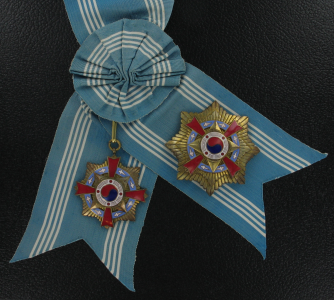
태극장 (太極章)
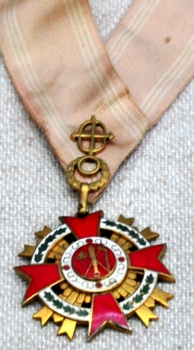
을지장 (乙支章)
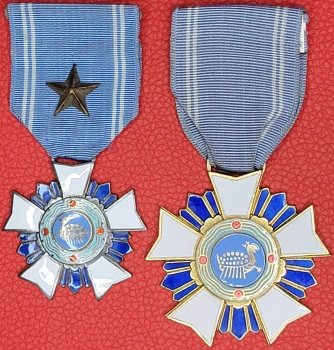
A quick comparison of the Aug. 1951 Series (L.) and the Dec. 1963 Series (R.) Notice that the turtle ships are facing in opposite directions.
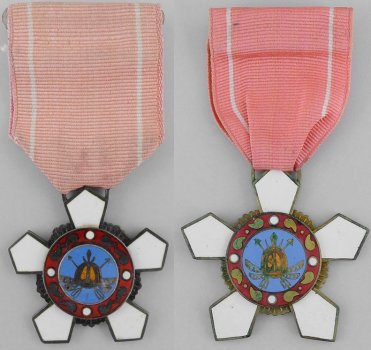
A quick comparison of the Aug. 1951 Series (L.) and the Dec. 1963 Series (R.)
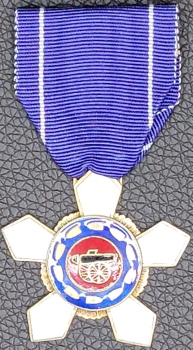
Inhun Class
인헌장 (仁憲章)
Note: Between 1967 and 2016, all the Korean legislation concerning the Order of Military Merit has information on awards sized slightly smaller for women. According to several sources found on the internet, no women were issued an Order of Military Merit in the smaller size. I have included the dimensions for these smaller awards, just in case the sources are incorrect.
1967 SERIES
In 1967, the Korean Government completed a major revamping of its entire Orders and Merit Medals system. In addition to the creation of several new orders and merit medals, there were many design changes. The original Order of Service Merit was renamed the Order of National Security Merit. An entirely “New” Order of Service Merit was created. Military personnel and the civilians who worked for the military became ineligible for this “New” Order of Service Merit. The Order of Military Merit was awarded only for combat or situations of national crisis, while the newly named Order of National Security was for non-combat military actions. The Merit Medals were also reorganized. Both a National Security Merit Medal and a Military Merit Medal were created to replace the old Defense Merit Medal.
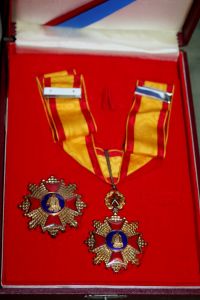
On Jan. 16, 1967, under Presidential Decree #2929, the Korean Government authorized the new designs for the Order of Military Merit. The classes retained the older names. Each class has a 38 × 10 mm ribbon bar and a 17 mm round lapel pin. The stripe patterns on the ribbon bars closely mimic the stripe patterns on the ribbons. The helmet (투구), which is used as the central design on all the suspended pendants and breast stars, is also found on the lapel pins, but not on the ribbon bars.
- Taeguk medal 태극장 (太極章). The pendant has a major diameter of 60 mm. It is mounted on a 1700 × 80 mm lemon yellow (담황색) sash with no stripes. The breast star has a major diameter of 71 mm.
- Taeguk medal 태극장 (太極章) (sized) for ladies. The pendant has a major diameter of 45 mm. It is mounted on a 1,700 × 70 mm yellow (황색) sash with no stripes. The breast star has a major diameter of 50 mm. There is no indication of why the difference in the sash color between the men’s and women’s sizes.
- Ulchi Medal 을지장 (乙支章). The pendant has a major diameter of 55 mm. It is mounted on a 600 × 38 mm cravat. The cravat has two 1 mm yellow 황색 edge stripes and two 7 mm red 주색 stripes, one on each side of a 22 mm yellow 황색 center stripe. The breast star has a major diameter of 71 mm.
- Chungmu Medal 충무장 (忠武章). The pendant has a major diameter of 50 mm. It is mounted on a 600 × 38 mm cravat. The cravat has two 4 mm yellow edge stripes and two 5 mm red stripes, with one on each side of a 20 mm yellow center stripe. There is no breast star.
- Hwarang medal 화랑장 (花郞章). The pendant has a major diameter of 45 mm. It is mounted on a 110 × 38 mm breast ribbon that has four 2 mm red stripes, two on each side of a 20 mm yellow center. There is a rosette on the drape.
- Inhun medal 인헌장 (仁憲章). The pendant has a major diameter of 41 mm. It is mounted on a 110 × 38 mm breast ribbon. The ribbon has two 5 mm yellow edge stripes and two 2 mm red stripes, with one on each side of a 22 mm yellow center stripe. The total of the stripe widths adds up to 36 mm. Later legislation puts the center stripe at 24 mm. The 20 mm listed in this legislation is probably wrong. There is no rosette on the drape.
If you find a Taeguk Medal with this pendant/badge and with a red sash with yellow stripes, you are looking at a 1971 award, not 1967.
From 1967 until 2016, there were Taeguk Class medals that were, at least by legislation, designed and sized for women. However, no woman has ever been awarded the Taeguk Class of the Order of Military Merit. There are several websites that state that Kim Jae-ok 김재옥 (金在玉 1931-1963), a 19-year-old schoolteacher, was not only the first civilian but also the first woman to receive the Taeguk medal. However, this is not corroborated in any official or even semi-official information sources. In 2012, when the Korean government finally recognized her for her part in the victory at the Battle of Dongrak, she received the Order of National Security Merit, Gwangbog Medal 광복장 (光復章), a 5th Class.
The table below and on the left was the result of an “Information Request” from the Korean Government Archives. The table below, on the right, was found on a Chinese website, which states that it only includes Korean recipients. I cannot verify the accuracy of the information in this table. The one thing I can say with certainty is that, according to the table on the left and the Korean Medal Roll, the numbers cited fall within the number of Orders issued within the years specified.
| Total number of Orders issued 1965-1973 | ||||||
|---|---|---|---|---|---|---|
| Class | ||||||
| Koreans | ||||||
| Foreigners | ||||||
| Class | ||||||
| Koreans | ||||||
| Foreigners | ||||||
| Orders of Military Merit issued during the Vietnam War | ||||||
|---|---|---|---|---|---|---|
1969 SERIES
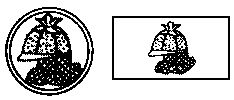
A new Decorations Law Enforcement Decree, Presidential Decree #4466, was issued on Dec. 19, 1969. For the Order of Military Merit, this new decree is almost identical to the previous 1967 decree. The most significant difference is in the round 17 mm lapel pins. These are being replaced with rectangular 12 × 8 mm lapel pins. If you have an award from this period but don’t have the lapel pin, case, or award document, there is generally no way to tell if you have a 1967 or a 1969 series medal.
Listed below are the other differences found in the 1969 legislation:
- Taeguk Medal 태극장 (太極章) (for both the male and female sizes). The sash is now described as being a pale orange 담주황색 instead of lemon yellow 담황색.
- Ulchi Medal 을지장 (乙支章). Identical to the 1967 legislation.
- Chungmu Medal 충무장 (忠武章). Identical to the 1967 legislation.
- Hwarang Medal 화랑장 (花郞章). The stripe pattern on the ribbon is now described as yellow (3 mm), red (2 mm), yellow (2 mm), red (2 mm), yellow (20 mm), red (2 mm), yellow (2 mm), red (2 mm), and yellow (3 mm). The earlier legislation did not provide specific widths for every stripe, only generalizations.
- Inhun Medal 인헌장 (仁憲章). The ribbon is described as having two 5 mm yellow edge stripes and two 2 mm red stripes, with one on each side of a 24 mm yellow center stripe. The earlier legislation had a 22 mm yellow center stripe and was probably wrong.
1970 SERIES (2)
On June 13, 1970, a new Decoration Law Enforcement Decree 상훈법시행령, Presidential Decree #5035, was enacted. The most significant difference between this legislation and the earlier one is found in the Merit Medals, not the Orders. For the Order of Military Merit, this legislation is identical to the previous 1969 legislation.
On Nov. 17, 1970, a new Decoration Law Enforcement Decree 상훈법시행령, Presidential Decree #5388, was enacted. For the Order of Military Merit, this legislation is also identical to the previous 1969 legislation.
1971 SERIES
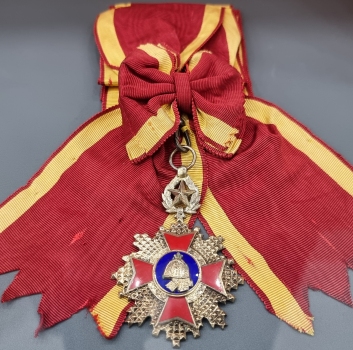
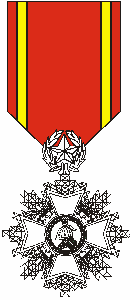
On June 30, 1971, under Presidential Decree #5688, the government made several changes to the Order of Military Merit. The appearance and sizes of the pendants and breast stars remained the same, but the colors on the ribbons have been reversed. The ribbons now have a red base color and yellow stripes. Each class has a 38 × 10 mm ribbon bar and a 12 × 8 mm lapel pin. The ribbon bars and lapel pins closely resemble the stripe patterns found on the ribbons. No dimensions are given for the stripes on the lapel pins. The helmet 투구, which is used as the central design on all the suspended pendants and breast stars, is also found on the lapel pins, but not on the ribbon bars.
- Taeguk Medal 태극장 (太極章). The pendant has a major diameter of 60 mm. It is mounted on a 1700 × 80 mm. The color pattern of the sash is red (2 mm), yellow (10 mm), red (56 mm), yellow (10 mm), and red (2 mm). The breast star has a major diameter of 71 mm. There is a 10 × 38 mm ribbon bar with a color pattern of red (1 mm), yellow (6 mm), red (24 mm), yellow (6 mm), and red (1 mm). The colors of the 8 × 12 mm lapel pin mimic the cravat and ribbon bar, but the legislation does not have specific width information.
- Taeguk Medal 태극장 (太極章) (sized) for ladies. The pendant has a major diameter of 45 mm. It is mounted on a 1,700 × 70 mm yellow (황색) sash. The color pattern of the sash is red (2 mm), yellow (10 mm), red (41 mm), yellow (10 mm), and red (2 mm). The breast star has a major diameter of 50 mm. The ribbon bar and lapel pin are identical to the men’s size.
- Ulchi Medal 을지장 (乙支章). The pendant has a major diameter of 55 mm. It is mounted on a 600 × 38 mm cravat. The stripe pattern on the cravat is red (2 mm), yellow (2 mm), red (1 mm), yellow (2 mm), red (1 mm), yellow (2 mm), red (1 mm), yellow (2 mm), red (12 mm), yellow (2 mm), red (1 mm), yellow (2 mm), red (1 mm), yellow (2 mm), red (1 mm), yellow (2 mm), and red (2 mm). The breast star has a major diameter of 71 mm. The 38 × 10 mm ribbon bar has the same colors and widths as the cravat. The colors of the 8 × 12 mm lapel pin mimic the cravat and ribbon bar, but the legislation does not have specific width information.
- Chungmu Medal 충무장 (忠武章). The pendant has a major diameter of 50 mm. It is mounted on a 600 × 38 mm cravat. The stripe pattern on the cravat is red (2 mm), yellow (1.5 mm), red (1.5 mm), yellow (1.5 mm), red (1.5 mm), yellow (1.5 mm), red (19 mm), yellow (1.5 mm), red (1.5 mm), yellow (1.5 mm), red (1.5 mm), yellow (1.5 mm), and red (2 mm). There is no breast star. The 38 × 10 mm ribbon bar has the same colors and widths as the cravat. The colors of the 8 × 12 mm lapel pin mimic the cravat and ribbon bar, but the legislation does not have specific width information.
- Hwarang Medal 화랑장 (花郞章). The pendant has a major diameter of 45 mm. It is mounted on a 100 × 38 mm breast ribbon. The stripe pattern on the breast ribbon is red (2 mm), yellow (2 mm), red (2 mm), yellow (2 mm), red (22 mm), yellow (2 mm), red (2 mm), yellow (2 mm), and red (2 mm). There is a rosette on the drape. The 38 × 10 mm ribbon bar has the same colors and widths as the cravat. The colors of the 8 × 12 mm lapel pin mimic the cravat and ribbon bar, but the legislation does not have specific width information.
- Inhun Medal 인헌장 (仁憲章). The pendant has a major diameter of 41 mm. It is mounted on a 50 × 38 mm breast ribbon. The stripe pattern on the breast ribbon is red (2 mm), yellow (2.5 mm), red (29 mm), yellow (2.5 mm), and red (2 mm). There is no rosette on the drape. The 38 × 10 mm ribbon bar has the same colors and widths as the cravat. The colors of the 8 × 12 mm lapel pin mimic the cravat and ribbon bar, but the legislation does not have specific width information.
1973 SERIES
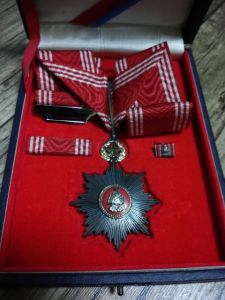
On Nov. 1, 1973, under Decorations Law Enforcement Decree #6916, significant changes were made to the design of the Order of Military Merit. The central helmet was retained on the pendant, but the four arms, found on the previous series, disappeared. The faceted surface of the starburst is replaced by a more dynamic surface of straight lines emanating from the center. The pendant on the Inhun class has 96 rays emanating from the center. The remaining classes have 180 rays. (The number of rays will change in the 1984 series.) The large star in the suspension symbolizes the soldier, while the laurel wreath indicates victory. The rays of the sun symbolize the heightened dignity of the country. The helmet at the center implies the morale of the soldiers. The red plate behind the helmet symbolizes loyalty, while the dotted circle around the red plate signifies unity and solidarity. The names of the classes remained the same. All the ribbons have a base color of red, with any stripes being white. Each class has a 38 × 10 mm ribbon bar and a 12 × 8 mm lapel pin. Except for the Taeguk Class, the number of stripes and their dimensions are identical to the ribbons. There is a helmet in the center of the lapel pins, but not on the ribbon bars.
This can be a very difficult series to collect. It was issued for less than one year, and those awardees of this series who remained in the military generally had the ribbons changed when the 1974 series began to be issued. In general, only those awardees who left the military in 1973 kept the original ribbon.
The changes to this series are:
- Taeguk Medal 태극장 (太極章). The pendant has a major diameter of 60 mm and weighs 42.7 g. It is mounted on a 1700 × 80 mm sash, which is a solid red 적색 with no stripes. The breast star is 70 mm and weighs 50.7 g. The legislation clearly shows a ribbon bar and a lapel pin with stripes but does not give any dimensions. If we use later legislation as a guide, the ribbon bar has two 6 mm white stripes, one on each side of a 24 mm center, and the lapel pin has two 1.5 mm white stripes, one on each side of the center. But as I said, the dimensions of the ribbon bar and lapel pin stripes are not confirmed in the legislation.
- Taeguk Medal 태극장 (太極章) (sized) for ladies. The pendant has a major diameter of 50 mm and weighs 26.7 g. It is mounted on a 1700 × 65 mm sash, which is a solid red 적색 with no stripes. The breast star is 55 mm and weighs 37.4 g. The legislation clearly shows a ribbon bar and a lapel pin with stripes but does not give any dimensions. The ribbon bar and lapel pin are identical to the men’s size.
- Ulchi Medal 을지장 (乙支章). The pendant has a major diameter of 55 mm and weighs 37.4 g. It is mounted on a 600 × 38 mm red cravat, which has eight 1.5 mm white stripes, with four on each side of an 11 mm red center stripe. The breast star has a major diameter of 60 mm and weighs 42.7 g. The 38 × 10 mm ribbon bar has the same colors and widths as the cravat. The 12 × 8 mm lapel pin mimics the cravat and ribbon bar but does not give any specific dimensions.
- Chungmu Medal 충무장 (忠武章). The pendant has a major diameter of 50 mm and weighs 26.7 g. It is mounted on a 600 × 38 mm red cravat that has six 1.5 mm white stripes, with three on each side of a 17 mm red center stripe. There is no breast star. The 38 × 10 mm ribbon bar has the same colors and widths as the cravat. The 12 × 8 mm lapel pin mimics the cravat and ribbon bar but does not give any specific dimensions.
- Hwarang Medal 화랑장 (花郞章). The pendant has a major diameter of 50 mm and weighs 26.7 g. It is mounted on a 100 × 38 mm red breast ribbon, which has four 1.5 mm white stripes, with two on each side of a 24 mm red center stripe. There is a rosette in the center of the drape. The 38 × 10 mm ribbon bar has the same colors and widths as the cravat. The 12 × 8 mm lapel pin mimics the cravat and ribbon bar but does not give any specific dimensions.
- Inhun Medal 인헌장 (仁憲章). The pendant has a major diameter of 50 mm and weighs 26.7 g. It is mounted on a 100 × 38 mm red breast ribbon that has two 2 mm white stripes, with one on each side of a 30 mm red center stripe. There is a rosette in the center of the drape. The 38 × 10 mm ribbon bar has the same colors and widths as the cravat. The 12 × 8 mm lapel pin mimics the cravat and ribbon bar but does not give any specific dimensions.
1974 SERIES
On October 23, 1974, under Presidential Decree #7289, several changes were made to the ribbons and ribbon bars, but no changes were made to the pendants or breast stars. Except for the Taeguk Medal, the legislation does provide width dimensions for the white stripes, but not for the center stripes. A helmet has been added to the center of the 38 × 10 mm ribbon bar. On some ribbon bars, the helmet is glued, not stitched, and it is not unusual to find a ribbon bar where the helmet has fallen off. The ribbon bar for the Taeguk medal is the same color as the sash. For all the other classes, the colors and widths of the ribbon bar match those of the ribbon. The 12 × 8 mm lapel pins mimic the ribbons and ribbon bars, but the legislation does not give any specific width dimensions.
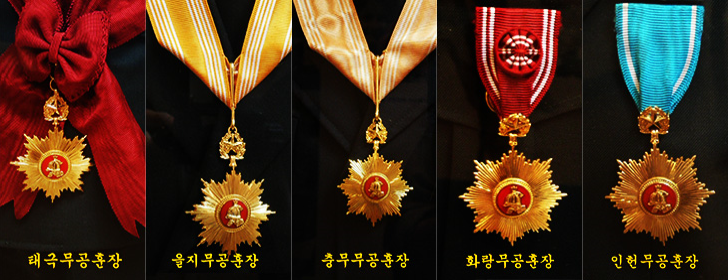
- Taeguk Medal 태극장 (太極章): Except for the addition of a helmet in the center of the ribbon bar, there is no change to the Taeguk class.
- Taeguk Medal 태극장 (太極章) (sized) for ladies. Except for the addition of a helmet in the center of the ribbon bar, there is no change to the Taeguk class (sized) for ladies.
- Ulchi Medal 을지장 (乙支章). The pendant is mounted on a 600 × 38 mm orange 주황색 cravat, which has eight 1.5 mm white stripes, with four on each side of an orange center stripe.
- Chungmu Medal 충무장 (忠武章). The pendant is mounted on a 600 × 38 mm pale orange 엷은 오렌지색 cravat, which has six 1.5 mm white stripes, with three on each side of a pale orange center stripe.
- Hwarang Medal 화랑장 (花郞章). The pendant is mounted on a 100 × 38 mm dark red 짙은 적색 breast ribbon, which has four 1.5 mm white stripes, with two on each side of a dark orange center stripe.
- Inhun Medal 인헌장 (仁憲章). The pendant is mounted on a 100 × 38 mm sky blue 하늘색 breast ribbon, which has two 2 mm white stripes, with one on each side of a sky blue center stripe.
On the ribbons, the red color symbolizes courage and passion; orange symbolizes vigor and development; white symbolizes purity of peace for the nation (Korea is traditionally referred to as the white wear nation); darker orange symbolizes brightness and advancement; and light blue symbolizes the ideal of the nation.

The other major change, in 1974, deals with the possible addition of Mugunghwa Flowers to the ribbon bar. These signify a second or third award of the same class of the Order of Military Merit. (The same system is also being used on the Order of National Security Merit.) For a second award, the Mugunghwa Flower is placed in the center of the ribbon bar, obscuring the helmet. For a third award, Mugunghwa flowers are placed on each side of the center.
1984 SERIES
On Jan. 23, 1984, under Presidential Decree #11336, the government made several changes to the Order of Military Merit. The number of rays on the starburst has changed from the earlier series. In the Taeguk and Ulchi classes, there are 184 rays. The Chungmu, Hwarang and Inhun classes have 96 rays. Each class has a 38 × 10 mm ribbon bar and a 12 × 8 mm lapel pin. Except for the Taeguk Class, the number of stripes and their dimensions are identical to the ribbons. There is a helmet in the center of both the ribbon bar and the lapel pins. On some ribbon bars, the helmet is glued, not stitched, and it is not unusual to find a ribbon bar where the helmet has fallen off.
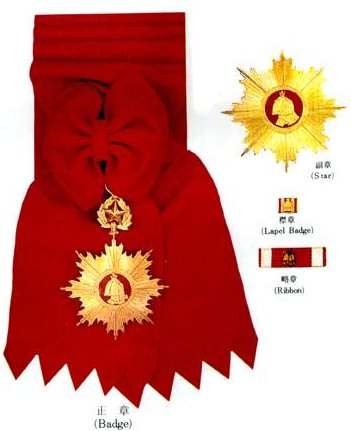
- Taeguk Medal 태극장 (太極章). The pendant has a major diameter of 70 mm and weighs 73 g. It is mounted on a 1,800 × 80 mm sash, which is a solid red 적색 with no stripes. The breast star is 80 mm and weighs 87 g. The 38 × 10 mm ribbon bar has two 1 mm red edge stripes and two 6 mm white stripes, with one on each side of a 24 mm red center stripe. The 12 × 8 mm lapel pin has two 1.5 mm white stripes, one on each side of the 4 mm red center stripe.
- Taeguk Medal 태극장 (太極章) (sized) for ladies. The pendant has a major diameter of 50 mm and weighs 36.5 g. It is mounted on a 1700 × 65 mm sash, which is a solid red 적색 with no stripes. The breast star is 55 mm and weighs 44 g. The ribbon bar and lapel pin are identical to the men’s size.
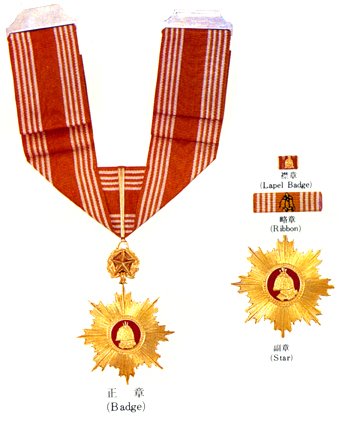
- Ulchi Medal 을지장 (乙支章). The pendant has a major diameter of 60 mm and weighs 52.5 g. It is mounted on a 600 × 38 mm orange 주황색 cravat, which has eight 1.5 mm white 백색 stripes, with four on each side of a 13 mm orange center stripe. The breast star has a major diameter of 70 mm and weighs 68 g. The 38 × 10 mm ribbon bar has the same colors and widths as the cravat. The 12 × 8 mm lapel pin mimics the cravat and ribbon bar with eight .2 mm white stripes, four on each side of a 4 mm orange center stripe.
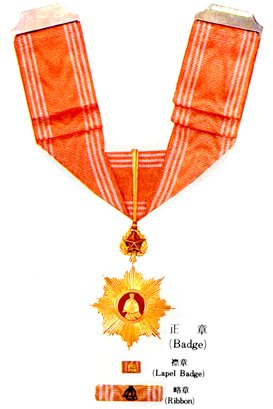
- Chungmu Medal 충무장 (忠武章). The pendant has a major diameter of 50 mm and weighs 37 g. It is mounted on a 600 × 38 mm pale orange 엷은 오렌지색 cravat that has two 2 mm pale orange edge stripes and six 1.5 mm white stripes, with three on each side of a 19 mm pale orange center stripe. There is no breast star. The 38 × 10 mm ribbon bar has the same colors and widths as the cravat. The 12 × 8 mm lapel pin mimics the cravat and ribbon bar with six .2 mm white stripes, four on each side of a 5 mm pale orange center stripe.
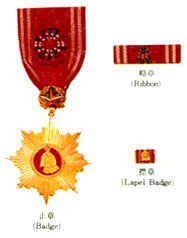
- Hwarang Medal 화랑장 (花郞章). The pendant has a major diameter of 50 mm and weighs 35.5 g. It is mounted on a 100 × 38 mm red 적색 breast ribbon, which has four 1.5 mm white 백색 stripes, with two on each side of a 24 mm red center stripe. There is a rosette in the center of the drape. The 38 × 10 mm ribbon bar has the same colors and widths as the cravat. The 12 × 8 mm lapel pin mimics the cravat and ribbon bar with four .3 mm white stripes, two on each side of a 5 mm red center stripe.
- Inhun Medal 인헌장 (仁憲章). The pendant has a major diameter of 50 mm and weighs 35.5 g. It is mounted on a 100 × 38 mm sky blue 하늘색 breast ribbon, which has two 2 mm sky blue edge stripes and two 2 mm white stripes, with one on each side of a 30 mm sky blue center stripe. There is a rosette in the center of the drape. The 38 × 10 mm ribbon bar has the same colors and widths as the cravat. The 12 × 8 mm lapel pin mimics the cravat and ribbon bar with two 2 mm sky blue edge stripes and two .5 mm white stripes, one on each side of a 5 mm center stripe.
Currently
Since 1984, the Decorations Law Enforcement Decree has been changed 19 times. The current legislation is Presidential Decree #30517 and was enacted on March 10, 2020. In the intervening years, the only major change was to the Order of Military Merit, Taeguk Medal (sized) for Ladies. It was found to be discriminatory and was dropped in 2016.24 There has been one minor wording change concerning the ribbon. The Korean legislation originally used the term 백색 for white. They now use the term 흰색. The word “백” (百) is basically a Chinese loanword. The Korean term for white is 하얀색, and 흰색 is a shorter version and a bit less formal. All the other sizes, patterns, etc., of the 1984 legislation are still in effect.
The Classes are:
Pensions
Recipients of the Order of Military Merit receive a slightly higher pension allowance. Veterans get 430,000 ₩ for the Taeguk Medal, 425,000 ₩ for the Ulchi, 420,000 ₩ for the Chung Mu, 415,000 ₩ for the Hwarang or 410,000 ₩ for the Inhun. Even if you were awarded two or three medals, only the highest medal is paid. The average exchange rate in 2022 was ₩1292.16 KR to $1.00 US, so 430,000 to 410,000 won is approx. US $333 to $317.
Animals, inanimate objects, or an excessive number of awards
There are websites that state that the South Korean Order of Military Merit has been awarded to military dogs. This is pure fabrication. No animal or inanimate object has ever been awarded a South Korean Order of Merit or Merit Medal.
The same cannot be said for the decorations of North Korea. Among other stories, there is this: In October 2001, the title of “Hero of the Republic,” the Gold Star Medal of the Hero of Labor, and the Order of the National Flag First Class were awarded to a 15-ton pneumatic hammer at the July 6 Railway Factory. According to state media, the hammer had been in operation for 30 years without fail and had received the awards for “contributions to producing many parts necessary for railway transportation and the industrialization of the country.”25 Another unusual award was made in 2000, when a Hero’s Title was awarded to a ginkgo tree for having had a United States aircraft crash into it during the Korean War. The plane was purportedly trying to destroy a North Korean military vehicle underneath the tree? 26
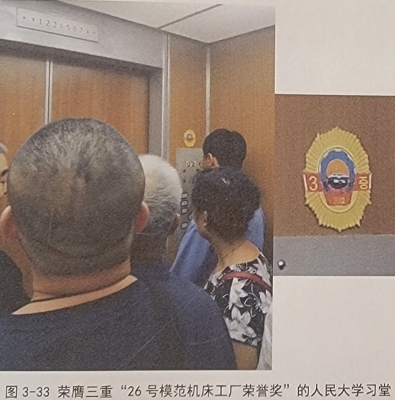
In April 1961, at the Pyongyang Textile Factory, Kim Jong Il pointed out problems with the management and repair of lathe #26. At the time, he stated that every worker should be fully responsible for keeping the machines well-managed and well-maintained. This paved the way for a nationwide movement to ‘model oneself after the 26th lathe.’ Today, ‘No. 26 Model Lathe Factory’ awards are given to factories, workplaces, and work teams that are recognized for their contributions to vitalizing the production. Individual pieces of equipment can receive awards for years of service or good performance. The “An Chun Kil Working Group” at Pyongyang’s Textile Machinery Factory, which was the origin of the movement, was awarded the ‘Kim Il Sung Medal.’ Source: Awards given to machines in North Korea. See also the book “Research on the National Honor System of the Democratic People’s Republic of Korea” 朝鲜民主主义人民共和国国家荣誉体系研究, pp. 302-307.
There are several pictures of high-ranking North Korean officers wearing an inordinate number of medals. Those pictures showing medals being worn on the pants/trousers, shirt sleeves, etc. are doctored. North Korea has a 3-generation hereditary system. It not only applies to penalties, but it also applies to military decorations. The reason North Korean generals have so many medals is because they can legally wear the medals of their fathers and grandfathers.
Footnotes:
- located at 742, Gyeonggi-daero, Osan-si, Gyeonggi-do (Oesammi-dong). The website for the memorial hall is located at https://www.osan.go.kr/osanunm/main.do.
- 무훈 발군장(임시 훈장) 1949년 6월 26일 > 1등 무공훈장 1950년 10월 18일 > 태극무공훈장 1951년 9월 9일 >>> 태극무공훈장 1984년 이후~현재
- He was awarded 14 U.S. medals, many with oak leaf clusters, and was also decorated by 37 countries in Europe and Latin America. He was awarded the Korean Order of Military Merit, Ulchi Medal, on Aug. 21, 1951.
- According to his Korean Wikipedia page, he received the Combat Service Medal 從軍章 (종군장) on this date.
- Kenney, General George C., The MacArthur I Know, Duell, Sloan & Pierce, New York, 1951, p. 220.
- Until April 28, 1952, Japan was under Allied occupation. Formal diplomatic relations and embassies between South Korea and Japan were not established until 1965.
- The 5th Class wasn’t created until 1963.
- During the Rhee Syngman administration, he served as the president of the Korea Shipping Corporation 대한해운공사 and in 1950 as the special plenipotentiary minister to Japan.
- On Feb. 28, 1967 the Public Welfare Merit Medal was renamed the Civil Merit Medal 국민포장
- If you want to search the Korean Medal Roll for his awards, his name was transliterated as 딘이햇스 and later transliterated as 해쓰 띤 이.
- A Study on the Regulations and Extant Objects of the Republic of Korea’s Military Decorations” 대한민국 무공훈장의 제식과 실물 연구, Author: Eom Tae-yong 엄태용 in the Korean Journal of Heritage: History & Science Vol. 58 No. 4, December 2025, pp. 200-224. Copyright ©2025, National Research Institute of Cultural Heritage.
- In the United States, there have been many civilians who have supported the military, but Bob Hope and Zachary Fisher are unique in that they received the congressional designation of “Honorary Veteran.” (1997 and 1999, respectively). Bob Hope’s family was offered a burial plot in Arlington National Cemetery, but the family decided to inter him at the San Fernando Mission Cemetery in California.
- Sold at auction: Morton & Eden Ltd., Catalogue #26, April 26, 2007, Medals, Orders and Decorations from the Collection of the American Numismatic Society, Part 3, Lot #252, Hammer price £320 plus a Buyer’s Premium of 15%.
- Captain Larson received the Oct. 1950, 4th Class ribbon bar, but the medal that he later received on June 8, 1951, was the 4th Class medal from the May 1951 Series. The Koreans later gave him a 4th class from the Aug. 1951 Series, not as a new award but as a replacement for the older (May 1951) style. The information source was his daughter.
- Today, Koreans use the word 별 (Byeol) for star.
- A Study on the Regulations and Extant Objects of the Republic of Korea’s Military Decorations” 대한민국 무공훈장의 제식과 실물 연구, Author: Eom Tae-yong 엄태용 in the Korean Journal of Heritage: History & Science Vol. 58 No. 4, December 2025, pp. 200-224. Copyright ©2025, National Research Institute of Cultural Heritage.
- The legislation does not give any dimensions for the Taeguk symbol or for the stars used on the ribbon bars.
- Regarding the color “brown,” I checked Decree #522, as it is recorded in the Official Gazette 관보 (Kwanbo), where the colors are written in Chinese. I also checked several translations into Korean characters of Decree #522 that are available on the internet.
- During the Korean War, the 2nd Army Corps and later the 3rd Army Corps suffered massive losses under his command. Some sources indicate that he lost every battle in which he commanded, and there is an unconfirmed story that he was decorated by the North Koreans for his failures on the battlefield. He was the decisive reason for the transfer of operational control of Korea’s military to the United States during the Korean War. He and his father are both listed in the Pro-Japanese Dictionary (Chinilpa). He served as Chairman of the Joint Chiefs of Staff, Minister of Defense and later as the Korean Ambassador to Thailand. Even with all of his defeats, he is considered one of the better Korean Generals who served during the Korean War.
- For clarity, the original Korean and Chinese words for the various colors in the legislation were included in the above descriptions.
- Robert T. Oliver, Korean Report 1948-1952, p. 8.
- Located at 742, Gyeonggi-daero, Osan-si, Gyeonggi-do (Oesammi-dong). The website for the memorial hall is located at https://www.osan.go.kr/osanunm/main.do.
- In May 1951, Lt. Cho Chang-ho 조창호 (趙昌浩 1930-2006) was captured by the Chinese at the Battle of Hanseok Mountain. In October 1994, he was the first South Korean POW to have made it out of North Korea since the Korean War ended. As of June 2009, 79 prisoners of war and some of their family members have escaped from North Korea. Former POWs receive back pay and pensions for their military service from the South Korean government once they reach South Korea.
- Decorations Law Enforcement Decree 상훈법 시행령, Presidential Decree #26838 대통령령 제26838호, dated 2015.12.31 and implemented on 2016.1.1.[시행 2016.1.1.], partial revision 일부개정].
- There are approx. ten major railroad-related facilities in the North, including the July 6 Factory.
- UNUSUAL “HEROES” OF NORTH KOREA by Robin C. Chiang, Article in Jomsa Vol. 58, No. 6, pp. 36-37